AC Compressor Bearing Noise: A Case From the Canton Fair
Why a car ac compressor bearing can be too noisy, how to tell a bad clutch pulley bearing from the compressor, and the nine sizes we supply.
A car ac compressor bearing can look perfect on the bench and still be too noisy to use once it is inside the compressor. In 2013 a buyer from Argentina found this out after he ordered on a quote that was below our cost. Below is his case, how bearing noise is measured, the car AC compressor bearing sizes we supply, and what to ask for before you order.
Why an ac compressor bearing has to run quiet
Compressors for refrigeration and air conditioning are one of the main applications bearing makers design compressor bearings for, and those bearings are sold on low vibration and low noise [1]. In automotive air conditioning, one bearing maker names two problems that occur with compressor bearings: a high noise level, and a broken bearing [2]. Noise is listed as a failure in its own right, next to breakage.
A car ac compressor bearing is usually a compressor clutch bearing: it sits inside the clutch assembly and lets the compressor pulley spin free on the shaft whenever the clutch is not engaged. The drive belt keeps constant pressure on this pulley bearing, and a clutch plate on the other side engages and disengages the compressor each time the air conditioning system switches it on or off.
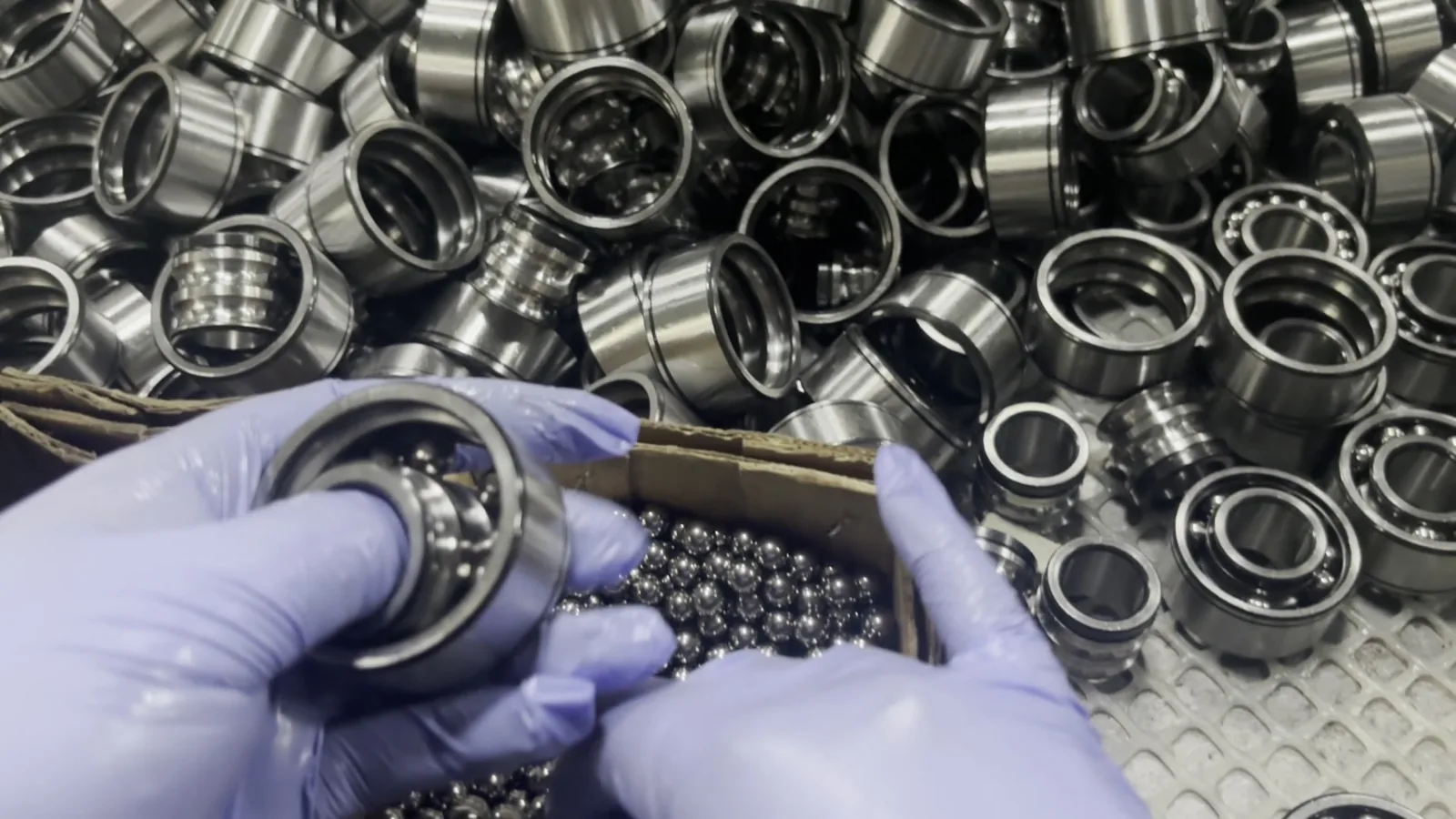
There are two reasons for this. Some types of bearing vibration are linked to shorter bearing life, and some are a source of customer dissatisfaction even when the bearing keeps turning [4]. And a car AC compressor sits in a vehicle that people sit in and drive. NSK’s handling instructions treat “minimum noise is required” as a duty of its own when choosing fits, with electrical home appliances as the example [8].
A noise level that goes unnoticed in a conveyor or a gearbox can be a reason to reject a compressor, because the noise reaches the user. So for a compressor bearing, the noise level is part of the specification, the same as the dimensions.
Our 2013 Canton Fair case: a quote below our cost
At the Canton Fair in April 2013, a buyer from Argentina came to our booth and asked us to quote car air conditioner compressor bearings, in sizes like the ones in our size table further down this page. He showed us a quote from another supplier. It was far below our price, and below what the bearings cost us to make. We told him, as a friendly warning, that the price was below cost. He said he would think about it.
After the fair we followed up by email. His replies were polite, but they never gave us a real answer, and we concluded that he had ordered from the cheaper supplier.

At the October 2013 Canton Fair he came back to our booth and told us he had been cheated. The bearings had looked fine when they arrived. Once they were installed, they were so noisy that they could not be used.
Later, through other channels, we learned what he had received: rejects culled by our factory during inspection, which someone else had sold to him.
After that he never brought up price again. He placed his order with us without hesitation, and after installation and testing the quality was very good.
Every bearing in every order from our factory is tested for vibration and noise, one by one. That is routine for all orders, not something we did for this one.
How bearing noise is measured
Bearing noise in a finished bearing is measured as vibration. The common instrument is the Anderon meter. The inner ring is mounted on a precision spindle and turned at 1,800 r/min, the outer ring is held still under a light axial load, and a velocity sensor rests on the outside of the outer ring [3]. Because the spindle turns smoothly and the sensor reads the outer ring directly, the instrument picks up small vibrations from the bearing itself [3].
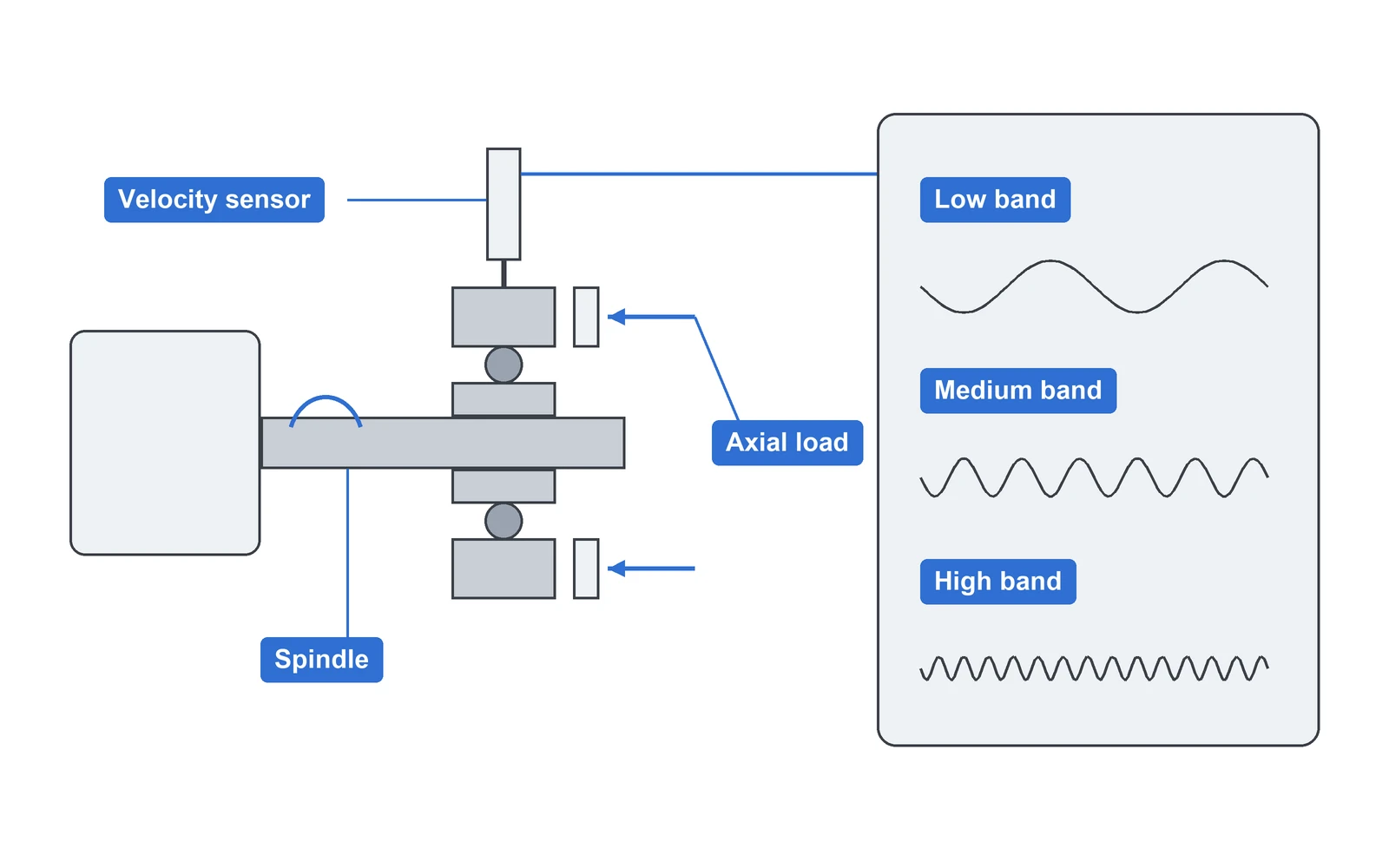
The signal is split into three frequency bands [3]:
| Band | Frequency range [3] |
|---|---|
| Low band | 50 to 300 Hz |
| Medium band | 300 to 1,800 Hz |
| High band | 1,800 to 10,000 Hz |
Results are given in micrometres per second or in Anderon units [4].
A tester of this kind can also tell what is causing the vibration. SKF’s tester brochure lists dirt, defects on components, cage noise and form deviations as the defect types the analysis identifies [4]. On a production line, a bearing that does not pass the low, medium and high-frequency tests is rejected automatically [5]. On a line like this, a reject is decided by a reading on a tester, not by anything visible on the part.
Why a noisy bearing can pass a visual check
The raceway faults that cause vibration are waviness, local defects, dirt particles, roughness and cage problems [4]. Rough raceways also get in the way of lubrication and can increase noise [5]. None of these show on the outside of a finished, greased bearing. A reject and a good bearing can carry the same markings, the same finish and the same packing. A bearing can fail this way without any visible warning, which is why the tester exists.
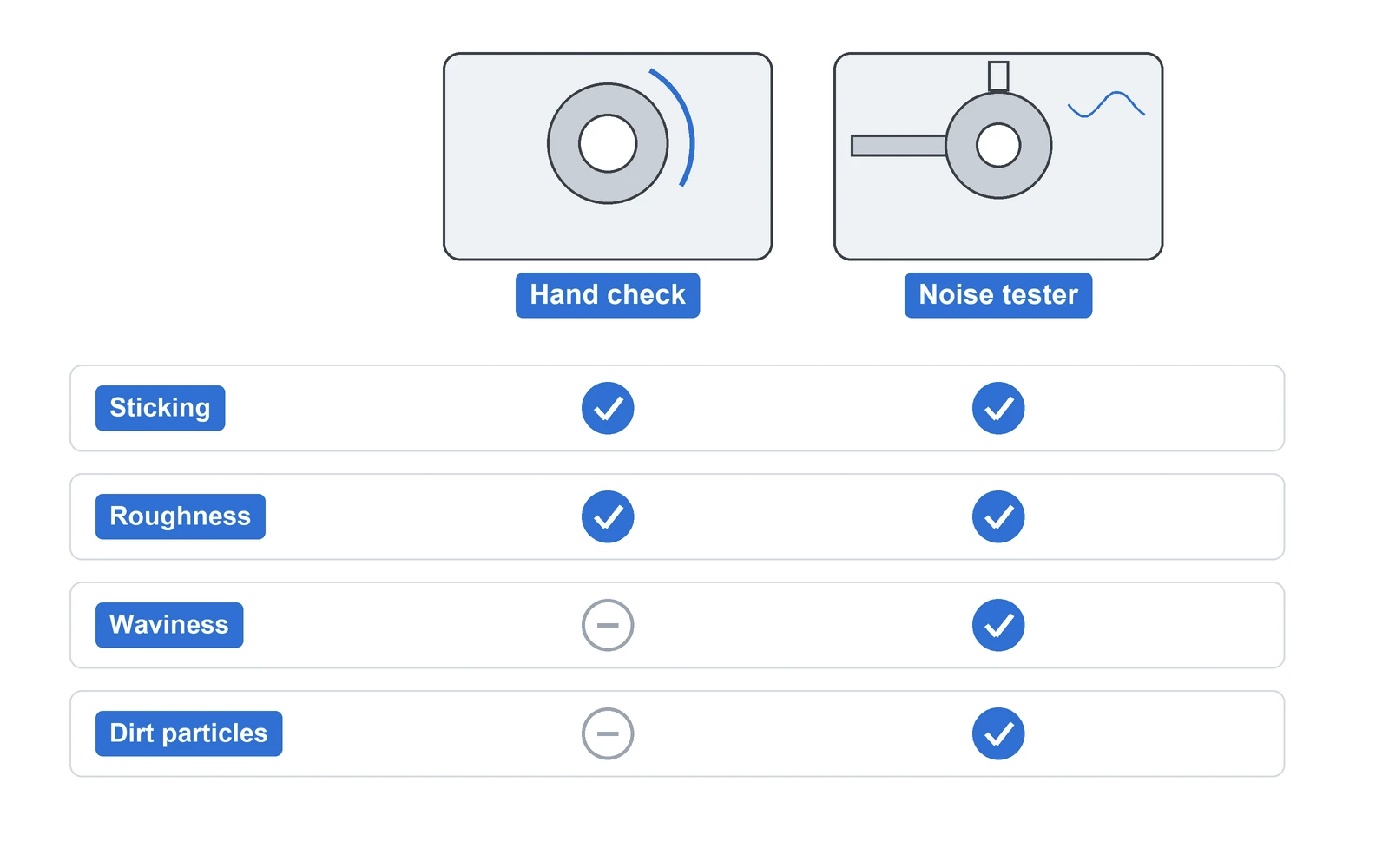
A hand check still has a use. Turning the outer ring by hand finds sticking from foreign matter and rough spots [6] [7]. It cannot measure waviness, and it cannot put a number on the vibration in each band. The bearings in our case looked fine when they arrived and were only found to be noisy once they were installed.
Damage can also come later. A bearing that is dropped or knocked can get small dents in the raceway, called brinelling, and NSK’s troubleshooting table lists brinelling as a cause of a loud, regular sound [8]. So a bearing that left the tester quiet can become noisy through rough handling on the way.
What to ask when a compressor bearing quote is below cost
A compressor bearing price below what the steel and machining cost has to come from somewhere. It can come from the steel, from a process step that was left out, or from bearings that did not pass inspection. You cannot tell which from the price. You can tell from the papers behind it.
| Ask for | What it tells you | What to watch for |
|---|---|---|
| Material certificate from the steel maker | Which steel the rings and balls are made of | A certificate that does not name the batch |
| The inspection report and the list of items it covers | Whether noise and vibration are in it at all | A report that covers dimensions and appearance only |
| Vibration and noise test records | Whether each bearing was tested, in which bands and units [3] [4] | “Tested” with no bands, no units and no record |
| Batch traceability | Whether a bearing can be traced to the batch and its test results | No batch marking on the box or the report |
For comparison, a FULI inspection report normally covers dimensions, rotation noise, vibration, appearance, material certificate and batch traceability.
If the supplier cannot say which items the report covers, or offers no vibration and noise records, treat the low price as the warning that it was in 2013. Our order where a customer asked for a cheaper spec shows a different route to a lower price: the customer explained a very light duty, and the spec was changed openly for it before production.
Checking car AC compressor bearings on arrival
Checks on arrival will not replace the supplier’s test records, but they tell you about bearing condition the way a repair shop’s check would, and they catch the obvious problems before the bearings go into a compressor.
- Keep them wrapped. Bearings should stay in their packing until they are needed, because unwrapping them can let rust start [8]. If you unwrap bearings for inspection before acceptance, put anti-corrosion agent back on them and repack them [8].
- Turn a few by hand. Take bearings from several cartons, not only the first one you open. Hold a small ball bearing level in one hand and turn the outer ring to see that it turns smoothly [7].
- Run the first ones and listen. After mounting, turn the shaft by hand and check for sticking and uneven torque, then run the machine and watch for abnormal noise and temperature rise [6]. The sound can be checked with a noise locater or vibration monitoring equipment [6].
- Test a sample if you can. If you have access to a bearing vibration tester, test a sample in the same bands as the supplier’s records and compare.
Not all bearing noise after mounting comes from the bearing. Incorrect lubrication, poor alignment of the shaft and housing, and foreign matter getting into the bearing are also common causes [6]. Excessive clearance is another cause of a loud, regular sound [8]. A bearing with the wrong grease, or oil where it should run dry, will not last as long as one that passed every test, and a problem like this is far easier to fix before the bearing goes into the compressor than after. Our guides to bearing lubrication and bearing internal clearance cover both. A clearance order that came back to us shows how a bearing can be right on every dimension and still be wrong for the duty.
Bad ac compressor bearing: pulley bearing, compressor clutch or compressor?
A compressor has more than one bearing, and the noise does not always come from the one in our size table. The pulley bearing carries the clutch pulley on the nose of the compressor. The compressor shaft runs on its own bearings inside the housing, sealed in with the refrigerant. The electromagnetic coil sits behind the pulley. When it is switched on, it pulls the clutch plate onto the pulley face, and the compressor shaft turns with the pulley.
The serpentine belt turns the pulley whenever the engine runs, so the pulley bearing turns all the time, with the air conditioning on or off. That gives a simple first check:
| What you hear or see | Most likely source |
|---|---|
| Squeal, grind or rumble with the engine running and the AC off | AC compressor pulley bearing |
| Noise that starts only when the clutch is engaged | Clutch, or the compressor itself |
| Pulley wobble, or grease leaking past the bearing seal | Worn or faulty bearing in the pulley |
| Compressor shaft turns rough with the pulley removed | Compressor shaft bearing or other internal parts |
The hand check: turning the outer ring
A squeal can also be a slipping belt, so check the belt tension before blaming the bearing. Then stop the engine, open the hood and take the belt off the compressor pulley. The pulley sits on the outer ring, so spinning it by hand turns the outer ring around the fixed inner ring. It should turn freely and quietly, with no rough spots and no play when you rock it. Roughness or wobble means a bad ac compressor bearing in the pulley. A pulley bearing left like this gets hot, and if it is left to seize it can burn or throw the belt, which on many engines also drives other accessories.
The pulley bearing sits at the front of the engine, close to heat, water and road debris. Once the seal lets them in, the grease breaks down and the bearing starts to grind. This is a common route to bearing failure in a pulley. A sealed pulley bearing is greased for life and gets no regular lubrication, so a bearing in this state is replaced, not regreased.
Bearing replacement and repair on an AC compressor clutch pulley
One bearing maker describes two ways to deal with compressor bearing issues: a complete exchange of the compressor, or, in some circumstances and for reasons of economy, replacement of the bearings [2]. The same leaflet notes that the bearing in the compressor is a 2 row ball bearing, and that bearing replacement is not possible on some compressor models [2].
On most compressors the pulley bearing is outside the refrigerant circuit, so a bearing replacement does not need the system opened. The general sequence is:
- Disconnect the battery and remove the belt.
- Remove the centre bolt or nut and pull the clutch plate off the compressor shaft. Keep the shims behind it; they set the air gap.
- Remove the snap ring and pull the pulley with a bearing puller. Removing the pulley exposes the coil.
- Press the old bearing out of the pulley and press the new one in. Some pulleys are sold only as a clutch pulley assembly with the bearing staked in place.
- Refit the pulley, snap ring, shims and clutch plate, and check the air gap against the figure in the service manual.
- Refit the belt and run the engine with the AC on and off, listening for unusual noises.
When you press, push only on the ring you are fitting: the outer ring when the bearing goes into the pulley, the inner ring when the pulley goes onto the compressor nose. Force passed through the balls dents the raceway, the same brinelling damage described above [8].
If the compressor shaft itself turns rough with the pulley off, the fault is inside the compressor. That is a job for an AC technician, because the refrigerant has to be recovered before the compressor is opened, and that takes tools and expertise a pulley bearing change does not. In most cases the answer is replacing the compressor. If the car is still under the vehicle manufacturer’s warranty, consult the dealer before any component is changed.
Car AC compressor bearing sizes we supply
Our factory supplies car AC compressor bearings in the sizes below. These are the same kind of bearing the buyer in our 2013 case asked us to quote. An auto parts catalogue may list the bearing by car model, such as a Ford or a Jeep Cherokee, but one bearing maker’s aftermarket leaflet notes that replacement compressor bearings are selected by bearing dimensions, not by vehicle model [2], so the size is the first thing to check against the old bearing.
| Bearing number | Bore d (mm) | Outside D (mm) | Width B (mm) |
|---|---|---|---|
| 30BD4712 | 30 | 47 | 12 |
| 35BD5220 | 35 | 52 | 20 |
| 35BD5212 | 35 | 52 | 12 |
| 40BD5524 | 40 | 55 | 24 |
| 35BG05S6G | 35 | 52 | 23 |
| 35BG06-2DS | 35 | 62 | 21 |
| 38BG05S6G | 38 | 54 | 17 |
| 40BGS40G | 40 | 55 | 24 |
| 40BD219V | 40 | 57 | 24 |
40BD5524 and 40BGS40G have the same outside dimensions, 40 × 55 × 24 mm. Two bearings with the same outside dimensions can still differ in internal design and seals, so quote the full number on the original bearing, not only the size.
Numbers like these carry maker suffixes such as S6G, 2DS or V, and the meaning of a suffix differs from one maker to another. Send the full number with all suffixes, exactly as it is marked on the old bearing.
Sending us an inquiry
Send us the bearing number or a drawing, and we confirm the details when we quote. It helps to include:
- the full bearing number from the old bearing or the compressor parts list, with all suffixes, or a drawing;
- a photo of the markings on the old bearing;
- the compressor model or the car it came out of, and any noise or vibration requirement you already work to;
- the documents you need with the shipment, such as the inspection report and the material certificate.
FULI ships to 50+ countries & regions. You can send the details through the contact page or to sales@fuli-bearings.com.
SKF, NSK, NTN-SNR, MinebeaMitsumi, Ford and Jeep are trademarks of their respective owners. FULI is not affiliated with, authorized by or endorsed by any of these companies. Their published technical material is cited here as general reference only.
Sources
- https://www.nsk.com/content/dam/nsk/common/catalogs/ctrgPdf/bearings/e1279.pdf
- https://www.ntn-snr.com/sites/default/files/2017-03/air_conditioner_bearings_2016_en.pdf
- https://product.minebeamitsumi.com/en/technology/bearing/ballbearings_cat-3_004-16.html
- https://cdn.skfmediahub.skf.com/api/public/0901d1968016feca/pdf_preview_medium/0901d1968016feca_pdf_preview_medium.pdf
- https://www.nsk.com/content/dam/nsk/eu/en_gb/documents/P_TI-0015_EN.pdf
- https://www.nsk.com/am-en/tools-resources/bearings/maintenance/operation-inspection/
- https://www.nsk.com/am-en/tools-resources/bearings/maintenance/bearing-inspection/
- https://www.nsk.com/content/dam/nsk/common/catalogs/ctrgPdf/bearings/e9010c.pdf
FAQ
Why is my AC compressor bearing noisy?
A new bearing can be noisy because of raceway faults such as waviness, roughness or dirt, cage problems, or dents from rough handling. After mounting, incorrect lubrication, poor alignment and foreign matter are also common causes. If a whole new batch is noisy, ask the supplier for the vibration and noise records of that batch.
Can you tell a noisy bearing by looking at it?
No. The faults that cause vibration are form and surface errors on the raceways, and they do not show on a finished bearing. Turning it by hand finds sticking and rough spots. Only a vibration tester gives a reading for each band.
What is an Anderon?
A unit for bearing vibration velocity, read by a sensor on the outer ring while the inner ring turns at 1,800 r/min. Readings are given for low, medium and high frequency bands.
What should I ask for when a quote is below cost?
The steel maker's material certificate, the inspection report with the list of items it covers, vibration and noise test records, and batch traceability. If noise and vibration are not on the report, the price does not tell you whether the bearings passed a noise test.
What is the AC compressor clutch?
The electromagnetic clutch on the front of the compressor: a coil, a pulley running on its own bearing, and a clutch plate fixed to the compressor shaft. When the air conditioner compressor clutch is switched on, the coil pulls the plate onto the pulley, the two engage and the compressor runs. When it is off, the pulley spins free on its bearing.
Why isn't my AC compressor pulley spinning?
With the engine running the pulley should always spin, because the belt drives it. If it does not, the belt is off or broken, or the pulley bearing has seized. If the pulley spins but the clutch plate in the centre stays still with the AC on, check the clutch, the coil and its power supply, and the refrigerant charge.
How do I tell a bad clutch bearing from compressor bearing issues?
Listen with the engine running and the AC off. The clutch bearing in the pulley turns whenever the engine runs, so noise with the AC off points to the pulley. Noise that comes only when the clutch is on, or a compressor shaft that feels rough with the pulley removed, points to the compressor.
Can I replace the compressor shaft bearing, or do I need a new compressor?
The shaft bearing is inside the housing with the refrigerant, so changing it means recovering the refrigerant and opening the compressor. That is technician work, and in most cases the compressor is replaced. The pulley bearing is a different case: on most compressors it can be changed without opening the system.
How often should an AC compressor bearing be replaced?
There is no fixed interval. Replace the pulley bearing when it is noisy, turns rough by hand or has play. If the pulley is already off for clutch work and the bearing is not smooth, change it then.
What car AC compressor bearing sizes do you supply?
The numbers we supply include 30BD4712 (30 × 47 × 12 mm), 35BD5220 (35 × 52 × 20 mm), 35BD5212 (35 × 52 × 12 mm), 40BD5524 (40 × 55 × 24 mm), 35BG05S6G (35 × 52 × 23 mm), 35BG06-2DS (35 × 62 × 21 mm), 38BG05S6G (38 × 54 × 17 mm), 40BGS40G (40 × 55 × 24 mm) and 40BD219V (40 × 57 × 24 mm), given as bore × outside diameter × width. Send the full number from the old bearing with all suffixes.
Do you test every bearing for noise?
Yes. Every bearing in every order from our factory is tested for vibration and noise, one by one. It is routine for all orders.