Brass Cage Bearing Samples: Weigh Them Before You Order
A brass cage bearing sample can look and measure right with a hollow cage inside. How we caught one in 2016 and how to check samples before you order.
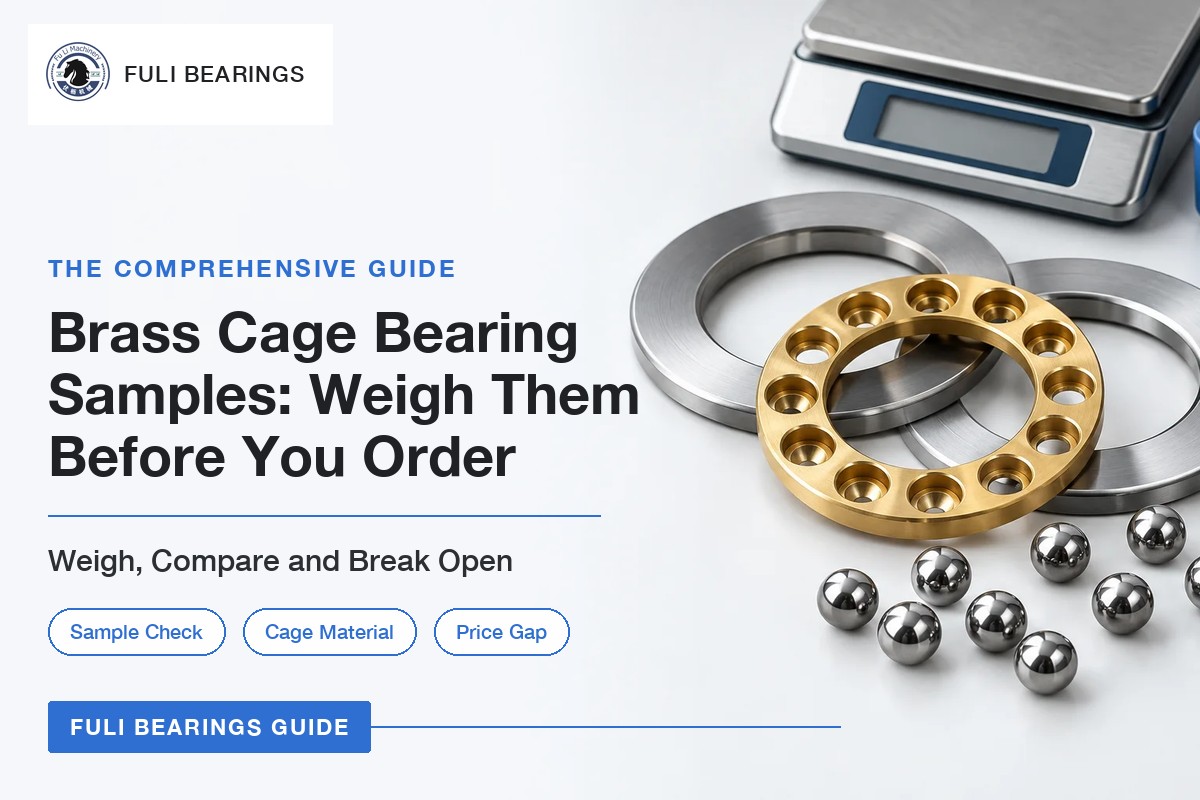
A brass cage bearing sample can pass every outside check and still be short of metal inside. In 2016 I saw this on a 51228 thrust ball bearing order. The only tool that caught it was a scale.
Below: that case, what the cage does, how a brass cage differs from a steel or polymer cage, why a hollow cage gets past a visual check, and the sample check I suggest to buyers. A second case, from 2003, shows what a very low price can mean.
The 51228 samples that looked the same
In 2016 a well-known Asian bearing brand was choosing an OEM supplier for the 51228 thrust ball bearing with a brass cage. The 51228 is a single direction thrust ball bearing with a 140 mm bore, a 200 mm outside diameter and a height of 46 mm [3]. Their buyer asked three or four factories for quotations and samples. Our factory was one of them.
Two of the quotations were far below ours. Because the gap was so large, the brand looked at those two samples with extra care. They checked the appearance and the dimensions and could not find any difference. The samples looked almost exactly like ours.
The brand then told us the order would go to another factory. The other prices were much lower, and the samples showed no difference.
I replied with one sentence: please check the weight of the samples.
They weighed them. The rings weighed the same as ours. The cage looked the same as ours, but it was clearly lighter. I suggested they break the cage open. When they did, they were surprised themselves. The cage was hollow inside.
The order came to us. Our price was not the lowest. The sample decided it. Nothing on the outside of that cheaper sample showed what was missing.
What the cage does in a brass cage bearing
The cage, also called a separator or retainer, holds the balls or rollers in place. SKF lists its main jobs [2]:
- Separate balls. The cage separates the rolling elements, which reduces the frictional heat generated in the bearing.
- Even spacing. It keeps them evenly spaced, so each ball or roller has its own space and the load is shared.
- Guide balls. It guides them through the unloaded zone of the bearing.
- Retain balls. It retains them in separable bearings when one ring is removed for mounting or dismounting.
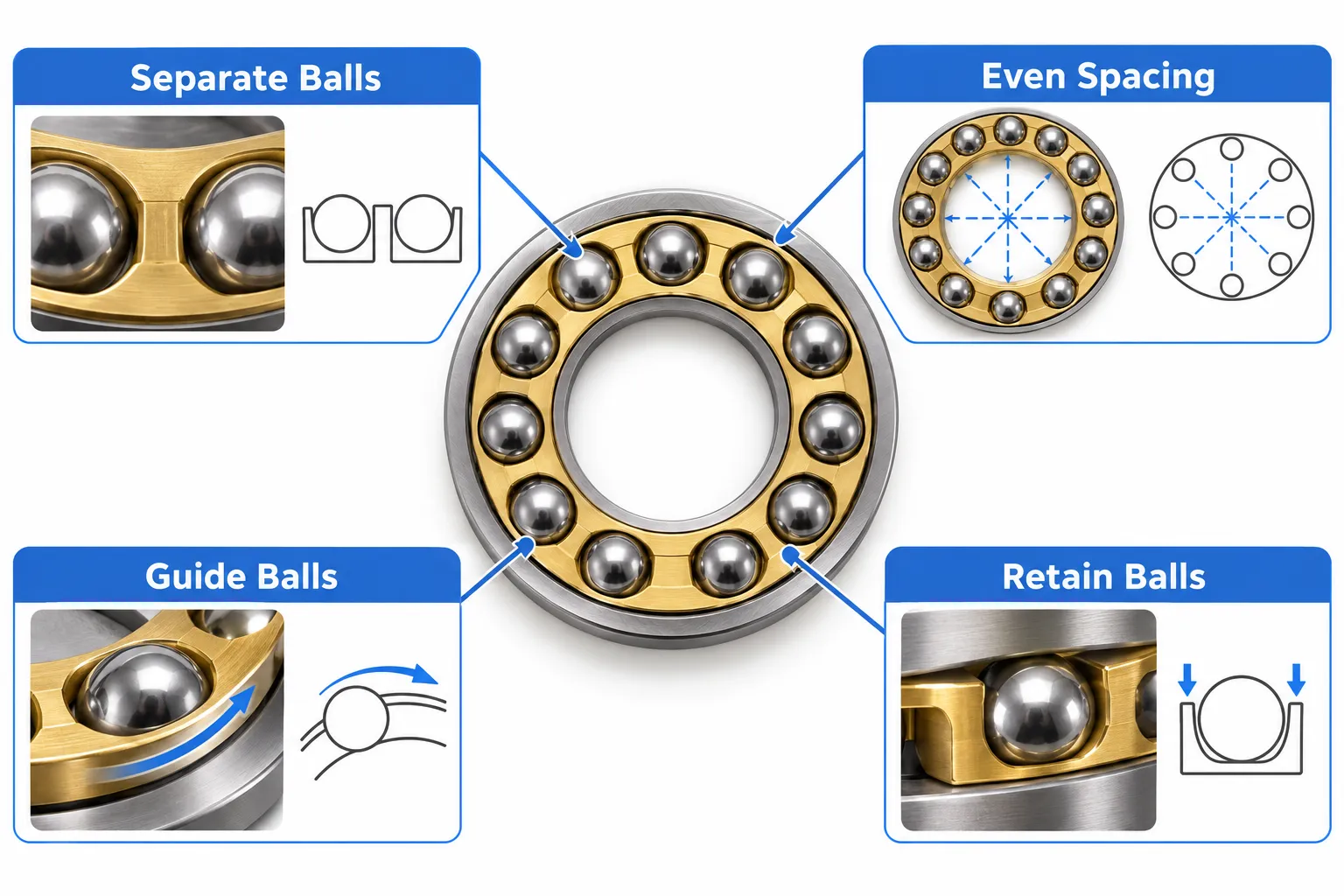
In a single direction thrust ball bearing, the balls and cage come as one ball and cage assembly that sits between the shaft washer and the housing washer [3].
The cage is not a passive part. In operation, friction, impacts, centrifugal force and inertia all act on it [1]. SKF’s damage guide calls the cage a critical part of the bearing [6]. It also notes that rings and rolling elements are hardened to about 60 HRC, but most sheet metal and brass cages are not hardened [6]. When lubrication is poor, the cage can wear before anything else in the bearing [6].
The cage is a small component. One with less metal than it should have still turns on the bench. The cage only starts working hard once the bearing runs under load, speed and vibration, and that is when a weak cage shows.
Brass ball cage vs steel cage and polymer cage
Cages are made from stamped sheet steel, machined brass, machined steel or polymer. The cage material has a significant influence on whether a bearing suits a particular application [1].
| Cage | Made from | What it suits |
|---|---|---|
| Stamped steel | Low carbon sheet steel, pressed to shape [1] | Lightweight, relatively high strength; some are surface treated to reduce friction and wear [1] |
| Machined brass | Most are machined from cast or wrought brass [1] | High speeds, temperatures, accelerations and vibrations [2]; operating temperatures up to 250°C [1] |
| Machined steel | Non-alloyed structural steel [1] | Not affected by the mineral or synthetic oil lubricants normally used in bearings [1] |
| Polymer | Polyamide 66 or 46, sometimes PEEK [2] | Little friction and high speeds; can run for some time with limited lubrication [2] |
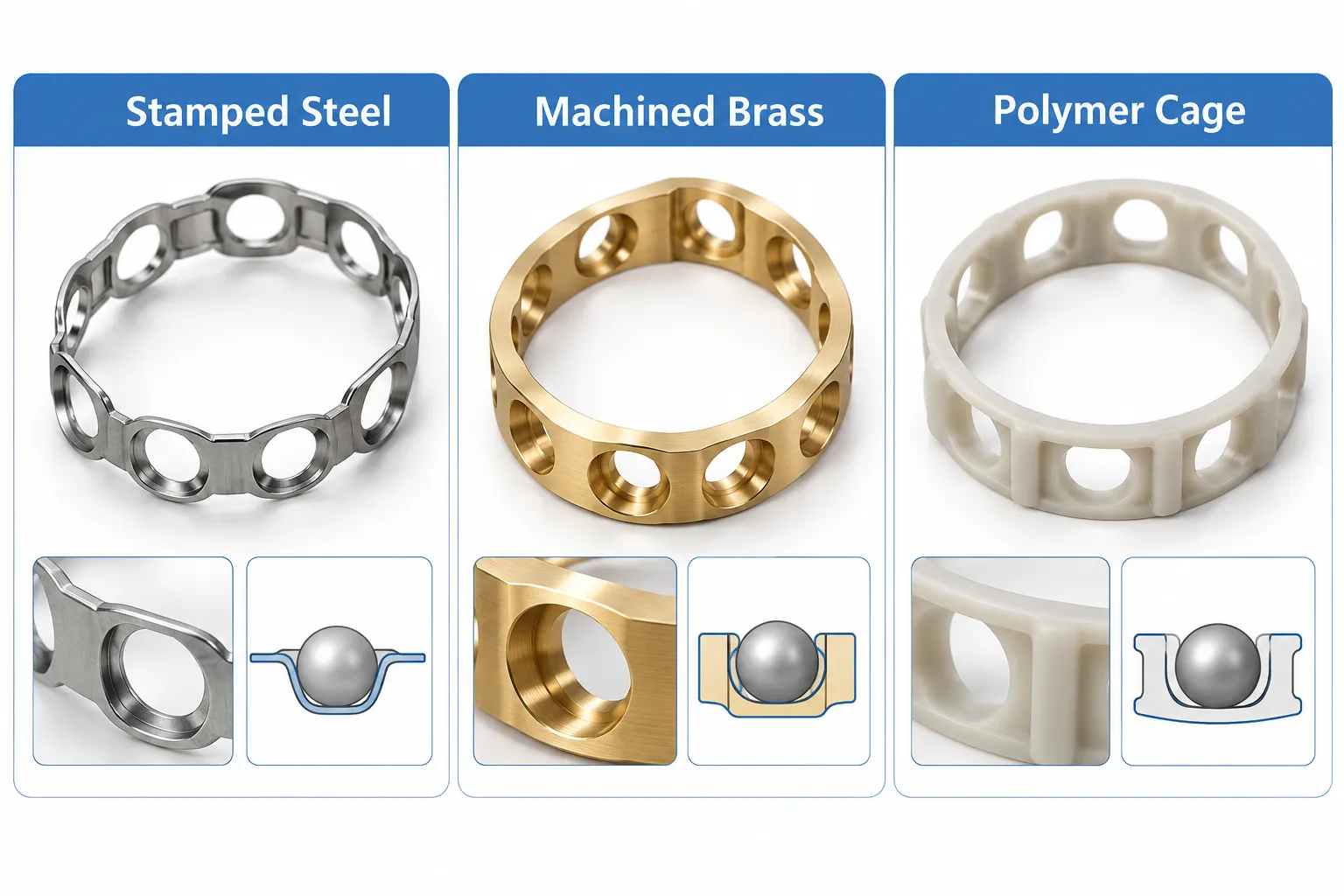
Polyamide 66, a nylon, is the most common material for injection moulded cages, and its strength depends on temperature and ageing [1]. PEEK cages are common in hybrid and super-precision bearings [1].
For thrust ball bearings, SKF’s catalogue offers three cages: stamped steel with no suffix, machined brass with the suffix M, and machined steel with the suffix F [3]. Other makers use their own codes. The clear way is to write the cage type in words on the inquiry, next to the designation.
The difference between a steel cage and a brass cage bearing also shows on a scale. A stamped steel cage is a light pressed part [1]. A machined brass cage is cut from a cast or wrought blank [1], so it carries more metal. The two manufacturing processes give parts of different weight by design. That is why a weight check only works between samples with the same designation and the same cage type. Compare brass with brass.
In our experience, buyers see brass cages most often on larger ball bearings and on roller bearings. The checks below apply to a roller bearing cage the same way they apply to a brass ball cage. If the inquiry is for stainless steel bearings, ask which cage material is fitted rather than assuming brass.
Why a hollow cage passes a visual check
A caliper measures the outside of a part. A hollow section has the same outside as a solid one, so a dimension check cannot find it.
A foundry guide on casting porosity puts it plainly: visual inspection detects surface-breaking or near-surface voids but cannot confirm internal integrity [4]. Voids reduce the effective cross-section of the metal and can concentrate stress [4]. Some voids only show once the part is machined or cut [4].
NSK makes a related point about low-price counterfeit bearings: problems from poor material or weak quality control are hard to see when the bearing is fitted, yet they end in premature failure in service [5].
A weight check fills part of that gap. It needs no lab, it takes a few minutes, and it tells you whether to look further.
How to check a brass cage bearing sample
This is the check I suggest to buyers comparing samples from several factories.
- Line up samples with the same designation and the same cage type. Ask each supplier to state in writing how it manufactures the cage, pressed or machined, and from what material.
- Weigh samples on one scale, as complete bearings. A difference between suppliers is a reason to look closer. It is not proof on its own.
- Take the parts apart where you can. A single direction thrust ball bearing comes apart into a shaft washer, a housing washer and the ball and cage assembly [3]. Weigh the washers and the ball and cage assembly separately. In the 2016 case the rings matched and the cage did not.
- If one cage is clearly lighter, break open a cage from that sample. The broken face of one cage bar shows whether the section is solid. Use a spare sample for this, not the one you keep as the reference.
- Keep one sample from the supplier you choose. Weigh a few bearings from the first delivery against it.
- Confirm cage type on paper: write it on the purchase order, and check that the quotation names the same cage. Our guide to reading a bearing quotation covers the other lines worth checking.
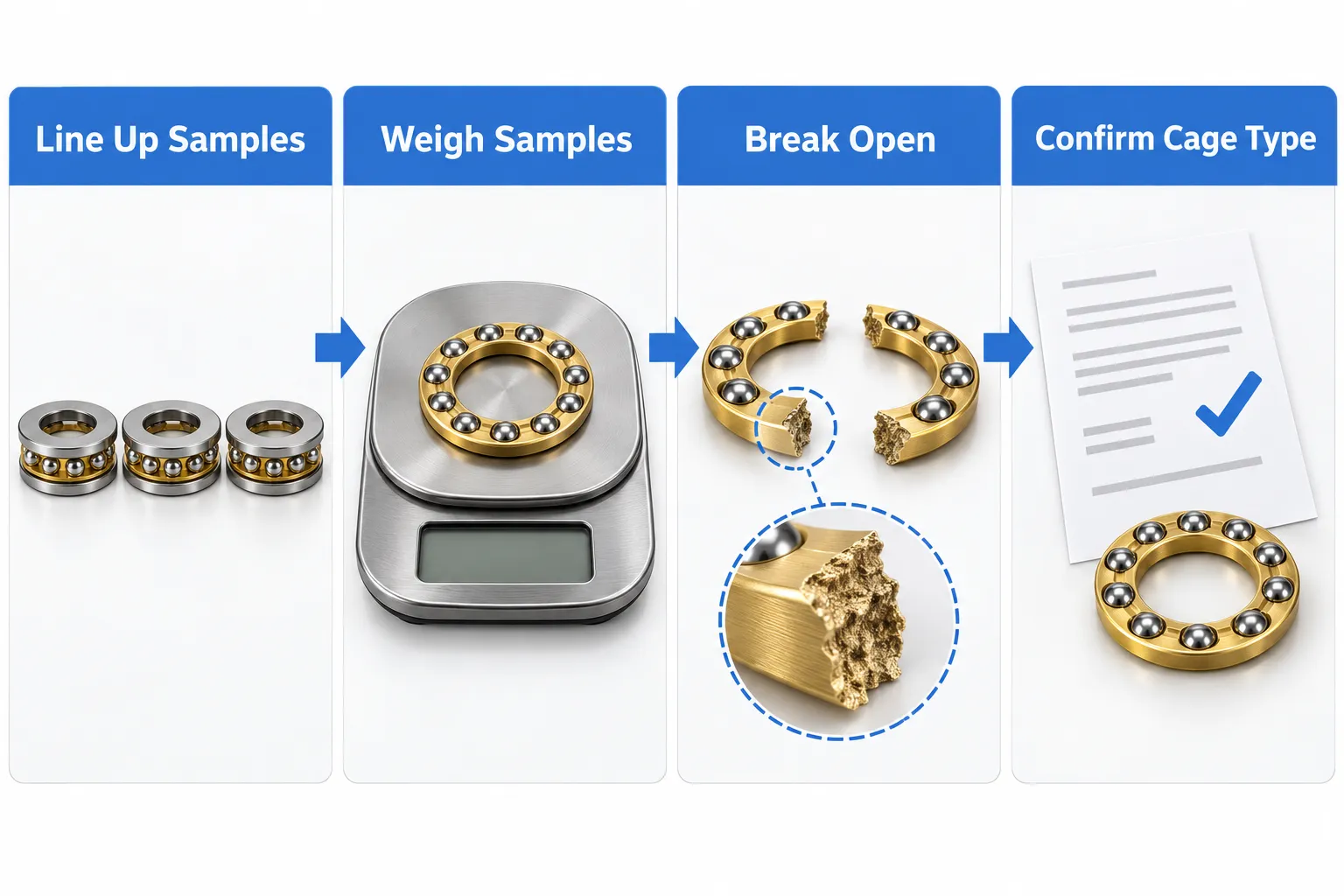
If the rings differ in weight, treat them the same way: compare, then break one open.
At our factory, each batch is checked before shipment for rotation smoothness, dimensions, grease fill, rust and appearance. You can run the same weight check on our samples against any other supplier’s.
A price near one third of normal
In 2003 the hub bearing trade was uneven. Some small workshops did not have the full production process for hub bearings, and some repaired rings or bearings rejected by specialist hub bearing factories and sold them as new.
That year a customer in Hong Kong insisted on buying a batch of hub bearings from a very small workshop. The customer felt they knew the bearing makers in China well enough. The price was about one third of the normal price. About two months after the goods were shipped, the customer told us that none of them could be used.
In my experience, a price that far below normal is not a discount. Something in the material, the process or the inspection has been left out, and the buyer usually finds out which one after the goods arrive. NSK’s whitepaper on counterfeit bearings makes a similar point: buying low-price counterfeit bearings is a high-risk strategy, and quality can change from shipment to shipment [5].
Before an order at such a price, ask for samples, weigh them against a sample from a supplier at a normal price, and break one open. For hub bearings, our guide to choosing wheel hub bearings lists what else to confirm. If you are comparing factories, choosing a bearing manufacturer in China covers the questions to ask before the first order.
We supply thrust ball bearings such as the 51108 to order. See our thrust ball bearing range, or send the designation and the cage type you need to sales@fuli-bearings.com.
Sources
- https://www.skf.com/group/products/rolling-bearings/principles-of-rolling-bearing-selection/bearing-selection-process/bearing-execution/cages
- https://www.skf.com/group/products/rolling-bearings/principles-of-rolling-bearing-selection/general-bearing-knowledge/bearing-basics/components-and-materials
- https://www.skf.com/binaries/pub12/Images/0901d196802809de-Rolling-bearings---17000_1-EN_tcm_12-121486.pdf
- https://haworthcastings.co.uk/casting_guides/porosity-in-castings-causes-prevention-and-how-to-specify-inspection/
- https://www.nsk.com/content/dam/nsk/common/company/pdf/The%20Risks%20of%20Buying%20Counterfeit%20Bearings%20Whitepaper_revision2.pdf
- https://cdn.skfmediahub.skf.com/api/public/093168a92d25cc46/pdf_preview_medium/093168a92d25cc46_pdf_preview_medium.pdf
FAQ
Is a brass cage bearing better than a steel cage bearing?
Not for every application. The advantage of a machined brass cage is that it permits high speeds, temperatures, accelerations and vibrations. Stamped steel cages are lightweight with relatively high strength and suit many standard bearings. Use the cage your engineering drawing or application calls for, and write it on the order.
Why are brass cages used in bearings?
Brass cages can run at operating temperatures up to 250°C. Machined brass is unaffected by most common bearing lubricants, including synthetic oils and greases. Machined metal cages also suit high speeds and vibration.
Can a hollow or light cage be found without breaking it open?
Weighing is the first screen. A cage that is clearly lighter than others of the same designation and cage type is the reason to break one open. Visual inspection cannot confirm what is inside a part.
What does the suffix M mean on a thrust ball bearing?
In SKF's designations, M means a machined brass cage, ball centred. F means a machined steel cage, and no suffix means a stamped steel cage. Other makers use different codes, so state the cage in words on the order.
Does a brass cage need special lubrication or maintenance?
No special lubricant is needed, because machined brass is unaffected by most common bearing lubricants. Normal lubrication and maintenance still matter. The cage is softer than the rings and balls, and it can wear first when lubrication is poor.