Types of Hub Bearings Used in Agricultural Machinery
Disc harrow bearings with square or round bores, flanged disc hubs, tapered roller pairs and hex bore bearings: where each fits and how to identify one.
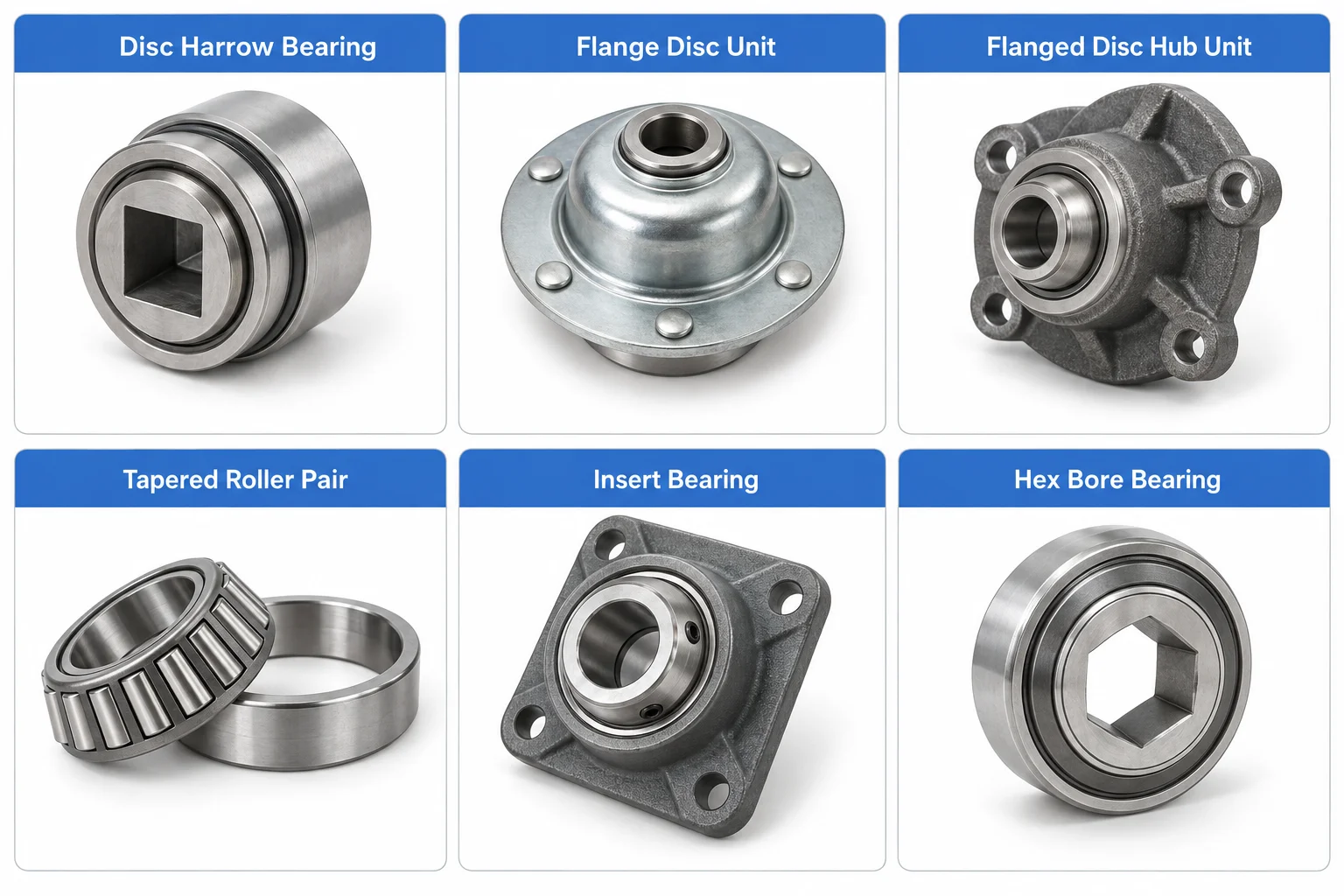
The types of hub bearings used in agricultural machinery are not the same as the wheel hub bearings in a car. On a farm, “hub bearing” can mean the bearing on a disc harrow gang, a flanged disc hub unit that bolts onto a tillage frame, the tapered roller pair in an implement wheel, or an insert bearing in a flange housing that carries a press wheel.
Each type of bearing has its own shape, its own numbering and its own way of failing. This guide goes through the main types, where each is used, how to identify one that has lost its markings, and what to send with an inquiry so the replacement fits the first time.
Types of hub bearings used in agricultural machinery
The table lists the types of agricultural bearings that farm mechanics and parts buyers call hub bearings, with the place each one is used and the visible feature that identifies it.
| Type | Where it is used | How to recognise it |
|---|---|---|
| Disc harrow bearing, square bore | Disc harrow and disc tiller gangs | Square hole, heavy multi-lip seals, extra-wide inner ring |
| Disc harrow bearing, round bore | Disc gangs on round shafts or spools | Round hole, same seals, sometimes a locking collar |
| Flange disc unit | Disc harrows, often with the bearing in pressed steel flanges | Bearing riveted between two stampings, often with a grease fitting |
| Flanged disc hub unit | Disc harrows and other soil working tools | Cast housing with 4, 5 or 6 threaded holes for the disc |
| Tapered roller pair | Implement and trailer wheel hubs | Separate cone and cup, two sets per hub |
| Insert bearing in a flange housing | Press wheels, gauge wheels, drive shafts | Spherical outer ring in a two- or four-bolt housing, set screws or collar |
| Hex bore bearing | Balers and implements with hex shafts | Hexagonal hole, no locking device |
| Ball bearing in a small hub | Seed discs, gauge wheels, mowers | Standard or special ball bearing pressed into the hub |
Disc harrow bearings: square bore and round bore
A disc harrow puts its bearings in the worst place on the farm: low down, in wet soil, carrying shock every time a disc hits a stone. NTN calls tillage one of the harshest operating conditions a bearing can face, and says field debris, dust and moisture cause countless failures every season [3].
To withstand this, disc harrow bearings use three features.
A bore that matches the gang shaft. Many disc gangs run on a square shaft, and the bearing has a square bore that slides on and turns with it. Timken’s catalogue lists Tri-Ply disc harrow bearings with square and round bores, and separate hex bore bearings [1], and NTN offers bore options of square, round, and round with a locking collar [3].
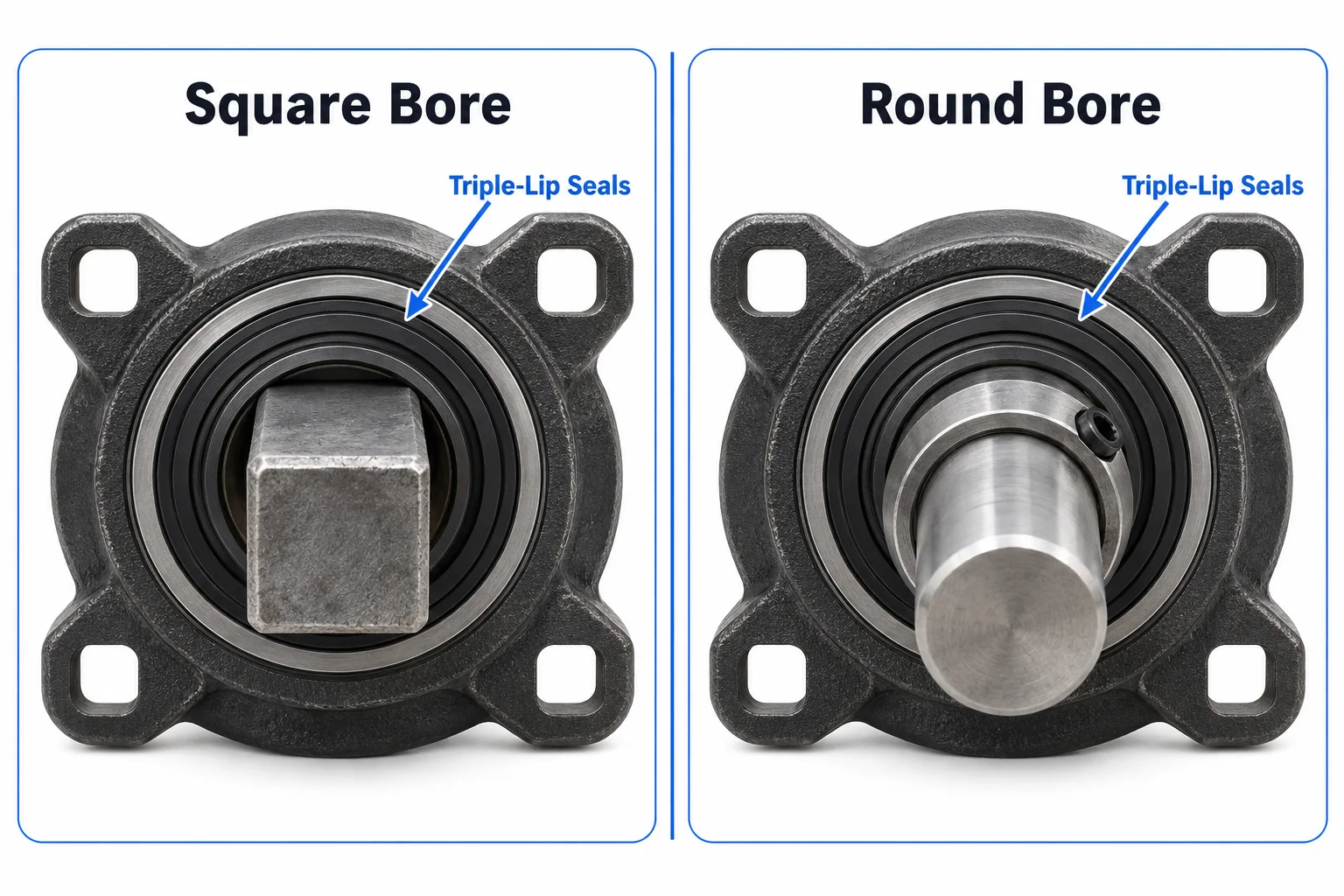
Heavy seals. Timken makes its Tri-Ply bearings for heavily contaminated positions: disk harrows, disk tillers and other seedbed tools. One design stacks three rubber seals with steel spacers between them, the other uses a single molded seal, and both sit behind a steel shroud cap on the outside [1]. NTN uses triple-lip seals on its disc harrow bearings [3]. In NTN’s rotating drum test, where bearings turning at 800 rpm run inside a drum filled to about 30% of its volume with water and test dust, triple-lip bearings significantly outperformed bearings with standard single-lip seals [3].
Extra-wide rings. Timken notes that the extra inner ring width of these bearings gives greater support on the shaft [1].
The price of the heavy seal is speed. Timken advises consulting the maker for Tri-Ply bearings above 500 r/min [1]. Disc gangs turn slowly, so this is rarely a problem on a harrow, but it is a reason not to use a disc harrow bearing on a fast shaft.
Reading a disc harrow bearing number
Disc harrow bearings carry maker-specific numbers rather than standard metric designations. In the Timken system, a W prefix with the PP suffix marks Tri-Ply seals, and the W208PPB5 is a square bore bearing for a 1-1/8 inch shaft, with an 80 mm outside diameter, a 36.53 mm (1.438 in) inner ring width and an 18.00 mm (0.709 in) outer ring width [1]. Timken lists the W208PPB5 among its spherical outside diameter types, and the W208PP5 for the same shaft among the cylindrical outside diameter types [1]. Timken’s relubricatable Tri-Ply versions carry a G in front, as in GW208PPB5, which keeps the 80 mm outside diameter and 36.53 mm inner ring but has a 21.00 mm outer ring instead of 18.00 mm [1].
Other makers use their own numbers for bearings of the same size. NTN-BCA’s DS208TT5, for example, is listed as a square bore disc harrow bearing, 80 mm across the outside and 36.5 mm wide [4]. Distributors publish interchange lists that pair these numbers, but the dimensions are what decide the fit. Our disc harrow bearing page compares five common square and round bore sizes in the Timken and NTN catalogues, and shows why a relubricatable version does not have the same width.
Two bearings with the same 208 base size can differ in bore shape, bore size, outside diameter shape and ring widths. When you order, check the four.
Flange disc units
Some disc harrows use the bearing already mounted in a pressed steel flange. NTN-BCA’s flange disc units have the bearing held between two heat treated, zinc plated stampings riveted together around the bearing and O-rings, with a grease fitting permanently installed in the stamping [3]. The bearing has a spherical outside diameter, which gives the unit about 3 degrees of dynamic alignment [3]. Timken’s disk harrow units follow the same idea: a Tri-Ply bearing mounted in two riveted stampings, offered around a 209 or a 211 size bearing [1].
These units are replaced complete. When you measure one, record the bore shape and size, the bolt hole pattern of the flange and the overall width.
Flanged disc hub units
A newer design puts the whole disc hub into one sealed unit. NTN-SNR’s AGRIHUB, for example, is a hub unit for soil working with a multi-lip sealing system and a ductile cast iron housing [2]. The catalogue lists versions with 4, 5 or 6 M12 x 1.25 threaded holes for the disc, a 120 mm housing diameter, and use with discs under 700 mm diameter [2].
A unit like this is not a bearing you replace on its own. The housing, bearing, seals and grease are designed together and the whole unit is changed. To identify one, count the disc mounting holes, measure the thread and the bolt circle, measure the housing diameter and note the disc diameter it carries.
Tapered roller bearings in implement wheel hubs
This is the type most people mean by a hub bearing. An implement or trailer wheel hub, towed behind a tractor, usually runs on two tapered roller bearings facing each other, one inner and one outer. The pair carries axial and radial load together: the radial load from the wheel’s weight and the thrust load from side forces when the machine turns or works across a slope, a combination that matters for durability on uneven ground in agriculture, where a hub can run for a full season between services.
Each tapered bearing has two parts that are numbered separately: the cone, which is the inner ring with the rollers and cage, and the cup, the outer ring. Inch sets are ordered as cone and cup, for example the L44649 cone with the L44610 cup. Metric tapered bearings such as the 30206 and 30208 carry one number for the complete bearing. NTN-SNR lists metric tapered bearings such as the 30210 and 32011 to 32014 for soil working tools, in a tighter tolerance class for quicker and more precise mounting [2].
Three points matter when you replace them:
- Replace the cup with the cone. A new cone on an old, worn cup will not run well.
- Pack the bearing with grease at assembly. In our experience, tapered roller bearings leave the factory with rust protection only and are rarely pre-greased.
- Set the end play the machine maker gives. Too tight and the hub runs hot; too loose and the rollers hammer under road shock.
Our article on how to choose wheel hub bearings covers hub bearings for vehicles, and the tapered roller bearing page lists metric and inch sizes.
Insert bearings in flange housings
Press wheels, gauge wheels, small rollers and many drive shafts on farm machinery turn on insert bearings in flange housings. The insert is a sealed ball bearing with a spherical outer ring and an extended inner ring that locks to the shaft. Two locking styles matter on farm machines:
- Set screw inserts lock with two grub screws. NTN-SNR notes that this type can run in both directions of rotation [2].
- Eccentric collar inserts lock with a collar turned against an eccentric step. NTN-SNR states that this type runs in one direction of rotation only [2].
NTN-SNR also offers bearing inserts with heavier agricultural seals, and warns that because of the reinforced seal they cannot be combined with every housing [2]. When you replace an insert with a different seal type, check that it sits in the old housing.
The insert bearing page lists UC, SB and SA inserts with dimensions, and the flange bearing page lists the UCF and UCFL housings they fit.
Hex bore bearings
Balers and many implements use hexagonal shafts, and the bearing bore matches the hex. Timken makes its hex bore bearings for slow, moderately loaded shafts where either ring may turn, mainly on agricultural implements and conveyors [1]. Their main advantage is easy mounting: apart from axial positioning by adjacent parts, no collars, set screws or other locking devices are needed [1]. NTN-SNR offers inserts with a hexagonal bore for balers [2].
To identify one, measure across the flats of the hex, then the outside diameter and both ring widths.
Ball bearings in small hubs, seed discs and mowers
Small wheels and simple hubs often carry standard deep groove ball bearings such as the 6204 or 6205 with 2RS seals. Two places use special ball bearings instead. NTN-SNR’s seeding bearings use four-point angular contact technology to guide the seeding discs [2], and its mower bearings for cutter bars include single-row and double-row designs [2]. On these positions, read the number on the old bearing; a standard 62 series bearing of similar size is not the same part.
Other bearing types in agricultural equipment
Hubs are only one group of bearings in agricultural machinery. A combine harvester or a baler has many other rotating parts, and the common types are chosen by the load each one sees: radial loads across the shaft, thrust loads along it, or both.
| Position | Usual type |
|---|---|
| Gearbox and PTO shafts | Deep groove ball bearings, cylindrical rollers |
| Bevel pinion, differential, front wheel hubs | Tapered rollers in adjusted pairs |
| PTO shaft universal joints, gear sets | Needle roller bearings |
| Heavy shafts in harvesters and crushers | Spherical roller bearings |
| Hydraulic cylinder eyes, linkage pivots | Spherical plain type, see below |
| Steering pivots on some front axles | Thrust ball bearings or tapered rollers |
| Augers, elevators, straw walkers, fans | Ball bearing units in pillow block and flange housings |
Cylindrical roller bearings carry heavy load across the shaft but little or none along it. Needle rollers do the same job in a thin section. Spherical plain bearings have no rolling element: a steel ball sits in a steel or lined outer ring and takes slow swinging motion and shock, which suits linkages and other slow moving parts better than a rolling bearing would. Our page on tractor bearings lists the usual sizes by position.
Choosing the right bearing for agricultural machines
For a farm position, choosing the right agricultural bearing comes down to five questions.
- What is the load? Radial and axial load together, as in a wheel hub, points to a tapered pair. A load straight across a long shaft points to an insert or a ball type.
- How dirty is it? Soil and water need triple-lip or shrouded seals. Chaff and dust need at least a good contact seal.
- What is the shaft? Round, square or hex, metric or inch.
- Can it be greased? A relubricatable version gives a longer service life where it can be reached in the service round. Sealed bearings that cannot be greased suit places the service round does not reach.
- How fast does it turn? Heavy seals add friction, so check the speed limit on fast shafts.
Standard bearings of the same size often fit, but a dedicated agricultural bearing has the seals, wider inner ring and bore shape the position needs. On a disc gang, the standard part usually fails first.
Why farm bearings fail, and how to extend bearing life
Most premature bearing failure on farm machines has the same few causes:
- Dirt and water past the seal. Grit and moisture get between the inner and outer rings, then wear and rust follow.
- Lubricant that was not renewed, or too much grease pumped in fast enough to push out the seal lip.
- Pressure washing straight at the seals.
- Wrong end play in a tapered wheel hub.
- Misalignment between two housings on one shaft, which adds load and vibration.
- Corrosion from fertilizer and standing outside between seasons.
To make them last, grease on the maker’s interval and stop when fresh grease shows at the seal. Check end play when a hub is opened. Store machines dry, and turn shafts by hand before the season starts. Replacing a worn part during the off-season costs less than the downtime of a failure at harvest.
How to identify an unmarked farm hub bearing
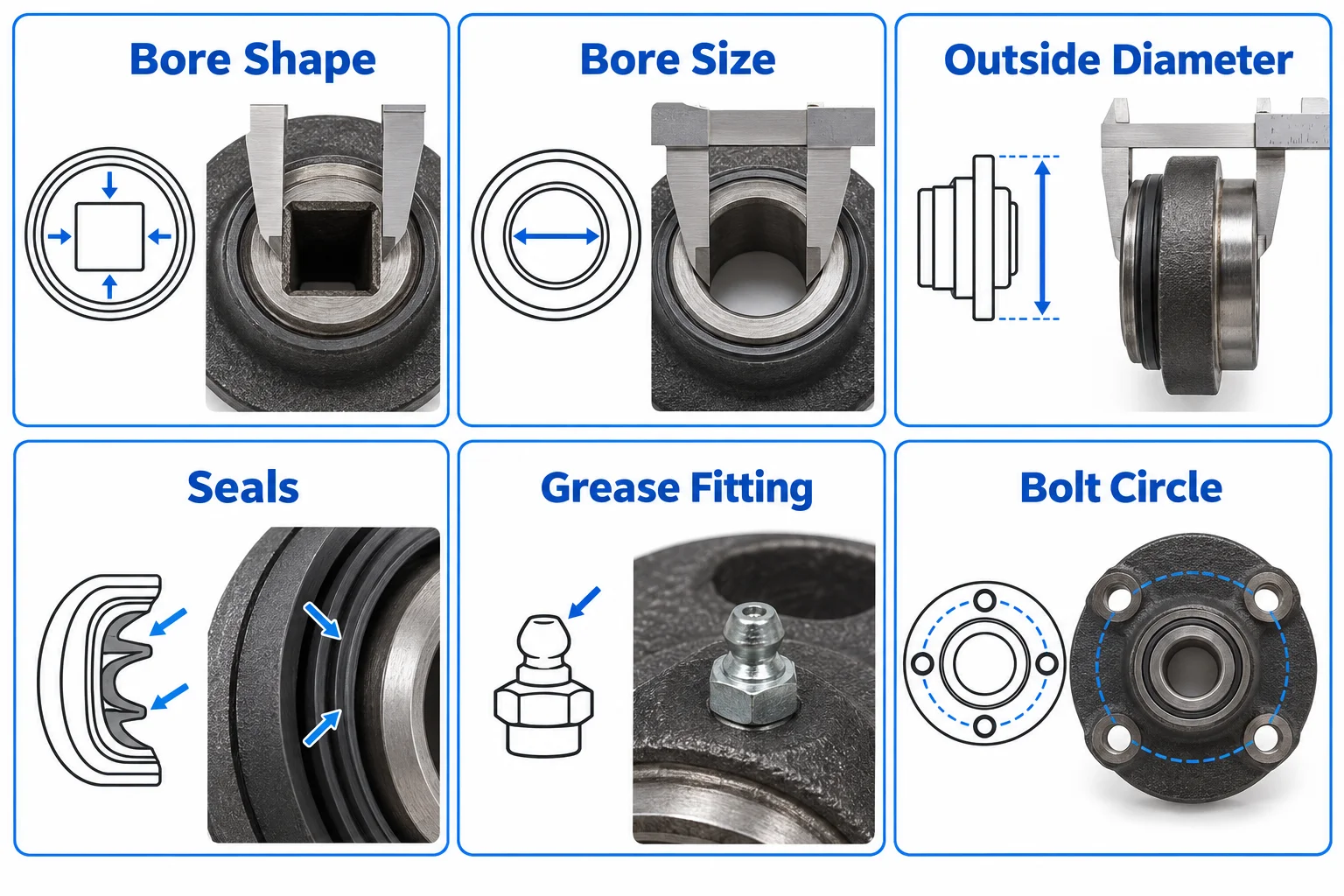
When the number has worn off, these checks are usually enough to find the part:
- Bore shape. Round, square or hex. For square and hex, measure across the flats.
- Bore size. In millimetres or inches. Many farm machines are built to inch drawings.
- Outside diameter, and its shape. Spherical (curved) or cylindrical (straight).
- Inner ring width and outer ring width. On disc harrow bearings the inner ring is much wider than the outer.
- Seals. Single lip, triple lip, shroud caps or shields.
- Grease fitting. Present or not.
- Housing or flange. If the bearing sits in a stamping or a cast hub, count the bolt holes and measure the bolt circle.
- For tapered bearings, the numbers on both the cone and the cup.
Take a photo of the part next to a ruler, and photograph the markings even if they are only partly readable.
What to send with an inquiry
The insert bearings, mounted units, deep groove ball, tapered roller and spherical roller bearings on our product pages cover many agricultural applications; the agricultural bearings page lists them by machine. FULI also supplies square-bore and round-bore disc harrow bearings, ag hub units and KRRB-type inserts. Send the model or a drawing and we confirm the exact part; for seals and lubrication, tell us which seal and relube version you need. The disc harrow bearing page explains how to measure an old disc bearing, and the tractor bearing page covers its gearbox, PTO and wheel positions.
An inquiry with these items can usually be answered in one round:
- The full number from the old part, with every prefix and suffix, or the measurements above.
- The quantity for each part.
- The machine and position: disc gang, wheel hub, press wheel, baler shaft.
- The bore shape and size, and the shaft size in millimetres or inches.
- Photos of the part and its markings.
- Any marking requirement. Rings can carry your authorized brand, the factory brand, or no brand.
Inquiries often leave out the prefix and suffix letters, and on farm bearings those letters carry the seal type, the bore shape and whether the bearing can be regreased. Copy everything on the ring. Our page on how to request a bearing quotation has a template you can paste into an email.
Our rings and balls are GCr15 chrome bearing steel as standard, and the steel maker’s material certificate is available on request for OEM and industrial orders. On mounted units, our factory checks the housing mounting torque, the fit between insert and housing, the batch consistency of the centre height and the internal clearance of the insert before they ship. Backed by 20+ years of bearing export experience in Linqing, Shandong. Send the list through the contact page or to sales@fuli-bearings.com.
Timken, NTN, SNR and BCA are trademarks of their respective owners. FULI is not affiliated with, authorized by or endorsed by any of them. Their published technical material is cited here as general reference only.
Sources
- https://www.timken.com/wp-content/uploads/2018/04/Timken-Ball-Bearing-Catalog_10734.pdf
- https://www.ntn-snr.com/sites/default/files/2021-07/DOC.I_AGRI_CAT3_GBa_web.pdf
- https://help.bdsbearing.com/hubfs/Knowledge%20Base/NTN/NTN%20Agricultural%20Bearing%20Brochure.pdf
- https://www.baldwinsupply.com/itemdetail/DS208TT5%20NTN
FAQ
What types of hub bearings are used in agricultural machinery?
The main types are disc harrow bearings with square or round bores, flanged disc hub units that bolt on as a complete part, pairs of tapered roller bearings in implement and trailer wheel hubs, insert bearings in flange housings, hex bore bearings on hex shafts, and deep groove or angular contact ball bearings in small wheels and seed discs.
What is the difference between a square bore and a round bore disc harrow bearing?
A square bore bearing slides onto the square gang shaft of a disc harrow and turns with it without any locking device. A round bore bearing fits a round shaft or spool and may be locked with a collar. The outside diameter and ring widths can be the same, so the bore shape is the first thing to check.
How do I measure a square bore bearing?
Measure across the flats of the square bore, not across the corners. Then measure the outside diameter, the inner ring width and the outer ring width, and note whether the outside diameter is spherical or cylindrical and whether there is a grease fitting.
Can I replace a hub unit with separate bearings?
Only if the hub was designed for separate bearings. A complete hub unit is engineered as one part with its own seals and housing, and is replaced as a unit. If you are not sure, send photos and the number from the unit.
Can I use a standard bearing instead of an agricultural bearing?
Sometimes, if the size, bore shape and seal suit the position. On disc gangs and other soil-working tools, a standard bearing with ordinary seals usually fails much sooner, because it is not designed for soil and water. Match the seal and bore of the original part.
Do you supply disc harrow bearings or ag hub units?
Yes. FULI supplies square-bore and round-bore disc harrow bearings, ag hub units and KRRB-type inserts. Send the model from the old part, or a drawing with the bore shape and dimensions, and we confirm the exact part before quoting. Tell us which seal and relube version you need.