Insert Bearing Inner Ring Size: A 2013 Case We Walked Away From
In 2013 a distributor forwarded a rival's signed PI at a price we could not match. We let the order go. It came back with an undersize inner ring.
This insert bearing inner ring size case is from 2013. A South American distributor who had bought outer spherical insert bearings from us for years told us another supplier had quoted him far below our price. He forwarded us the proforma invoice he had already signed with that supplier, and said he would still rather buy from us at the same number.
We costed it, could not get there on bearing steel, and told him so. He placed the order with the other supplier instead, to see for himself. Below is what came back, why a signed guarantee of “bearing steel” did not catch the real problem, and what the inner ring dimension actually told the end user.
The 2013 order we chose not to match
Our customer had been buying outer spherical insert bearings from us for a long time; these are the UC-style bearings with a ball-shaped outer ring that seats and self-aligns inside a pillow block or flange housing. When he sent us the other supplier’s PI, the price was well under what bearing steel, cut to standard size, cost us to produce. We ran the numbers and told him plainly: we could not match it without giving something up. Rather than lose the order quietly, we suggested he place a batch with the cheaper supplier and see what he actually got.
Before he ordered, we raised the obvious question with him: could the other factory be using 45 steel, an ordinary medium-carbon structural steel, instead of real bearing steel, to get to that price? He told us the other supplier had signed a written agreement guaranteeing bearing steel. On paper, the material question looked settled.
Why the written guarantee did not settle anything
A written guarantee describes what a seller is willing to claim, not what left the production line. Genuine bearing steel such as GCr15 (the SAE 52100 equivalent) gets its wear resistance and long rolling-contact fatigue life from a controlled chromium content and a cleaner melt than an ordinary carbon steel like 45 steel can offer; 45 steel can be surface-hardened but stays comparatively soft through its core, and under sustained rolling load that hard skin can collapse into the softer core beneath it [5]. That gap is exactly why we had asked the question in the first place.
But a paper guarantee only ever answers that one question, material grade, and it answers it with the seller’s word. It says nothing about whether the parts were actually cut, ground and finished to the dimensions a genuine insert bearing is supposed to have. In this case, the steel turned out not to be where the shortfall was.
What showed up after installation: a smaller inner ring, not a different material
Our customer is a distributor, and distributors do not necessarily carry a vernier caliper on the receiving dock. When the cheaper bearings arrived, nothing about the material or the finish looked wrong, so they went out to a customer without a dimensional check.
The end user mounted them and something felt off during installation, though he could not immediately say what. He pulled the worn original bearings he was replacing and set them side by side with the new ones. The inner ring on the new bearings was visibly shorter in width, and its outside diameter (O.D.) ran smaller, than the originals they were replacing. The end user rejected the batch and sent them back.
An insert bearing’s extended inner ring is what the set screws or locking collar grip, and its width is set out, alongside the bore and outside diameter of the bearing, in ISO 9628, the international standard for insert bearing dimensions [1]. A ring cut smaller than that standard has less steel in cross-section to carry the same radial load and the same press fit on the shaft, regardless of which steel it is made from. Ball bearing design literature treats the minimum wall thickness under the raceway as a design limit for exactly this reason: that section has to carry the compressive stress from the balls on the inside and the hoop stress from the press fit on the outside at the same time [3]. A ring that is not the size the shaft and housing were designed around is also a fit problem; too-loose fits, including an inner ring creeping on its shaft, are listed in bearing damage-analysis guides among the causes of excessive noise and vibration [4].
Insert bearing inner ring size: standard UC200 figures
Here are catalog inner ring width (B) and outside diameter (D) figures for the UC200 light-duty series, the sizes a pillow-block distributor is most likely to stock and resell [2] [7]:
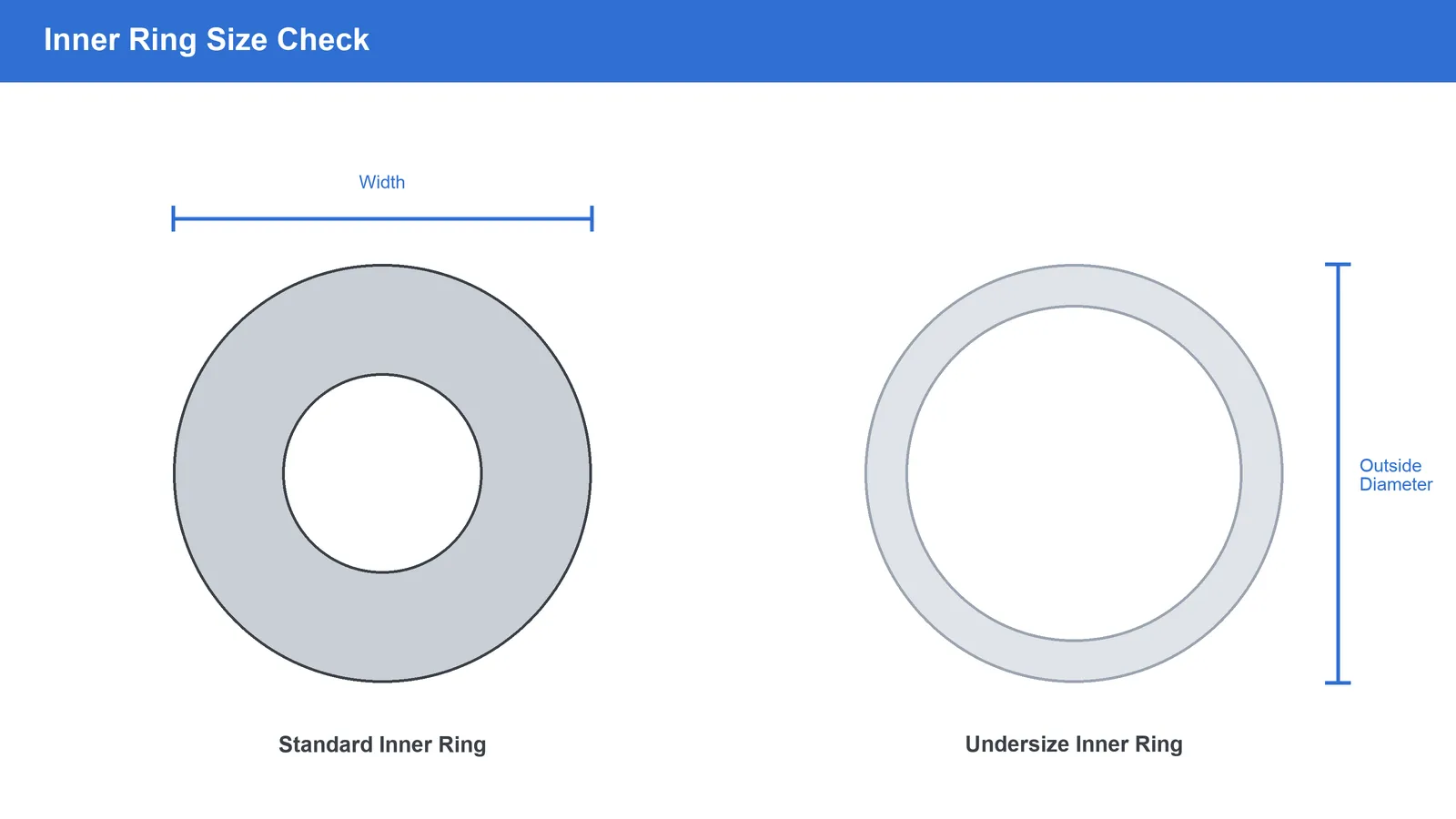
The graphic is the inner ring size check in one picture: a standard inner ring beside an undersize one, with the width and the outside diameter called out, because those are the two figures that gave the cheaper batch away.
| UC number | Bore d (mm) | Outside diameter D (mm) | Inner ring width B (mm) |
|---|---|---|---|
| UC204 | 20 | 47 | 31.0 |
| UC205 | 25 | 52 | 34.1 |
| UC206 | 30 | 62 | 38.1 |
| UC207 | 35 | 72 | 42.9 |
| UC208 | 40 | 80 | 49.2 |
Catalogs round the UC205 width differently: one lists 34 mm [2], another 34.1 mm [7]. That is a rounding difference, not the kind of shortfall this case was about. These are the figures to check a received batch against, or to check against a worn original, exactly as the end user in this case did by comparison. Full size and interchange detail across the UC, SB and SA insert series is on our insert bearing page.
How insert ball bearings lock to the shaft: the main types
They differ mainly in how they grip the shaft. The UC kind in this case is the set screw insert: two set screws in the extended inner ring bite onto the shaft. The SA kind is the eccentric insert, locked by an eccentric lock collar: an offset collar turns against a step on the ring and wedges it onto the shaft. The SB kind is the narrow inner ring insert, for light duty where there is little room. Bores come in metric and inch: a UC205 takes a 25 mm shaft, while a UC205-16 takes a 1 inch shaft, so the part number has to carry the bore [2]. We also make KRRB special inserts with an eccentric sleeve, a hex bore or a square bore; send the number or a drawing and we will confirm.
Checking a cheaper insert bearing batch before you resell it
A written material guarantee and a smooth spin test both missed the real problem in this case. Here is what actually would have caught it:
| Check | What it tells you | What it misses |
|---|---|---|
| Written material guarantee | What the seller is willing to claim about steel grade | Nothing about whether parts match standard dimensions |
| Visual check and hand spin | Obvious damage, rough spots; a lower-grade part is very hard to tell apart at delivery [6] | Inner ring width and outside diameter are invisible here |
| Vernier caliper on bore, O.D. and inner ring width | Whether the part matches the catalog figures for that UC number [1] [2] | Does not confirm steel grade on its own |
| Side-by-side against a worn original | Catches an undersize part even without catalog figures on hand, as the end user did here | Only works once you already have an original to compare |
A caliper check takes a few minutes per batch, the same order of effort as the hardness check in our 2007 case on a 48548/10 order, where the shortfall was in the steel rather than the size. Between the two cases, the lesson is the same, and in our experience it holds across most of the quotes we are asked to look at: a price well under market is cutting something, and a quick measurement, of hardness or of dimensions, usually shows you what. For a distributor weighing a factory-direct quote against a familiar supplier, our guide to buying from a distributor versus a factory covers the other side of that decision.
Asking us to quote or check a batch
If you have a quote that looks out of line with ours, or a batch you want checked before you resell it, send us the details. It helps to include:
- the bearing number or series, for example the UC number;
- a sample or the dimensions you measured, if you have a caliper on hand;
- the quantity and target price, so we can tell you what that number can and cannot buy in bearing steel at standard size.
FULI ships to 50+ countries & regions. Send the details through the contact page or to sales@fuli-bearings.com.
SKF, Koyo and NSK are trademarks of their respective owners. FULI is not affiliated with, authorized by or endorsed by any of them. Their published technical material is cited here as general reference only.
Sources
- https://standards.iteh.ai/catalog/standards/iso/d436b0b0-02b5-4553-8f79-92b0a8dfdb51/iso-9628-2019
- https://cdn.skfmediahub.skf.com/api/public/0901d196808054f8/pdf_preview_medium/0901d196808054f8_pdf_preview_medium.pdf
- https://www.cedengineering.com/userfiles/Ball%20Bearing%20Design%20and%20Applications%20R1.pdf
- https://cdn.skfmediahub.skf.com/api/public/093168a92d25cc46/pdf_preview_medium/093168a92d25cc46_pdf_preview_medium.pdf
- https://chinaspecsteel.com/gcr15-aisi-52100-bearing-steel-vs-standard-carbon-steel-why-high-carbon-chrome-alloy-is-essential-for-precision-components/
- https://www.nsk.com/content/dam/nsk/common/company/pdf/The%20Risks%20of%20Buying%20Counterfeit%20Bearings%20Whitepaper_revision2.pdf
- https://koyo.jtekt.co.jp/en/support/catalog-download/uploads/catbs006en.pdf
FAQ
What is an insert bearing's inner ring width, and why does it matter?
It is the B dimension in the international insert-bearing standard, the overall width of the extended inner ring that carries the locking device. A shorter or thinner inner ring than the standard calls for has less cross-section to carry the same load and the same press fit, and it was the dimension that gave away the cheaper bearings in this case.
Can an undersize inner ring look and feel like a genuine insert bearing?
Yes. A ring that is slightly short or thin can still be ground, plated and assembled to run smoothly on a bench. The only reliable way to catch it is to measure the width and outside diameter against the standard or against a worn original, which is exactly what the end user in this case did after installation felt wrong.
We were told in writing that the bearings are bearing steel. Is that enough?
A written guarantee tells you what the seller is willing to claim, not what left the factory. In this case the paperwork promised bearing steel and the steel was not even the problem; the shortfall was in the inner ring's dimensions, something no material guarantee covers.
What is the minimum equipment a distributor needs to catch this kind of problem before resale?
A vernier caliper, at minimum, to check bore, outside diameter and inner ring width against the catalog figures or against a sample of the bearing being replaced. It takes a few minutes per batch and would have caught the shortfall in this case before it reached the end user.
Why did FULI walk away from this order instead of matching the price?
We costed the quantity against our own material and production cost and the number did not work for bearing steel at full size. Rather than cut a corner to match it, we told the customer plainly that we could not do that price, and suggested he order a batch from the other supplier to see for himself what it was.