GCr15 vs 52100, SUJ2 and 100Cr6: One Bearing Steel, Four Names on a Spec Sheet
GCr15 vs 52100 bearing steel: GB, ASTM, JIS and EN composition limits side by side, where they differ and what to check on a material certificate.
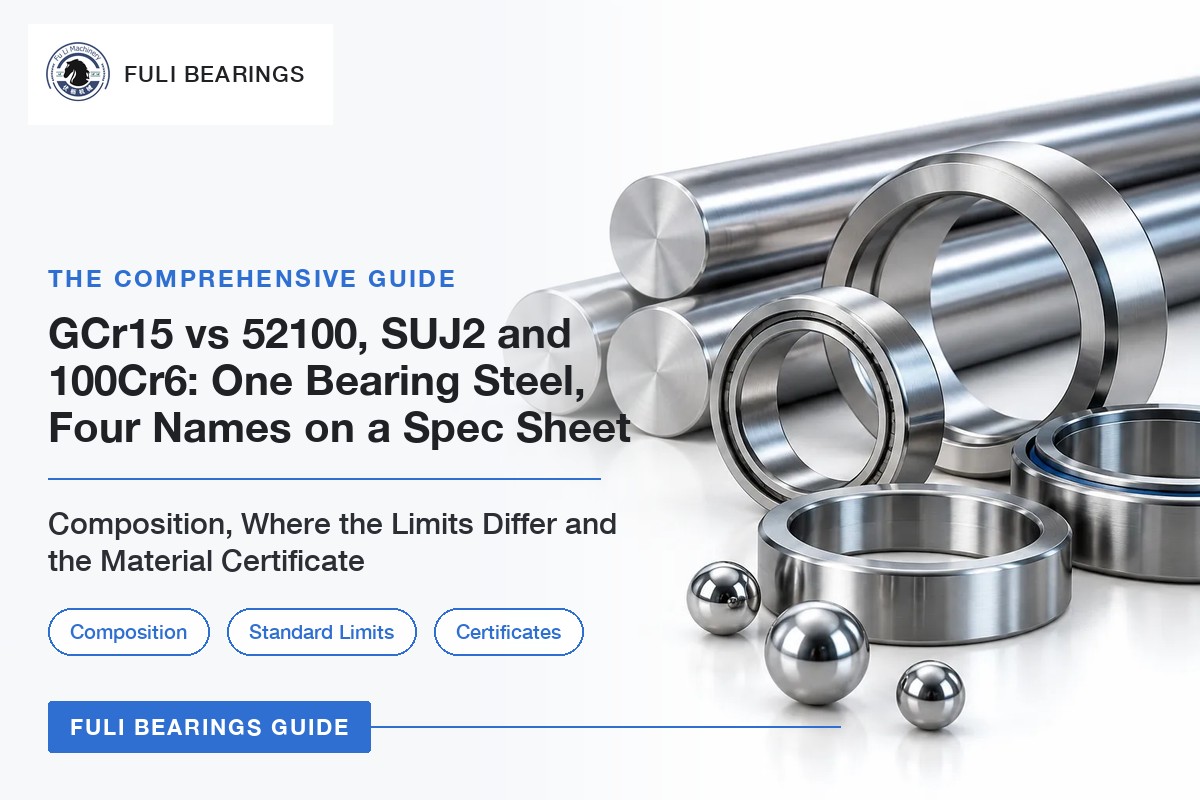
GCr15 vs 52100 is a question of names more than of steel. GCr15 and 52100 are the same kind of steel under two national names, and so are SUJ2 in Japan and 1.3505 in Europe. The four are high-carbon chromium bearing steel, a low alloy steel with about 1% carbon and 1.5% chromium, made to be hardened through for bearing rings, balls and rollers [1].
NTN’s engineering catalogue says JIS SUJ2 is nearly equivalent in composition to AISI/SAE 52100, the German DIN 100Cr6 grade and Chinese GB GCr15 [1]. “Nearly” is the word a buyer should read twice. Each name belongs to a different standard, and each standard draws its limits a little differently. This article sets the four side by side, shows where they differ, and lists what to check on a material certificate when a Chinese supplier’s spec sheet says GCr15 and your drawing says 52100.
Is GCr15 bearing steel the same as 52100?
Yes, for the job of making a rolling bearing. The grade name tells you which country’s standard the steel was ordered to:
| Country | Standard | Grade | Edition in use |
|---|---|---|---|
| China | GB/T 18254 | GCr15 | 2016 [2] |
| USA | ASTM A295/A295M | 52100 | 2014, reapproved 2020 [3] |
| Japan | JIS G 4805 | SUJ2 | 2019 [1] |
| Europe | EN ISO 683-17 | 100Cr6 (1.3505) | 2023, replacing 2014 [4] |
ASTM A295 covers steel of bearing quality for anti-friction bearings, and asks for a fully spheroidized structure when the bar is supplied soft [3]. GB/T 18254 covers hot-rolled, forged and cold-drawn bar and wire rod for rings and rolling elements [2]. ISO 683-17 sorts the types of bearing steel into five groups, and this grade sits with the through-hardening ones [4]. Same job, same metallurgy, four documents.
Published research uses the two names together: a 2020 ASTM paper on steelmaking at a Chinese special steel mill uses both names together in its title [5].
In our experience the question that reaches us is whether GCr15 is a step down from 52100, not what the detailed differences are. Our answer is short: it is the same steel under a different name. The sections below show the small differences between the standards.
GCr15 vs 52100 vs SUJ2 vs 100Cr6: chemical composition side by side
The figures below are heat (cast) analysis limits in mass percent. GB, ASTM and ISO 683-17 values are from the China National Institute of Standardization comparison of the four standards [6]; the JIS column is from NTN’s table [1].
| Element, % | GB/T 18254-2016 | ASTM A295 | JIS G 4805 | ISO 683-17 [6] |
|---|---|---|---|---|
| C | 0.95–1.05 | 0.93–1.05 | 0.95–1.10 | 0.93–1.05 |
| Si | 0.15–0.35 | 0.15–0.35 | 0.15–0.35 | 0.15–0.35 |
| Mn | 0.25–0.45 | 0.25–0.45 | ≤0.50 | 0.25–0.45 |
| Cr | 1.40–1.65 | 1.35–1.60 | 1.30–1.60 | 1.35–1.60 |
| Mo | ≤0.10 | ≤0.10 | ≤0.08 | ≤0.10 |
| Ni | ≤0.25 | ≤0.25 | ≤0.25 | not listed |
| Cu | ≤0.25 | ≤0.30 | ≤0.25 | ≤0.30 |
| P | ≤0.025 | ≤0.025 | ≤0.025 | ≤0.025 |
| S | ≤0.020 | ≤0.015 | ≤0.025 | ≤0.015 |
| O | ≤0.0012 | ≤0.0015 | not listed | ≤0.0015 |
| Al | ≤0.050 | ≤0.050 | not listed | ≤0.050 |
| Ti | ≤0.0050 | not listed | not listed | not listed |
GB values are for the base quality grade. The ISO 683-17 column follows the comparison, which predates the 2023 edition [6]. Check the edition printed on the paperwork you receive. Some catalogue tables still show the Chinese grade with S ≤0.025 and Ni ≤0.30 [1]; those are the 2002 limits, and the 2016 edition tightened nickel, phosphorus, sulphur and oxygen [2].
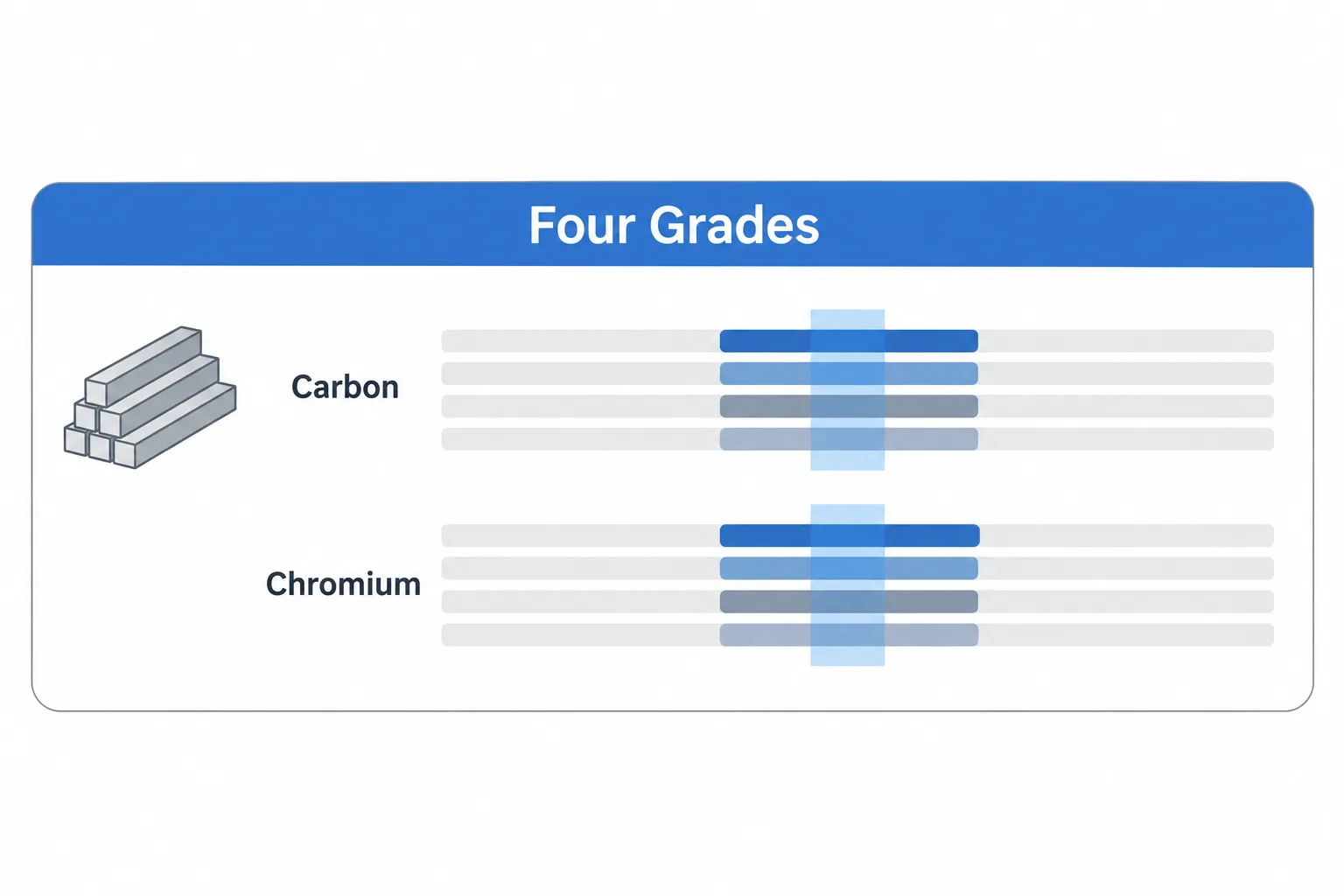
Read the C and Cr rows first. Carbon at about 1% is what lets the steel reach raceway hardness after the quench [6]. Chromium at about 1.5% forms hard carbides, improves hardenability and adds wear resistance [6]. Every column puts both elements in the same narrow band.
Where the four standards actually differ
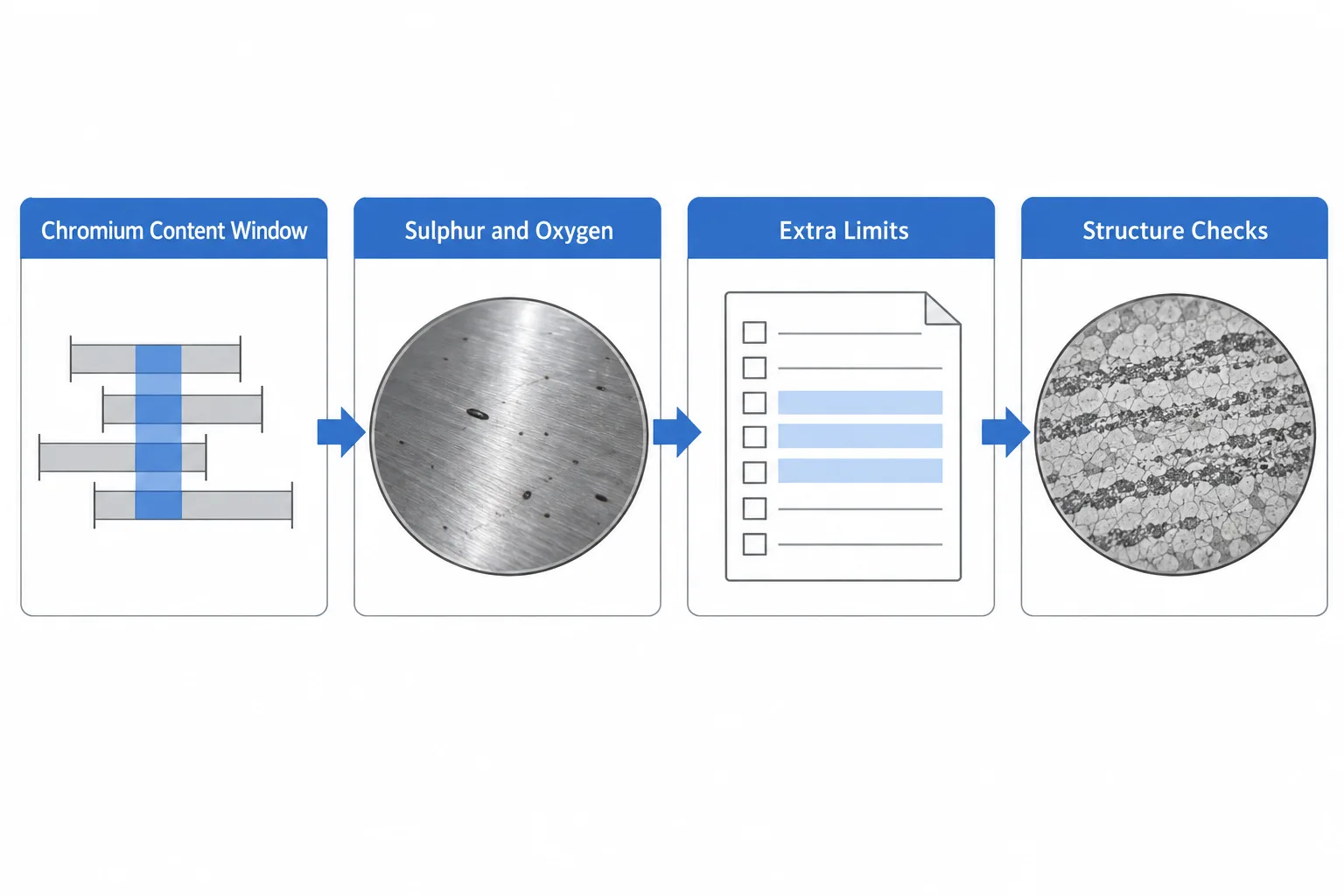
The differences are real but small, and they sit in four places.
The chromium content window. GB/T 18254 runs 1.40–1.65%, higher at both ends than ASTM A295 and ISO 683-17 at 1.35–1.60% [6]. JIS goes lowest, down to 1.30% [1].
Sulphur and oxygen. ASTM A295 and ISO 683-17 cap sulphur at 0.015%; GB allows 0.020% and JIS 0.025% [6] [1]. On oxygen it turns the other way: GB sets 12 ppm for its base grade, while ASTM A295 and ISO 683-17 set 15 ppm [6]. Oxygen matters because it measures how many oxide inclusions are left in the steel. NTN names non-metallic inclusions as the most common cause of rolling fatigue, and uses vacuum-degassed steel for that reason [1].
Extra limits in the Chinese standard. GB/T 18254-2016 adds limits for titanium, arsenic and lead that ISO 683-17 does not have [6]. It also sorts the steel into three metallurgical quality grades, a base grade, a high-grade and a special-grade fine steel, each with its own limits [2]. Many mill certificates print only the grade, not the quality grade. The oxygen value and the inclusion ratings then show where the heat sits.
Structure checks. The CNIS review notes that ISO 683-17 asks little on carbide distribution, while the Chinese standard rates banding, liquation and network in the structure [6]. The non-metallic inclusion ratings in that comparison are the same for the four standards [6].
So one heat of steel can meet the four standards at once. Take the overlap of the columns: C 0.95–1.05%, Cr 1.40–1.60%, Mn 0.25–0.45%, S at most 0.015%, Cu at most 0.25%, Mo at most 0.08% and O at most 12 ppm [6] [1]. Saarstahl’s typical analysis for its 1.3505 grade, at 1.00% C, 0.25% Si, 0.35% Mn and 1.50% Cr, falls inside every column [7]. In practice that is why mills can certify one heat to more than one standard.
GCr15SiMn, 440C stainless steel and 45 steel: when the spec sheet says something else
GCr15SiMn is in the same GB/T 18254 standard, with silicon raised to 0.45–0.75% and manganese to 0.95–1.25% [1]. The extra alloy raises hardenability for thick-section bearing rings. Saarstahl limits its 1.3505 grade to rings and discs with an effective thickness of 30 mm or less [7], and NTN uses higher-Mn grades for large or thick-walled rings [1]. Do not read GCr15SiMn as SUJ3: SUJ3 drops Cr to 0.90–1.20%, while GCr15SiMn keeps 1.40–1.65% [1]. NTN’s table lists no foreign equivalent for GCr15SiMn; the nearest composition in that table is the ISO 683-17 grade 100CrMnSi6-4, with Si 0.45–0.75% and Mn 1.00–1.20% [1].
440C is a different steel altogether: a martensitic stainless with 16–18% chromium [1]. 52100 and its equivalents have low chromium, so chrome steel bearings rust in humid or corrosive environments unless grease, oil or packing keeps water off. If the application is wet, ask for stainless; do not expect corrosion resistance from chrome steel.
45 steel is not a bearing steel. It is a medium-carbon grade close to C45 or AISI 1045, one of the plain carbon steels. We used it once on purpose. In 2008 an American customer bought 51108 thrust bearings from us for a robot arm that carried a very low load and turned only a few revolutions a day. The customer asked whether we could make them cheaper. We changed the material from GCr15 to 45 steel and cut rough grinding from six passes to three, and the price came down by about 30%. There were no returns from that order. The full case is in our 51108 dimensions article. The point here: a spec sheet should state the grade, because a cheaper one is the right choice only when the buyer knows and the duty allows it.
Heat treatment and properties of 52100 steel
Because the chemistry overlaps, you heat treat a GCr15 steel bar and a 52100 bar the same way. Saarstahl’s sheet for its 1.3505 grade gives [7]:
- Soft anneal at 780–800 °C with furnace cooling, to at most 207 HB, so the bar is easy to machine [7].
- Hardening from 830–870 °C, followed by oil quenching [7].
- Temper at 150–180 °C, giving a surface hardness of about 62 HRC [7].
The Chinese standard sets annealed hardness for bar at 179–207 HBW [6]. For the mechanical properties after hardening, NTN lists SUJ2 at 700–750 HV, a modulus of 208 GPa and a density of 7.83 g/cm³ [1]. High hardness and wear resistance come with low toughness: NTN’s table gives elongation of 0.5% or less and Charpy values of 5 to 8 J/cm² [1]. That suits rolling contact, not shock-loaded structural parts.
This is why it is the preferred material for rolling elements. As a high carbon steel it sits close to a tool steel, and the alloy offers excellent wear resistance after hardening. It is the most commonly used type of steel for steel balls, rollers and rings; NTN’s catalogue says SUJ2 is the grade it uses most often, with the higher-Mn grades reserved for large and thick-walled bearings [1]. Bearings made from clean heats also have good fatigue resistance under high load. Where it falls short, in wet service, hot running or very thick sections, other bearing materials take over.
Two limits follow. First, dimensional stability: retained austenite in standard heat-treated parts can change ring size over time, and NTN gives about 100 °C as the normal limit for general grades, with Si-modified grades for 150–200 °C [1]. Second, fatigue life depends on cleanliness more than on the name. The same ASTM steelmaking paper found that RH degassing left oxygen about 0.5 ppm lower than tank vacuum degassing [5].
Hardness acceptance for finished rings and rollers, and how to test it, is covered in our bearing steel hardness test article, so it is not repeated here.
What to check on a 52100 steel material certificate
On our spec sheets the material line reads GCr15, and on our industrial range GCr15SiMn. For OEM and industrial orders, the steel maker’s material certificate is available on request.
Our GCr15 bar comes from two Chinese special steel mills. Each mill issues a quality certificate for every heat it ships. Here are two from 2023, one from each mill:
| Mill A, Ø45 mm bar | Mill B, Ø35 mm bar | |
|---|---|---|
| Standard | GB/T 18254-2016 | GB/T 18254-2016 |
| C, % | 0.98 | 0.98 |
| Mn, % | 0.40 | 0.35 |
| Cr, % | 1.54 | 1.49 |
| S, % | 0.003 | 0.002 |
| O | 7 ppm | 6.3 ppm |
| Steelmaking route | not printed | BOF + LF + VD + CC |
Every element on both certificates is inside the four columns of the composition table above, so both heats would also meet the 52100 limits. Neither certificate prints the GB quality grade. When it is missing, read the oxygen value and the inclusion ratings instead.
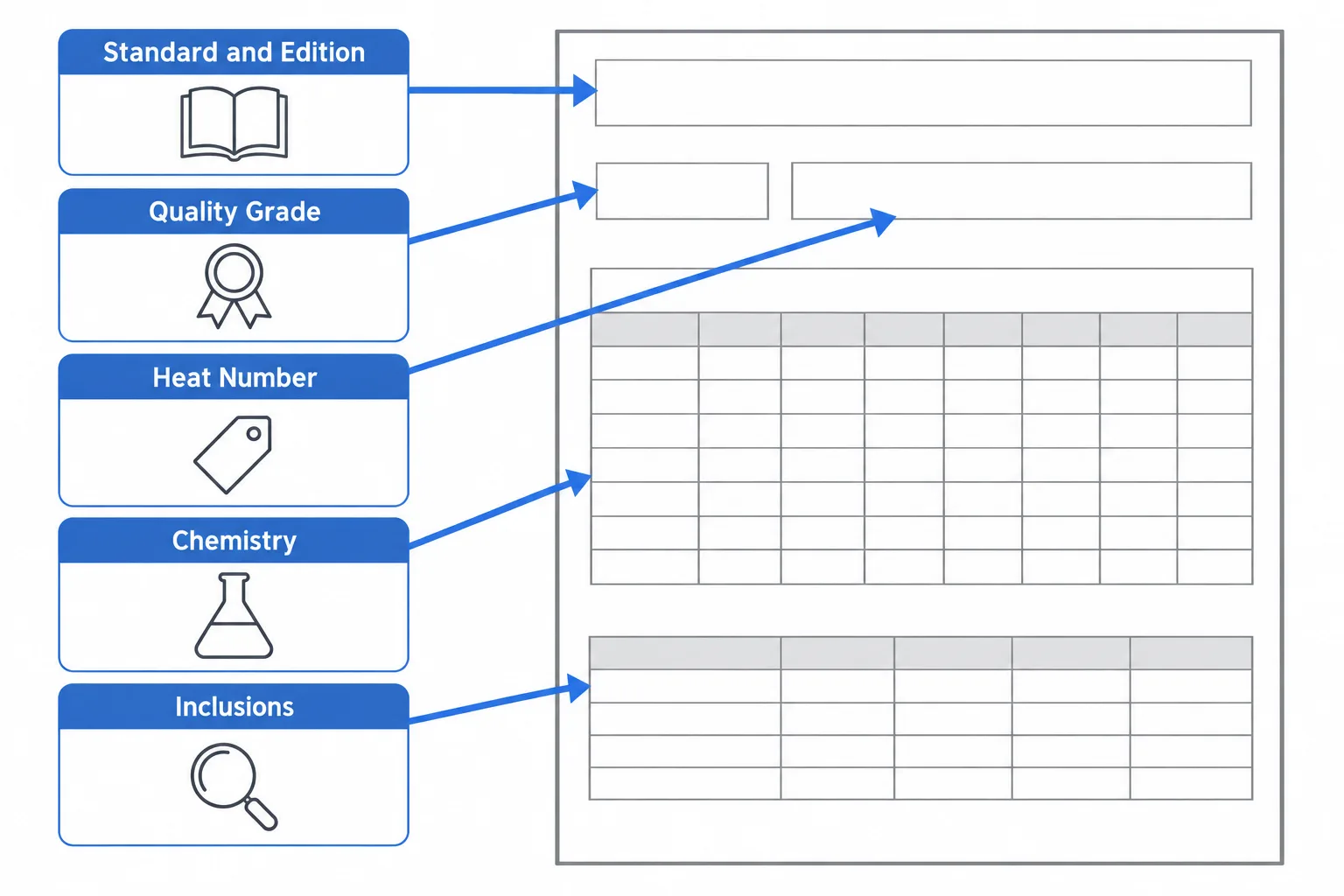
A certificate should name the steel type, the standard and the heat. When one arrives, read it in this order:
- Standard and edition. GB/T 18254-2016, ASTM A295, JIS G 4805 or ISO 683-17, the four compared above [6]. A grade name without a standard is not a specification.
- Quality grade (GB only). The base grade, high-grade fine steel or special-grade fine steel [2]. Many mills leave it off; then go by the oxygen and inclusion lines.
- Heat number. It should match the batch you are paying for and trace back to the bars or tubes used for the rings.
- Chemistry. Compare each element with the table above, especially Cr, S and O.
- Inclusion and structure ratings. Check that they are reported, not just the chemistry.
For the checks you can do yourself when goods arrive, use our bearing incoming inspection checklist.
How to write the grade on a drawing or RFQ
If your drawing says 52100 and you are buying from a Chinese factory, the difference between 52100 and the GB limits is small but real, so write the steel grade, the standard and the edition that governs. For example: “Rings and rolling elements: GCr15 to GB/T 18254-2016, equivalent to 52100 to ASTM A295. Material certificate required.” That tells the supplier which limits apply if the two standards disagree on sulphur or Cr, and it tells your incoming inspector what to compare the certificate against.
If you need certification to the American, Japanese or European standard rather than to GB, say so in the inquiry and ask the steel supplier or the factory to confirm it in the quotation. For how we handle drawings and spec sheets, see our OEM bearing supplier page and what to expect from a bearing manufacturer in China. Our deep groove ball bearing spec sheets list GCr15 as the material.
Sources
- https://www.ntnglobal.com/en/products/catalog/pdf/2203E_a13.pdf
- https://www.codeofchina.com/standard/GBT18254-2016.html
- https://store.astm.org/a0295_a0295m-14r20.html
- https://www.sis.se/en/produkter/mechanical-systems-and-components-for-general-use/bearings/rolling-bearings/iso-683-172023/
- https://store.astm.org/stp162320190060.html
- https://www.cnis.ac.cn/bydt/kydt/202212/t20221226_54421.html
- https://en.saarstahl.com/app/uploads/2024/03/20160323100507-100Cr6-.pdf
FAQ
What material is GCr15 equivalent to?
It is equivalent to AISI 52100 under ASTM A295, SUJ2 under JIS G 4805 and 100Cr6 (1.3505) in the European standard. The four overlap closely in composition. Each standard still sets its own limits for sulphur, oxygen and residual elements.
Is GCr15 the same as 52100?
For bearing use they are the same family, and NTN calls them nearly equivalent. The GB standard sets a higher Cr window and limits titanium, arsenic and lead, while ASTM A295 is tighter on sulphur. A heat inside the overlap of both can be certified to either.
Is 52100 ball bearing steel good?
It is the standard steel for ball bearings and for the rings and rollers of roller types. After hardening and low tempering it reaches raceway hardness, which gives high wear resistance and contact fatigue strength. Its weak points are wet service and high temperature, where stainless or heat-stabilized grades are used.
Is 52100 bearing steel stainless?
No. Its chromium content is far below that of a stainless steel, so it will corrode in damp air if a ring is left bare. Parts in this grade rely on grease, oil and protective packing. For wet service the usual alternative is a martensitic stainless grade.
What is GCr15SiMn?
It is the GB grade with more silicon and manganese, listed in the same standard. The extra alloy improves hardenability, so it is used for thicker rings that the plain grade would not harden through. Its nearest match in the European standard is 100CrMnSi6-4.
Is SUJ2 the same as 52100?
Nearly. JIS G 4805 allows slightly more carbon and slightly less chromium than ASTM A295, and it allows more sulphur. Most production heats fall inside both ranges.