51108 Bearing Dimensions and Matching the Spec to the Duty
51108 bearing dimensions: 40 x 60 x 13 mm (1.575 x 2.362 x 0.512 in). How it differs from 51208 and 81108, and which washer goes on the shaft.
The 51108 bearing dimensions are 40 mm bore, 60 mm outside diameter and 13 mm height, all metric sizes [1]. The 51108 is a single-direction thrust ball bearing in the ISO 104 dimension plan [1], so any maker’s 51108 fits the same space. Sellers often write the size as 40x60x13 mm, or as ID 40mm OD 60mm width 13mm, where “width” means the height. Below we cover the parts and which way round they go, then an order from 2008 in which a customer asked for a cheaper 51108 and we matched the spec to a very light duty.
51108 bearing dimensions: 40x60x13 mm and the parts of a thrust ball bearing
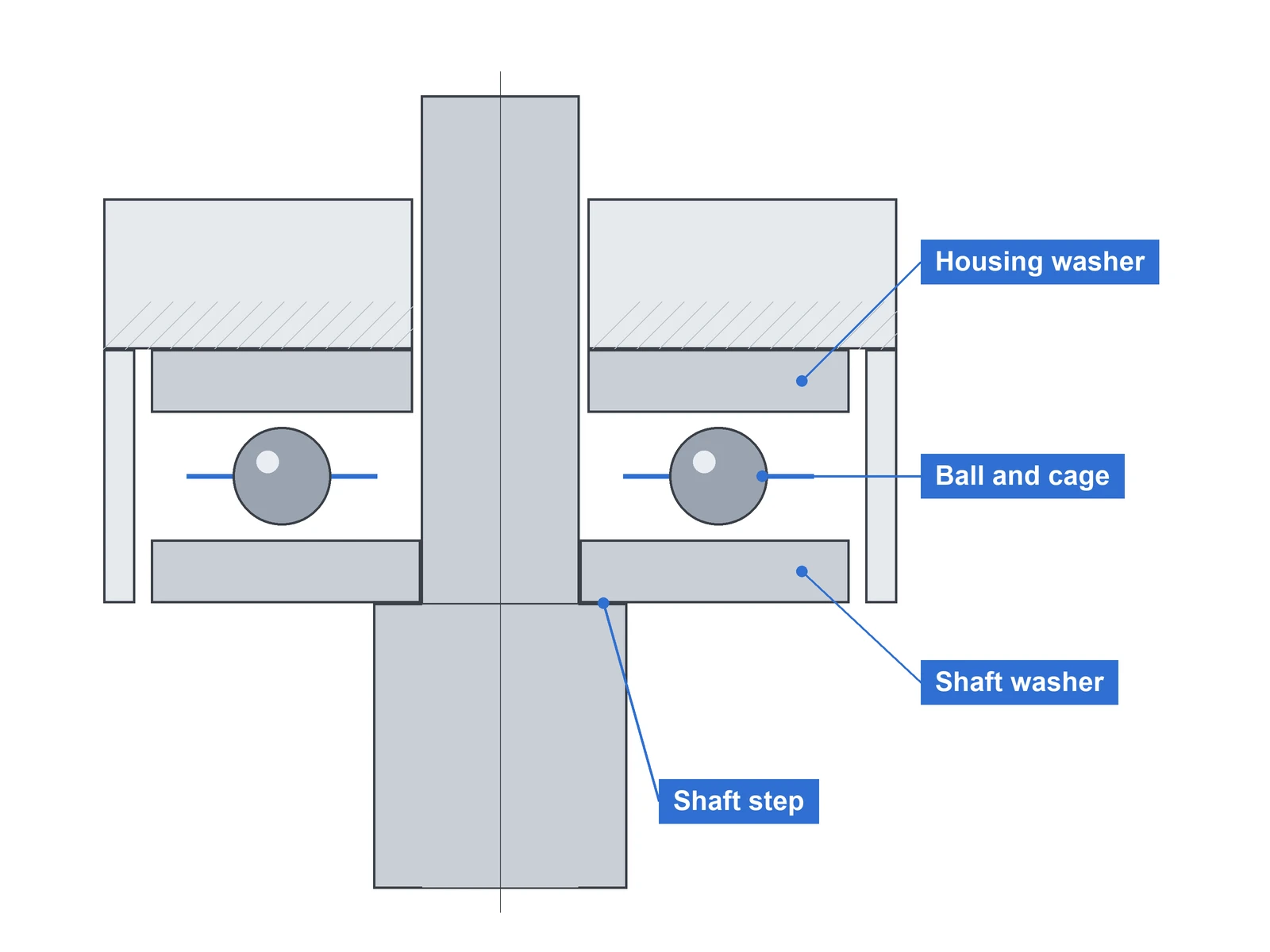
A thrust ball bearing has three components. The shaft washer sits on the shaft, the housing washer sits in the housing, and a ring of balls held by a cage runs between the two raceways. The washers do the job that the inner and outer rings do in a radial bearing [3].
The table gives the 51108 thrust bearing dimensions next to the other bearings with a 40 mm bore [1]. The “5” marks a thrust ball bearing, the next two digits give the height and diameter series, and the last two digits are the bore code: 08 times 5 gives 40 mm [1].
| Bearing | Bore d (mm) | Outside D (mm) | Height H (mm) | Mass in one published catalogue (kg) |
|---|---|---|---|---|
| 51108 | 40 | 60 | 13 | 0.12 |
| 51208 | 40 | 68 | 19 | 0.28 |
| 51308 | 40 | 78 | 26 | 0.53 |
Dimensions and masses are technical data from the SKF catalogue [1]. Load and speed ratings for our 51108 are on request.
The three share a bore but not a housing. A 51208 is 6 mm taller and 8 mm wider across than a 51108 [1], so it will not drop into a space machined for a 51108. If you only have the old bearing, measure the bore, the outside diameter and the overall height with a caliper. Those three numbers identify the size even when the marking is worn off. Other bores are in our 51100 and 51200 thrust ball bearing sizes chart.
The two washers look alike, but they are not the same. The shaft washer has a ground bore sized for the shaft, and the bore of the housing washer is turned and larger than the shaft washer bore [1]. Put the washer with the smaller bore on the shaft.
The 51108 is separable. The shaft washer, the ball and cage assembly and the housing washer come apart, and in SKF thrust ball bearings these parts are interchangeable, which makes mounting, dismounting and maintenance inspections easier [1]. It is still safer not to mix washers from two makers, because their raceway grooves are not made to one drawing. If you compare 51108 samples from several suppliers, weigh the ball and cage assemblies too, because a brass cage can look right and still be hollow.
The size alone does not make a 51108. The 81108 cylindrical roller thrust bearing has the same 40 x 60 x 13 mm envelope [1]; our thrust bearing types guide shows how to tell them apart by the type digit.
Fitting a 51108 thrust bearing: direction, washers and minimum load
A 51108 carries load along the shaft in one direction and locates the shaft in that direction only [1] [3]. Place the shaft washer against a shaft step or another fixed part on the shaft [1], so the axial load passes from the shaft into the washer and through the balls to the housing. If the load can reverse, a single direction bearing is the wrong part; the double direction design with a central shaft washer takes load both ways [3].
The bearing is designed to handle axial loads only and must not be given any radial load [1]. A thrust ball bearing with a flat housing washer, which is what a plain 51108 has, cannot tolerate misalignment [1]. So the shaft needs its own radial bearing, and the housing seat has to be square to the shaft. Our guide to ball and roller bearings by load direction covers how the two load directions are usually split between bearings.
Thrust ball bearings also need a minimum axial load so the balls roll instead of skidding. The catalogue formula is Fam = A x (n/1000)², with a factor A of 0.02 for the 51108 [1]. At 100 r/min that works out to 0.0002 kN, about 0.2 N [1]. At the slow speeds in this article, minimum load is not the problem. The problem, as the next sections show, is the load that sits on the balls while they are hardly moving.
What are thrust ball bearings used for?
A thrust ball bearing is used where the load runs along the shaft, the speed is moderate and a separate bearing takes any radial load. Typical places are rotary tables and turntables, swivels, crane hooks, screw jacks, vertical shafts that carry a weight, and some low-speed shafts in a gearbox. In these industrial setups the 51108 gives axial load support in one direction, and deep groove ball bearings or other radial ball bearings hold it in position across the axis.
It is the wrong component for high speed. At speed the balls are thrown outward, away from the line of the load, and an angular contact bearing usually does that job better. Where the load is heavy and the space is small, a roller thrust bearing such as the 81108 above is the usual choice.
Our 2008 51108 order: a spec matched to a light duty
In 2008 a customer in the United States bought 51108 thrust ball bearings from our factory. Because it was a customer in the US, we were anxious that nothing in the order should fall short, and the production team took extra care over every step.
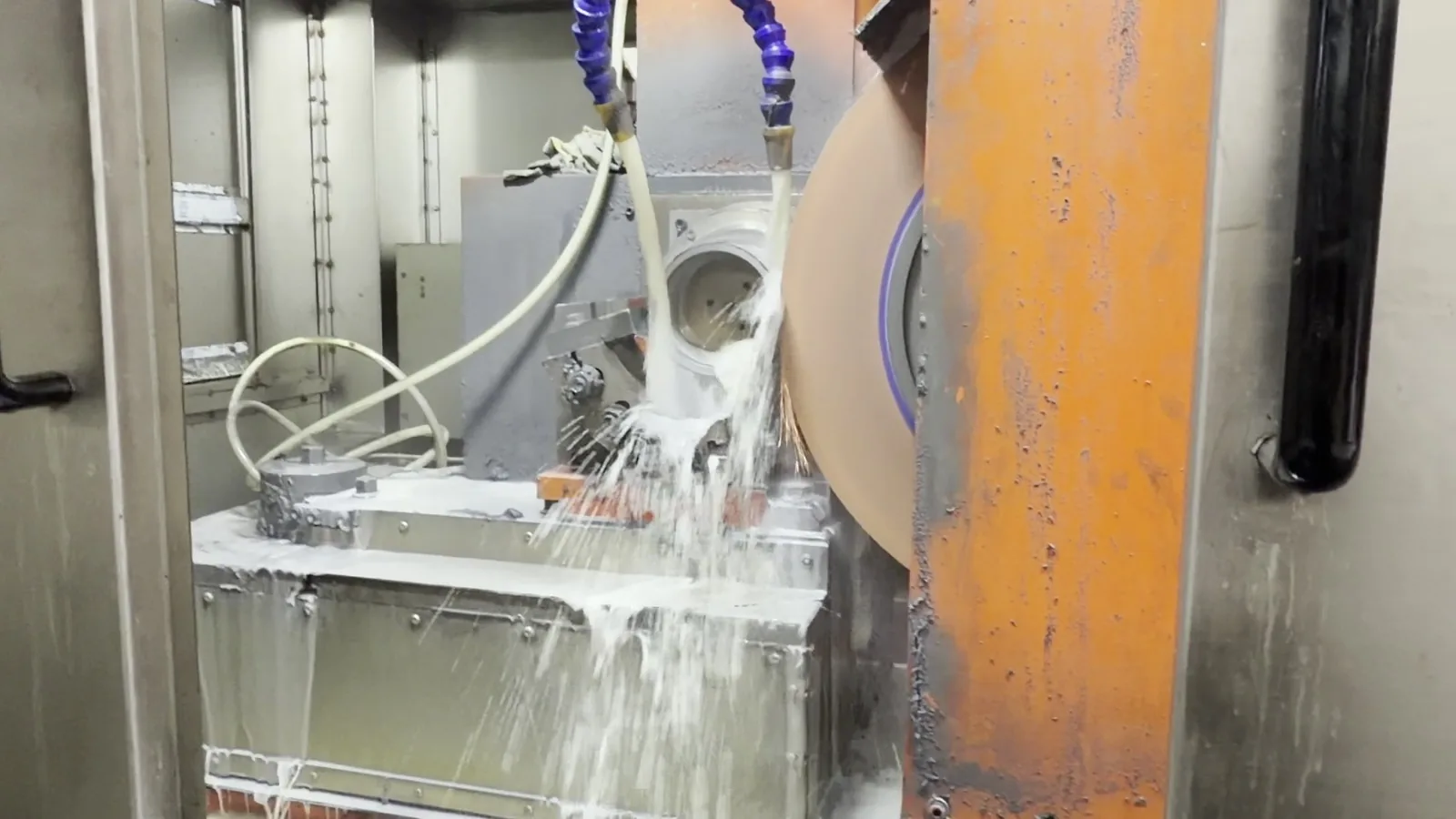
When the goods arrived, the customer kept praising the quality. In the same breath they asked whether we could offer a lower grade at a lower price. The bearings went into a robot arm. The load on them was very low, the arm used them only a few times a day, and they turned a few revolutions each time the arm moved sideways to pick up goods.
Once the customer had explained the duty, our factory changed the process for that order. We cut rough grinding from six passes to three, and we made the bearings from 45 steel, a medium-carbon steel close to C45 or AISI 1045, in place of GCr15 chrome bearing steel. The overall price came down by about 30%. After the second shipment the customer was very satisfied with both the quality and the price, and there were no returns from that order.
The change came only after the customer described how the bearing would run. Our 6205 clearance case shows the other side: there the duty was not stated before production, and the batch came back.
Metal, finish and tolerance: what a light duty can change and what it cannot
A bearing specification is a set of choices, and some of them serve duties that a robot arm turning a few times a day does not have.
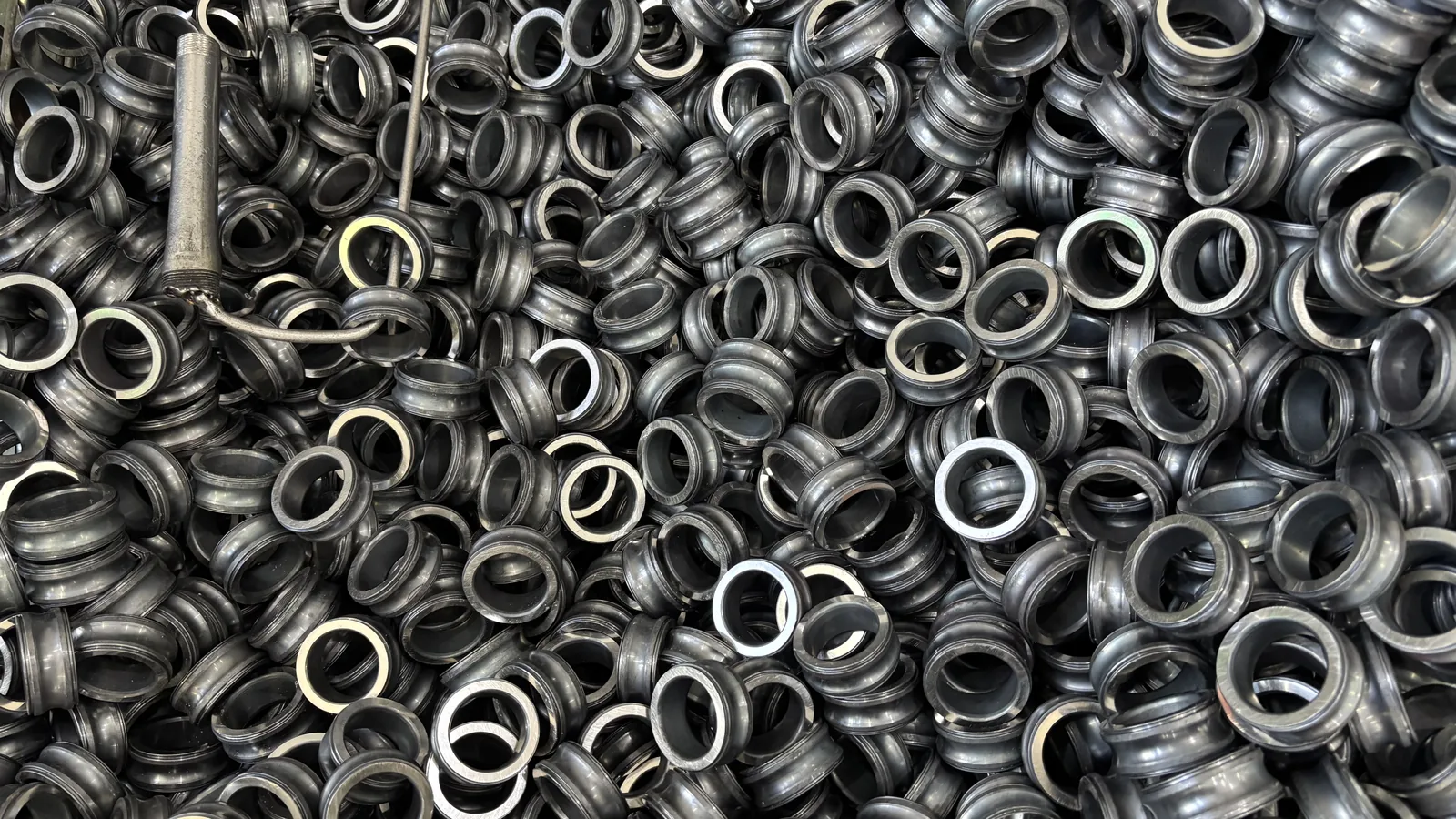
What can follow the duty:
- Finishing. Smooth raceways help lubrication and quiet running; rough raceways inhibit lubrication and can increase noise [4]. That finish matters in a motor that runs for hours at speed. In our experience, a bearing that turns a few revolutions a day at low load gives noise and heat little time to build up, so cutting rough grinding from six passes to three was acceptable for that order.
- Tolerance class. Tolerances for thrust bearings are set in ISO 199, as NSK’s tolerance guide explains [2]. The Normal class is enough for most general applications; higher precision classes are used for machine tool spindles, instruments and high speed [2]. A handling arm is not in that group.
- Steel grade. Catalogue load ratings apply to chromium bearing steel hardened to at least 58 HRC [1]. A bearing in a different steel grade does not carry those ratings. It can still be the right choice when the real load is far below them, but the customer should know the ratings no longer apply. In the 2008 order the grade was 45 steel.
What does not follow the duty:
- The dimensions. The bearing still has to fit the shaft and housing, so the boundary dimensions stay to the dimension plan [1].
- Hardness at the contact. Rings and rolling elements have to be hard enough to cope with fatigue and with plastic deformation [1]. A bearing that rotates under load at low speed, below 10 r/min, with a limited life is sized by its static load, not its fatigue life [1]. If the balls press dents into the raceway, the bearing then runs with high vibration and friction [1]. Slow and light means little fatigue, not that the steel can be soft.
- Direction and fit. A cheaper bearing mounted the wrong way round or given radial load fails the same way as a standard one.
| Duty | Spec to ask for | Not for | What you give up |
|---|---|---|---|
| Continuous running, unknown or changing load | Standard spec: GCr15 chrome bearing steel, standard finishing | – | Nothing; this is the default |
| Light load, slow, a few turns a day, duty stated in writing | Duty-matched spec, for example 45 steel and three rough grinding passes instead of six | Shock loads, continuous running, unknown load | Catalogue ratings no longer apply [1] |
| Spindles, instruments, high speed | Tighter tolerance class | General machinery, where Normal is enough [2] | Higher price; confirm with the factory first |
In our experience at FULI, the duty-matched spec only works when the customer can describe the duty in plain numbers. If the load or the running time is a guess, stay with the standard spec.
What to put in a 51108 inquiry
We supply thrust ball bearings such as the 51108 to order. If you want to buy 51108 thrust ball bearings from us, with these seven items an inquiry can usually be answered with a spec and a price in one round:
- The model and any suffix on the old bearing. A bearing marked “51108” with nothing after it is the plain design with flat washers.
- The quantity.
- The speed in r/min and how often the bearing turns: continuous, or a few times a day.
- The axial load, even a rough figure, and whether there are shocks.
- Whether any radial load or misalignment reaches the bearing.
- The environment: dust, water, temperature.
- Whether you want the standard spec, or would consider a spec matched to the duty.
Our standard rings and balls are GCr15 chrome bearing steel, and the steel maker’s material certificate is available on request for OEM and industrial orders. Before shipment each product in the batch is checked for rotation smoothness, dimensions, grease fill, rust and appearance. Export documents are the commercial invoice, packing list and CCPIT certificate of origin, plus an FTA Form COO where the destination country qualifies.
Backed by 20+ years of bearing export experience in Linqing, Shandong. FULI ships to 50+ countries & regions. You can send the list through the contact page or to sales@fuli-bearings.com, and we will reply with full product information and a price.
SKF and NSK are trademarks of their respective owners. FULI is not affiliated with, authorized by or endorsed by either company. Their published technical material is cited here as general reference only.
Sources
- https://www.skf.com/binaries/pub12/Images/0901d196802809de-Rolling-bearings---17000_1-EN_tcm_12-121486.pdf
- https://www.nsk.com/tools-resources/abc-bearings/bearing-tolerances/
- https://www.nsk.com/tools-resources/abc-bearings/thrust-bearings/
- https://www.nsk.com/content/dam/nsk/eu/en_gb/documents/P_TI-0015_EN.pdf
FAQ
What is the 51108 bearing size in inches?
About 1.575 in bore, 2.362 in outside diameter and 0.512 in height. The 51108 is a metric bearing, so order it by the 40 x 60 x 13 mm size; an inch thrust bearing of a similar size will not fit the same shaft and housing.
Is a ball thrust bearing 51108 the same part as a 51108 thrust ball bearing?
Yes. Ball thrust bearing 51108, axial ball bearing 51108 and 51108 thrust ball bearing are names for the same single direction bearing, 40 x 60 x 13 mm. Check the three dimensions and the flat washers rather than the name on the listing.
What is the weight of the 51108 bearing?
About 0.12 kg for a standard steel 51108 in a published catalogue. The steel and cage change it slightly, so ask for the weight of ours with the quote if you need it for freight.
What are the dimensions of the 51208 bearing?
40 mm bore, 68 mm outside diameter and 19 mm height. It has the same bore as the 51108 but is larger and taller, so it does not replace a 51108 in the same space.
Can a 51108 take radial load?
No. A thrust ball bearing is made for axial load only and must not be given radial load. Carry the radial load on a separate radial bearing.
Which washer goes on the shaft?
The one with the smaller, ground bore. That is the shaft washer, and it should sit against a shaft step.
Does a lower-cost spec shorten the life of the bearing?
It removes margin. Catalogue ratings assume chrome bearing steel hardened to at least 58 HRC, so a different grade has no published rating to compare against. We would only suggest it where the load is light, the speed is low and the bearing turns a few times a day, as in our 2008 order, where we used 45 steel.