Thrust Bearing Types, Sizes and How to Specify One
How a thrust bearing takes axial load, the thrust bearing types from ball and cylindrical to spherical and thrust needle, and how to select the right one.
A thrust bearing carries load that acts along the shaft, not across it. A rolling bearing with a nominal contact angle above 45° is classed as a thrust bearing [1]. That one fact explains most of what follows: the parts are washers instead of rings, the load must come from the right direction, and the speed limit is lower than for a radial bearing of the same size [1].
This guide covers the main thrust bearing types, how to read and measure a thrust ball bearing, which way round it goes, and what to put in an inquiry so the first quotation is for the right part.
How does a thrust bearing work?
A vertical shaft hangs its weight on a bearing. A screw pushes a load along its own axis. A turntable presses down on its base. In each case the force runs parallel to the shaft, and a thrust bearing is the part that lets the shaft rotate while carrying it.
Inside, balls or rollers sit between two washers. One washer turns with the shaft, the other is held in the bearing housing, and the rolling elements pass the thrust force from one to the other. Because they roll instead of slide, they reduce friction and heat compared with a flat thrust washer rubbing on a collar.
Rolling bearings are classified by load direction. Radial bearings carry forces perpendicular to the shaft. Thrust bearings, also called axial bearings, carry force along it. A radial bearing, such as a deep groove ball bearing, is built the other way round. It takes radial load first and some axial load as well. Where axial support is the main job, or the axial load is heavy, a thrust bearing does it better. Timken’s comparison of bearing types rates the thrust ball bearing excellent for pure axial load and poor for pure radial load. A cylindrical roller bearing is rated the other way round: excellent for radial load, unsuitable for axial [3]. Angular contact ball bearings and tapered roller bearings sit between the two and take combined load. Once the contact angle passes 45°, the design counts as a thrust bearing [1].
So most machines with a thrust bearing also have a radial bearing next to it, and each bearing supports the shaft in one direction. The thrust bearing locates the shaft along its axis and the radial bearing holds it centred. Our guide to ball and roller bearings by load direction shows how the two jobs are usually split.
Types of thrust bearings
There are four main families. The rolling element decides the load capacity that fits into a given space, and the washer shape decides whether the bearing tolerates misalignment.
| Type | Typical series | Load it takes | Misalignment |
|---|---|---|---|
| Thrust ball bearing, single direction | 511, 512, 513, 514 | Axial, one direction only | None with a flat housing washer |
| Thrust ball bearing, double direction | 522, 523 | Axial, both directions | None with flat housing washers |
| Thrust ball bearing with sphered housing washer | Same series, used with a U 2, U 3 or U 4 seat washer | Axial | Initial misalignment only |
| Cylindrical roller thrust bearing | 811, 812 single row; 893, 894 double row | Heavy axial and shock load, one direction | None |
| Needle roller thrust bearing | AXK, AXW | Axial, one direction | None |
| Spherical roller thrust bearing | 292, 293, 294 | Axial, one direction, plus radial load | Self-aligning |
Series and features from the SKF catalogue [1].
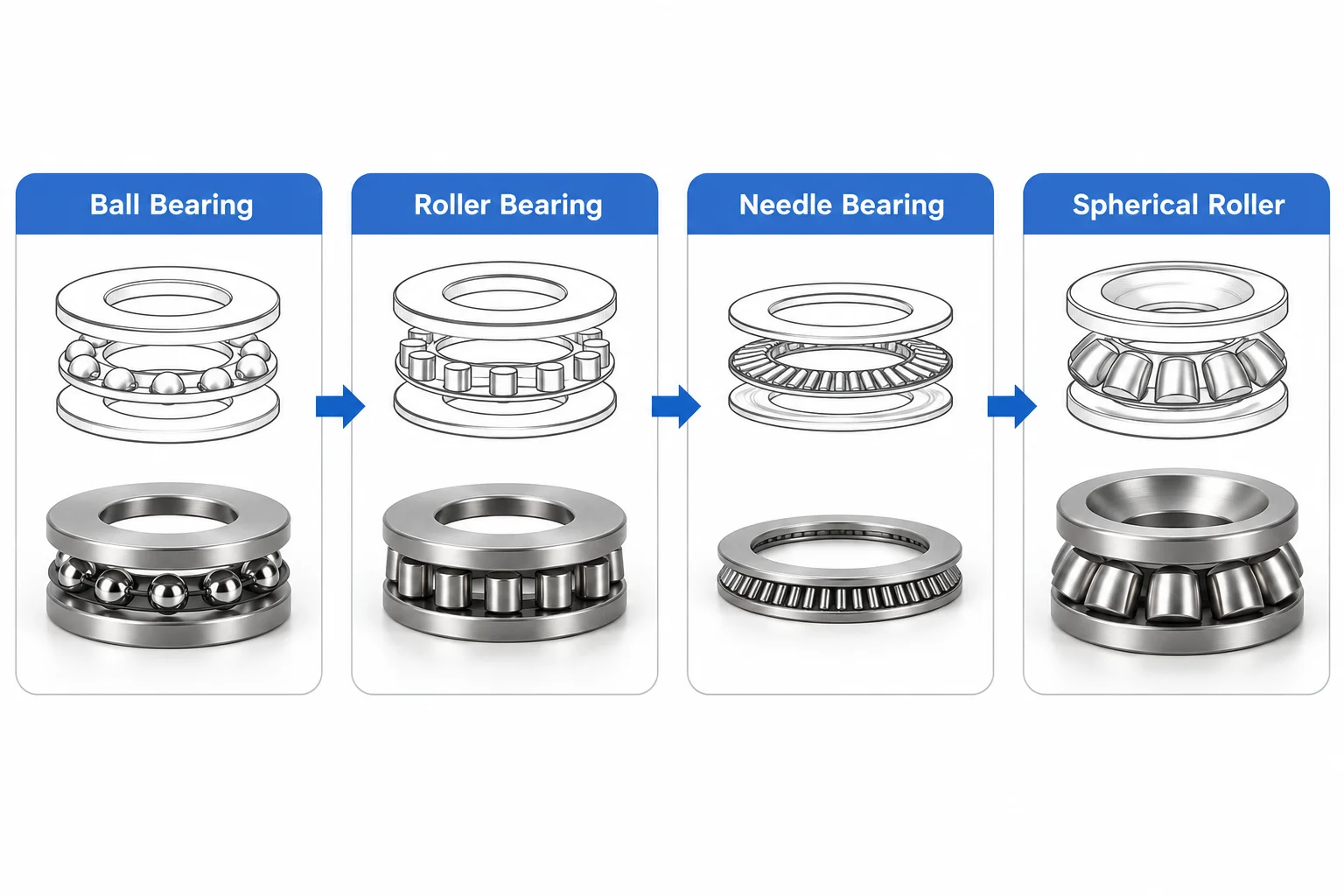
Thrust bearings show up in rotating assemblies wherever a shaft pushes rather than spins sideways: automotive transmissions and steering columns, screw and piston compressors, and industrial applications such as gearboxes, pumps and presses. A few specialty families, including taper roller thrust bearings, exist for the heaviest one-direction loads, but the type of bearing used in most inquiries is one of the four families above, chosen by how much axial force the job puts through it and how fast the shaft turns.
Thrust ball bearings
A single direction thrust ball bearing (often called a ball thrust bearing) has three parts: a shaft washer, a housing washer, and a ball and cage assembly between them [1]. The washers do the work of the inner and outer rings of a radial bearing [2]. The balls roll instead of sliding, which keeps friction low compared with a plain thrust washer. It carries axial load and locates the shaft in one direction only [1].
A double direction thrust ball bearing has one shaft washer in the middle, two housing washers and two ball and cage assemblies, so it locates the shaft both ways [1] [2]. Use it where the axial thrust can reverse.
Both designs carry axial load only and must not take radial load [1]. A bearing with a flat housing washer cannot tolerate any misalignment. One with a sphered housing washer, sitting in a matching seat washer, accommodates initial misalignment from mounting, not misalignment that changes while the machine runs [1]. NSK describes the aligning seat as a way to reduce the effect of mounting errors [2].
Cages are stamped steel in small sizes and machined brass or steel in larger ones [1] [2].
Cylindrical roller thrust bearings
Rollers in place of balls give line contact and much more axial capacity in the same space. Cylindrical roller thrust bearings are the bearing for heavy axial and shock loads; they are very stiff, need little axial space, and SKF positions them for cases where thrust ball bearings do not have enough capacity [1]. They take no radial load [1]. This is the usual choice for heavy duty, slow-turning thrust loads such as extruder gearboxes and large screw drives.
The envelope can be identical to a ball type. The SKF catalogue lists the 81108 TN cylindrical roller thrust bearing at 40 x 60 x 13 mm, the same bore, outside diameter and height as the 51108 thrust ball bearing [1]. Same space, different bearing: check the type digit, not only the size.
Thrust needle roller bearings
A needle roller and cage thrust assembly is the thinnest option. The SKF AXK 4060 for a 40 mm shaft is 3 mm thick [1]. Where the shaft shoulder and housing face are hardened and ground, they can serve as the raceways directly. Otherwise the assembly runs between separate thin washers [1], either thin AS washers or thicker LS washers [1].
Thrust needle bearings suit places where axial space is tight and the load is moderate: automotive transmissions, planetary gear sets and compressors. They need a hard, flat counterface. A soft or wavy shoulder wears quickly under the needles.
Spherical roller thrust bearings
This is the one thrust type built for combined load. Its barrel-shaped rollers and spherical raceways let the bearing align itself [1] [2]. It carries axial load in one direction together with a radial load of up to 55% of the axial load; above that, SKF says to add a radial bearing [1]. NSK recommends oil lubrication for these bearings even at low speed [2].
Plain thrust bearings without rolling elements
A plain bearing for axial load can be a bronze thrust washer, or, in large turbines, hydro generators and ship propeller shafts, a fluid film design: a collar on the shaft rides on an oil film over tilting bearing pads (the Kingsbury type). Its radial partner is the journal bearing. Car and truck engines run the crankshaft on plain bearing shells too, with end float held by a flanged main bearing shell or a pair of washers at one main journal. A clutch release bearing is a different case: a rolling thrust bearing built into a sleeve with its own seal and grease, so a plain 51108 is not a drop-in replacement for one. This article covers the rolling thrust bearing used in gearboxes, pumps and other general machinery.
Reading a thrust ball bearing number
The thrust ball bearing designation follows the same pattern as other metric bearings. The first digit 5 is the type. The next two digits give the height series and the diameter series. The last two digits are the bore code, and multiplied by 5 they give the bore in mm [1].
The table shows how much the space changes for one 40 mm bore, with dimensions taken from the SKF product tables [1].
| Bearing | Type | Bore d (mm) | Outside D (mm) | Height H (mm) |
|---|---|---|---|---|
| 51108 | Single direction, light | 40 | 60 | 13 |
| 51208 | Single direction | 40 | 68 | 19 |
| 51308 | Single direction, heavier | 40 | 78 | 26 |
| 52208 | Double direction | 30 | 68 | 36 |
Two traps sit in this table. First, a 51208 is 6 mm taller and 8 mm larger across than a 51108, so it will not drop into a 51108 seat even though the bore is the same [1]. Second, the 52208 does not have a 40 mm bore [1]. In a double direction bearing the bore code belongs to the series, and the central shaft washer of a 52208 is 30 mm [1]. If you order a double direction bearing by working out the bore from the last two digits, you will get the wrong shaft size.
Thrust ball bearing boundary dimensions follow ISO 104, and the sphered-washer versions follow ISO 20516 [1]. That is what makes the sizes interchangeable from one bearing manufacturer to another. SKF supplies them to Normal tolerances, with P6 or P5 on request for single direction bearings only [1].
Which washer goes on the shaft
The two washers of a single direction thrust ball bearing look almost the same. They are not. The shaft washer has a ground bore sized for an interference fit on the shaft. The housing washer has a turned bore that is larger than the shaft washer bore [1].
Put the washer with the smaller bore on the shaft, against a shaft step or another fixed part on the shaft [1]. The axial load then runs from the shaft into the shaft washer, through the balls, and into the housing washer and the housing. If the washers are swapped, the washer that should turn with the shaft is the one with the loose bore.
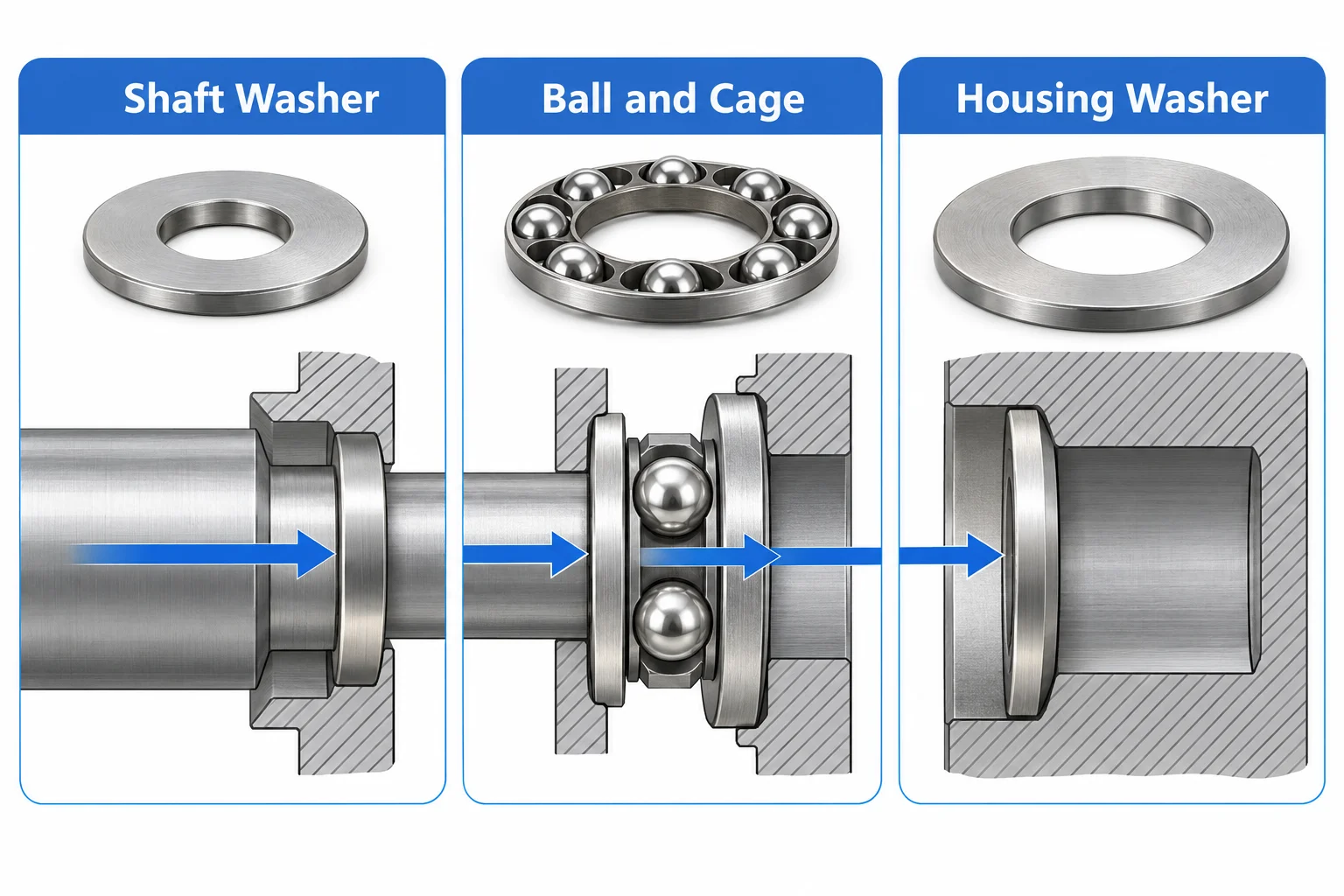
The housing seat must be square to the shaft. A flat housing washer cannot absorb any tilt [1], so a seat machined out of square loads the balls on one side of the track only.
How to select the right thrust bearing
Start from the load, then check speed and space.
| If the job has | Look at |
|---|---|
| Light or moderate axial load, higher speed | Thrust ball bearing |
| High axial or shock load, low speed | Cylindrical roller thrust bearing |
| Moderate load, very little axial space | Thrust needle roller bearing |
| Heavy axial load plus radial load or shaft deflection | Spherical roller thrust bearing |
| Combined load at high speed | Angular contact ball bearing pair |
Thrust ball vs thrust roller bearings
The difference comes down to contact. Steel balls touch the raceway at a point, so they run cooler and faster. Rollers touch along a line, which gives high load capacity in the same envelope but more friction and a lower speed limit. A suitable thrust bearing also has to fit the space: check the bearing dimensions against the seat before you change type.
Minimum load and speed
Thrust ball bearings need a minimum thrust load so the balls roll instead of skidding. The catalogue formula is Fam = A x (n/1000)², where A is a factor for each bearing and n is the speed in r/min [1]. For the 51108 the factor is 0.02 [1]. At 3,000 r/min that gives 0.02 x 9 = 0.18 kN, about 180 N, using the factor from the product table [1].
Where the working load can drop below that value, for example when one thrust bearing of a pair becomes unloaded, SKF’s combined needle roller and thrust ball bearing arrangements are preloaded with Belleville washers; the preload helps to keep the balls from skidding and also reduces noise [1]. In our experience the same idea applies to a plain pair of thrust ball bearings on a shaft that can run lightly loaded.
Speed is the other limit. Thrust bearings handle speed less well than radial types and cannot run at the high speeds a radial bearing of the same size manages [1], so a fast shaft with moderate axial load is a bearing design question to settle before the order.
A thrust bearing order matched to a light duty
In 2008 a customer in the United States bought 51108 thrust ball bearings from our factory. The bearings went into a robot arm that carried very little load and turned a few revolutions a few times a day. Once the customer explained that duty, our factory changed the process for that order: rough grinding went from six passes to three, and the rings were made from 45 steel in place of GCr15 chrome bearing steel. The price came down by about 30%, and there were no returns from that order.
The full story is in our article on 51108 bearing dimensions. The spec could be changed only because the customer described how the bearing would run.
What causes thrust bearing failure
Most thrust bearings fail for one of a few reasons, and most of them show on the raceways.
- Too little load. Below the minimum load the balls skid. The tracks show smeared, frosted bands.
- Washers swapped. The shaft washer spins on the shaft or the housing washer rubs it. Look for wear in the bores.
- Seat out of square. The track is worn on one side only.
- Radial load on a pure thrust type. The balls ride up the edge of the groove.
- Lubricant failure or dirt. The grease is dark and dry, or there are dents from particles. Fill part of the free space with grease, not the whole space, or the grease churns and the bearing runs hot; spherical roller thrust bearings usually run on oil instead [2].
- Heavy load or shock. Dents at ball spacing on the raceway (brinelling).
A thrust bearing that has gone is usually noisy or rough when turned by hand, runs hot, or lets the shaft move further along its axis than before. Measure the end float and compare it with the drawing.
How to identify an unmarked thrust bearing
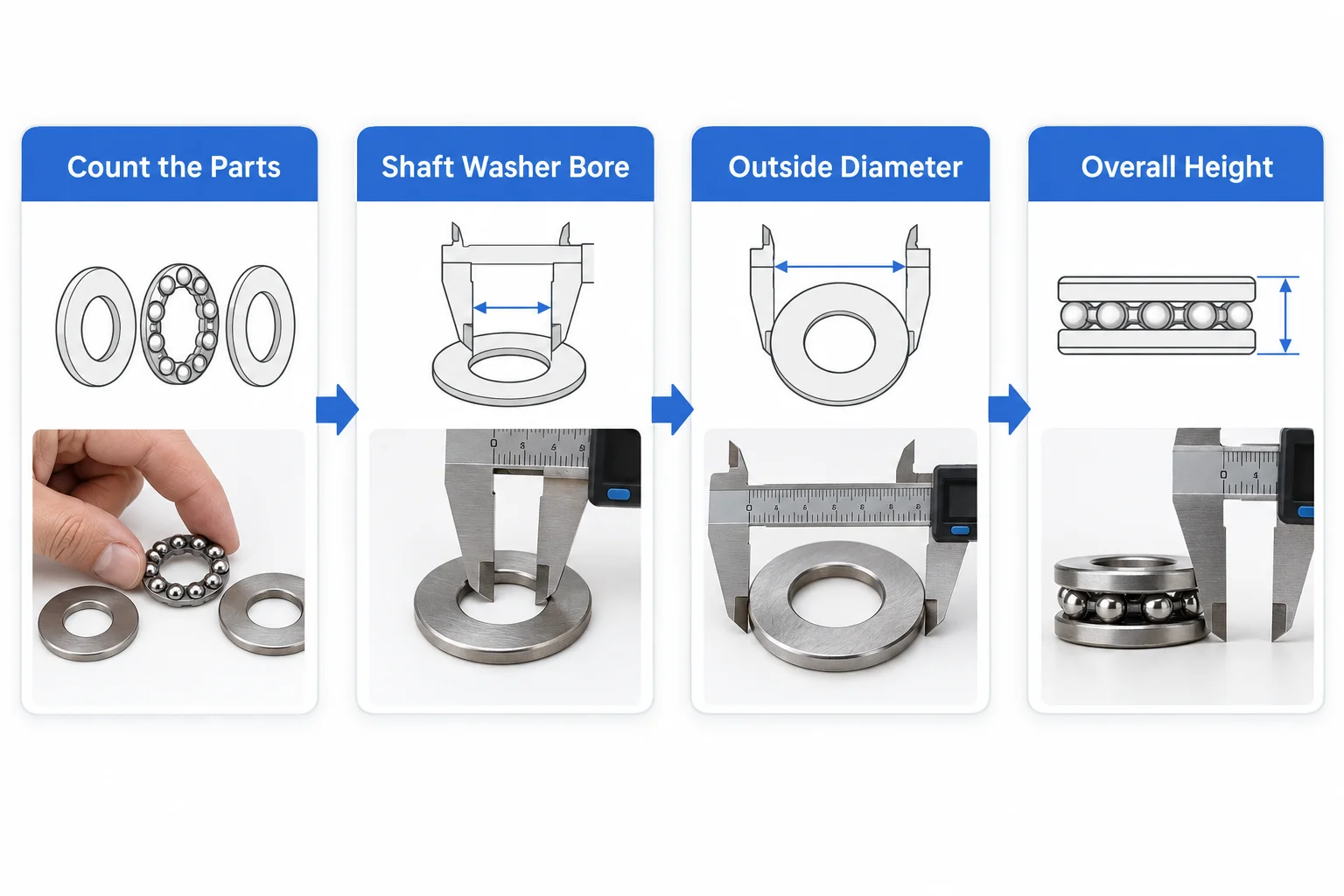
When the old bearing has no readable number, five checks are usually enough.
- Count the parts. Three parts (two washers and one ball set) is single direction. Five parts (three washers and two ball sets) is double direction.
- Measure the bore (inner diameter) of the shaft washer, the smaller of the two bores.
- Measure the outer diameter of the housing washer.
- Stack the parts and measure the overall height H.
- Look at the back face of the housing washer. Flat, or sphered to sit in a seat washer? If there is a seat washer, measure it as well.
Note the rolling element too: balls, short cylindrical rollers, needles, or angled barrel-shaped rollers. With these facts, the size can be found in the ISO 104 boundary dimension tables [1], and a measured 40 x 60 x 13 mm single direction ball bearing is a 51108 from any maker [1].
What to send with a thrust bearing inquiry
We supply thrust ball bearings such as the 51108 to order. Standard 51100 and 51200 sizes are on our thrust bearing size chart. For cylindrical, needle or spherical roller thrust bearings, send the number or the measurements and we will tell you whether we can supply it.
An inquiry with these items can usually be answered in one round:
- The full number from the old bearing, with any suffix, or the five measurements above.
- Single or double direction, flat or sphered housing washer.
- The quantity.
- The axial load, even a rough figure, and whether it can reverse or comes with shocks.
- Whether any radial load or misalignment reaches the bearing.
- The speed in r/min and how many hours a day it runs.
- Oil or grease, and the running temperature.
Inquiries often leave out the prefix and suffix letters, and those letters tell the factory which cage, tolerance and material the old bearing had. Copy everything on the washer face. Our page on how to request a bearing quotation has a template you can paste into an email.
Our rings and balls are GCr15 chrome bearing steel as standard, and the steel maker’s material certificate is available on request for OEM and industrial orders. Before shipment each batch is checked for rotation smoothness, dimensions, grease fill, rust and appearance. Backed by 20+ years of bearing export experience in Linqing, Shandong. Send the list through the contact page or to sales@fuli-bearings.com.
SKF, NSK and Timken are trademarks of their respective owners. FULI is not affiliated with, authorized by or endorsed by any of them. Their published technical material is cited here as general reference only.
Sources
FAQ
What is a thrust bearing used for?
A thrust bearing carries load that acts along the shaft axis, for example the weight hanging on a vertical shaft or the push from a screw. Radial load, acting across the shaft, is carried by a separate radial bearing unless the thrust bearing is a type designed for both.
Can a thrust ball bearing take radial load?
No. A thrust ball bearing is designed for axial load only and must not be given any radial load. If radial load reaches the position, add a radial bearing or use a spherical roller thrust bearing, which takes some radial load together with the axial load.
Which washer of a thrust bearing goes on the shaft?
The washer with the smaller, ground bore. That is the shaft washer and it should sit against a shaft step or another fixed part on the shaft. The housing washer has a turned bore, the larger of the two.
How do I identify a thrust bearing with no readable number?
Measure the bore of the shaft washer, the outside diameter and the overall height with the parts stacked. Count the parts: three means single direction, five means double direction. Check whether the housing washer face is flat or sphered. Those facts are enough to find the size in any maker's standard size table.
What is a thrust ball bearing?
A thrust ball bearing is a thrust bearing with steel balls held in a cage between two grooved washers. It carries axial load in one direction, or both directions in the double direction design, and no radial load. The 511 and 512 series are the common sizes.
Do you supply thrust bearings?
We supply thrust ball bearings such as the 51108 to order. For other thrust types, send the number or the measurements and we will tell you whether we can supply it.