Bearing HS Code: 8482 for Ball, Tapered and Spherical Bearings, 8483 for Pillow Blocks
Six-digit HS codes for ball and roller bearings, pillow blocks, housings and parts, and what to check with a broker before you import.
The bearing HS code for rolling bearings is heading 84.82 of the Harmonized System, and pillow blocks and other housings go to heading 84.83 [1]. The six digits under those headings are the same in every country on the current HS edition [4]. Everything after the sixth digit, and the duty rate, comes from your national schedule and your broker, not from the supplier.
This guide lists the six-digit codes for each bearing type, shows how the code is built, and covers the lines buyers most often get wrong: mounted units split into parts, loose rings and balls, and wheel hub units.
Bearing HS code chart: the six-digit subheadings
| Code | Official text (HS 2022) | What it covers in practice |
|---|---|---|
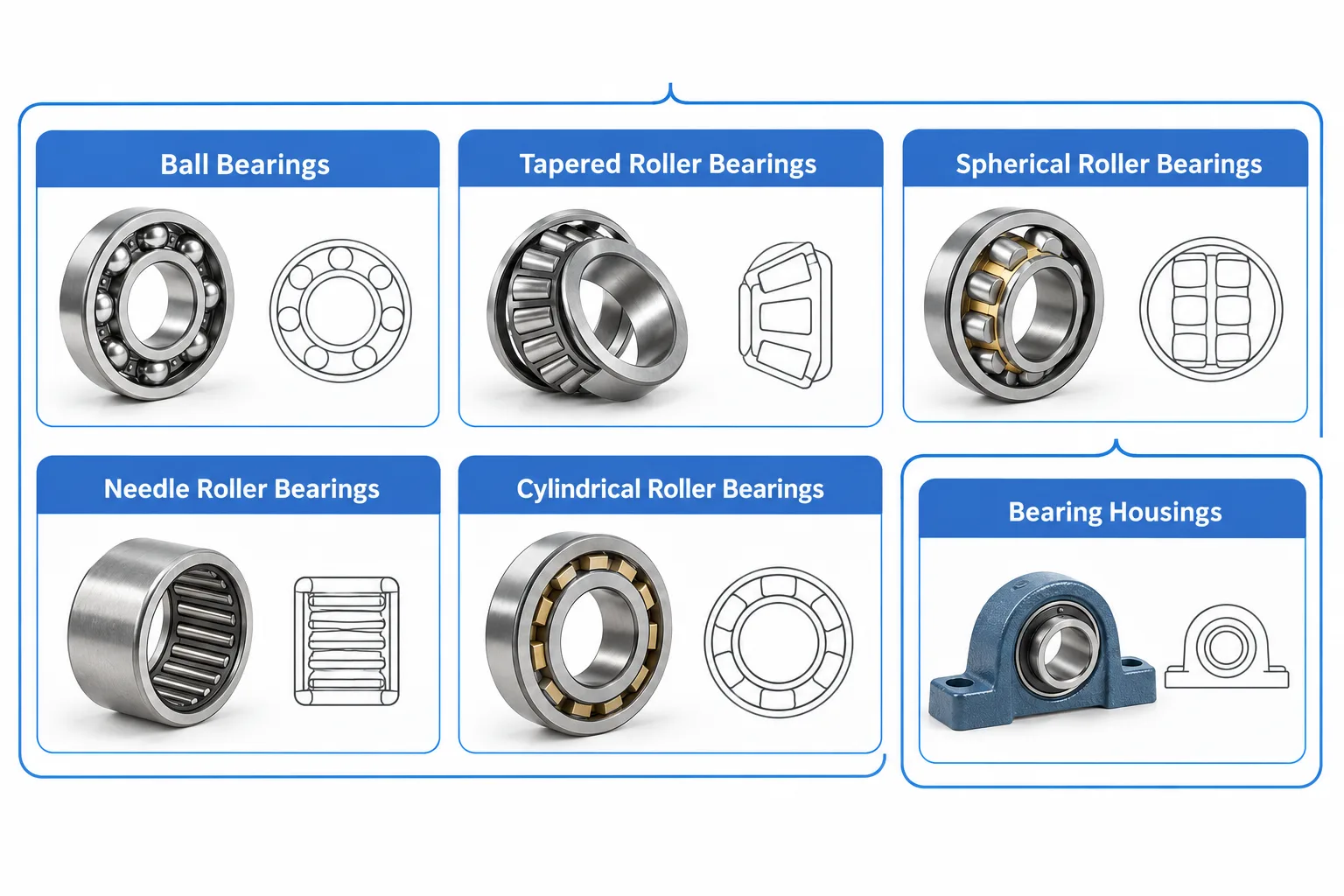
| 8482.10 | Ball bearings | Deep groove, angular contact, self-aligning ball, thrust ball and insert (UC, SB, SA) bearings |
| 8482.20 | Tapered roller bearings, including cone and tapered roller assemblies | Complete tapered bearings and cone assemblies, metric and inch |
| 8482.30 | Spherical roller bearings | 222 and 223 series, cylindrical or tapered bore |
| 8482.40 | Needle roller bearings, including cage and needle roller assemblies | Drawn cup needle bearings, needle cages |
| 8482.50 | Other cylindrical roller bearings, including cage and roller assemblies | NU, NJ, NUP and N types |
| 8482.80 | Other, including combined ball/roller bearings | Designs not covered above |
| 8482.91 | Balls, needles and rollers | Loose rolling elements |
| 8482.99 | Other (parts) | Rings, cages and cups sold on their own |
| 8483.20 | Bearing housings, incorporating ball or roller bearings | UCP, UCF, UCFL and UCT units with the insert fitted |
| 8483.30 | Bearing housings, not incorporating ball or roller bearings; plain shaft bearings | Empty housings, bushings, sleeve bearings |
Texts from the WCO HS 2022 nomenclature [1].
The heading text behind HS code 8482 is only four words: “Ball or roller bearings” [1]. Every other split is by the type of rolling element and its shape. Heading 84.83 is broader. It covers transmission shafts, housings and plain bearings, gears, gear boxes, pulleys and couplings [1], and only two of its codes concern bearing buyers.
How an HS code for bearings is built
The HS sorts goods into more than 5,000 groups, and every group has a six-digit code. More than 200 countries and economies use it, and over 98 % of merchandise in international trade is classified in its terms [4]. Read a bearing code from left to right:
- 84 is the chapter: machinery and mechanical appliances.
- 84.82 is the heading: rolling bearings.
- 8482.10 is the six-digit code: ball bearings.
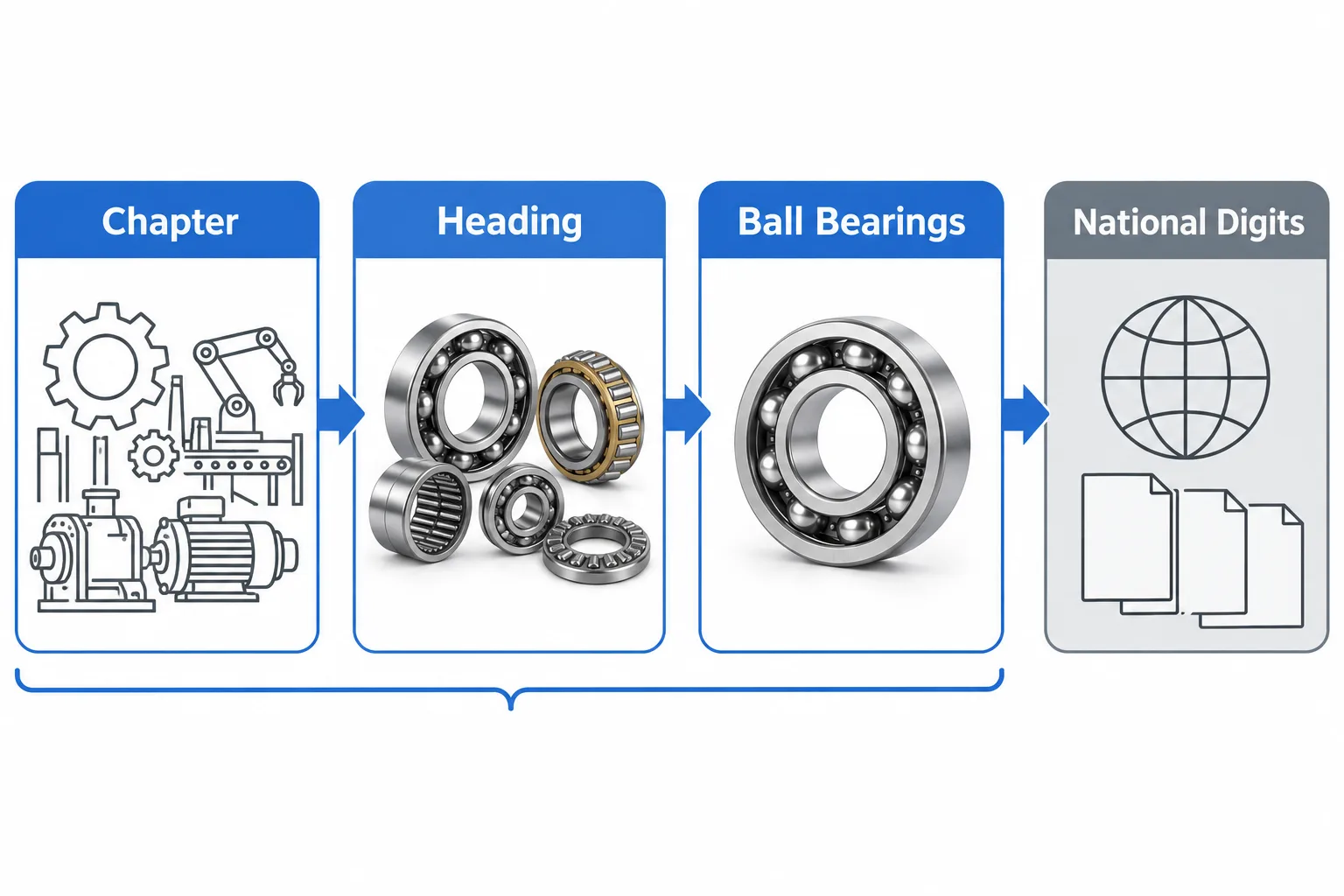
Everything after that is national. The Harmonized Tariff Schedule of the United States adds its own lines and statistical suffixes under each six-digit code. Under 8482.10, for example, it lists bearings with integral shafts on a separate line from the rest [5]. The EU, India and China each add their own extension code in the same way. The national digits decide what you pay and how the import shows up in trade data, so two importers in different countries can declare the same 6205 under the same six digits and different full codes.
If the HTS code your US broker puts on the import entry and the code on a Chinese export declaration do not match after the sixth digit, that is normal. If the first six digits differ, stop and find out why before the goods ship.
On our own Chinese export declarations, deep groove ball bearings go out under 8482102000, tapered roller bearings under 8482200000 and mounted units under 8483200000. Apart from mounted units, almost everything we ship starts with 8482. We have very rarely got a code wrong, because a wrong code on the declaration is the mismatch your broker will find first.
Which code each bearing type goes under
Ball bearings are the simplest case. A deep groove ball bearing such as the 6205, an angular contact 7205, a self-aligning 1205, a 51108 thrust ball bearing and a UC205 insert bearing are all 8482.10 [1]. Seals, shields, snap ring grooves and clearance class do not change the six-digit code.
Tapered roller bearings go to 8482.20, and the text includes “cone and tapered roller assemblies” [1]. So a cone, meaning the inner ring with its rollers and cage, keeps the 8482.20 code even when it ships without the cup. A cup on its own is an outer ring with no rollers. It is a part, and most national schedules put it under 8482.99. Invoice cones and cups on separate lines when they are not sold as matched sets.
Spherical roller bearings are 8482.30, whether the bore is cylindrical or tapered. If an adapter sleeve is invoiced as a separate item, give it its own line and get its code from your broker.
Needle and cylindrical types are split by roller shape. Subheading Note 4 to Chapter 84 says 8482.40 applies only to bearings with cylindrical rollers of a uniform diameter not exceeding 5 mm and a length at least three times the diameter [1]. A roller outside that limit is not a needle for the purposes of classification, and the bearing goes to 8482.50.
Pillow blocks and housings: 8483.20 or 8483.30
A mounted unit can be bought three ways, and each has its own code:
| What you import | Code | Why |
|---|---|---|
| Complete unit, for example UCP205 | 8483.20 | Housing with a ball bearing fitted |
| Insert alone, for example UC205 | 8482.10 | It is a ball bearing |
| Housing alone, for example P205 | 8483.30 | Housing with no bearing in it |
Texts from the WCO HS 2022 nomenclature [1].
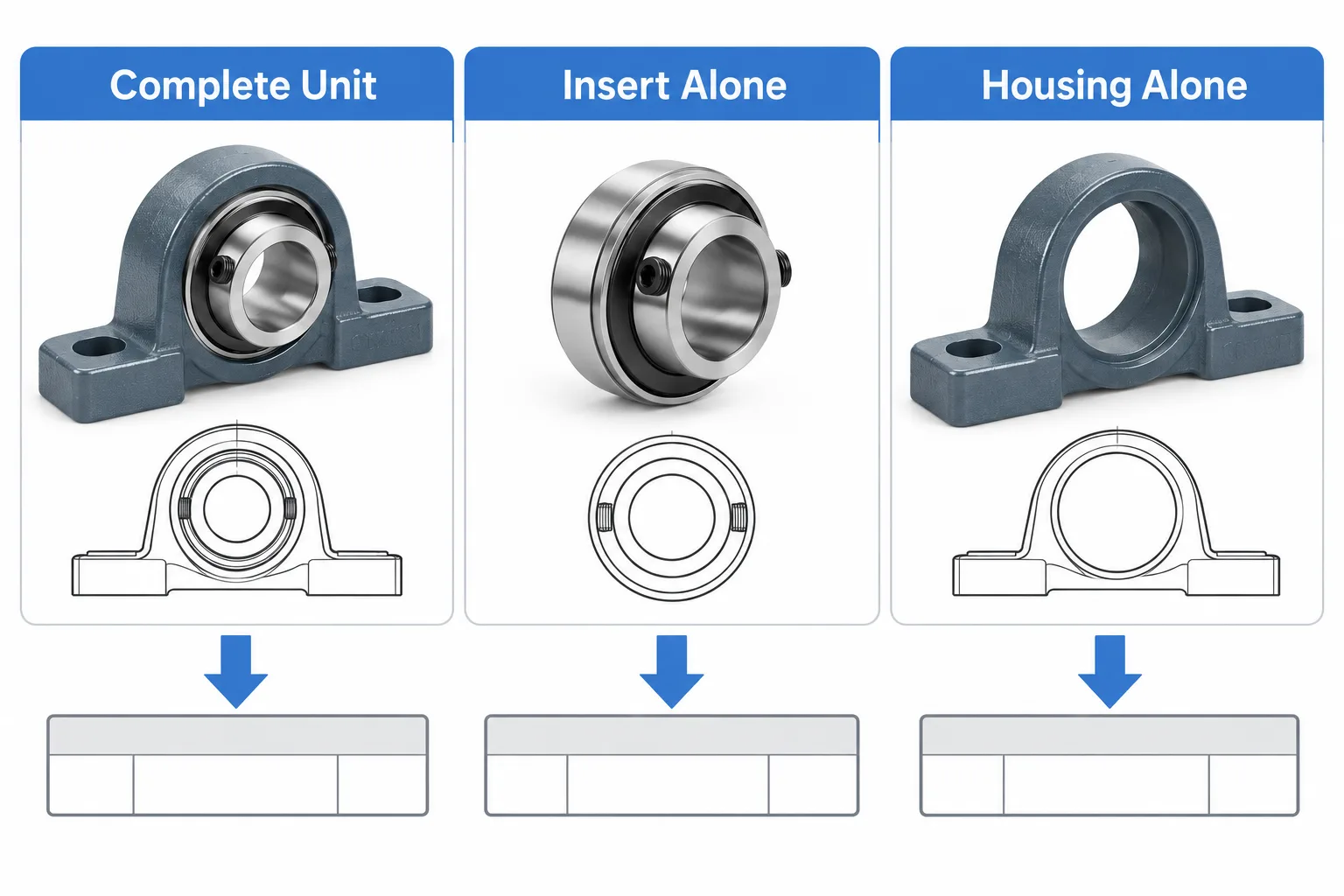
The same three-way split applies to every housed bearing [1]: pillow block units, flange units and take-up units. When a buyer orders 500 complete UCP205 units plus 100 spare inserts and 50 spare housings, that is three invoice lines and three codes. Our bearing housing page covers housing-only orders.
The 8483.30 code also covers plain bearings: bushes and sleeve bearings of bronze, sintered metal or polymer, with no rolling elements. A bush has no rolling elements, so it has no place in heading 84.82 [1].
Parts and bearings inside machines: the lines that get reclassified
Rings, balls, rollers and cages
Parts of rolling bearings stay in heading 84.82 and split into two codes [1]:
- 8482.91: balls, needles and rollers.
- 8482.99: everything else, which in practice means inner and outer rings, cups and cages.
Bearing balls have a precision test. Note 7 to the chapter places polished steel balls in heading 8482 only if their maximum and minimum diameters do not differ from the nominal diameter by more than 1 % or by more than 0.05 mm, whichever is less [1]. Other balls of steel go to heading 73.26 [1]. A buyer of grinding media or rough balls should not expect them to share a code with bearing balls.
Bearings for cars, pumps and other machines
A 6205 bought for a pump motor is still 8482.10, not a pump part. Note 2(a) to Section XVI says that parts which are goods included in any of the headings of Chapter 84 or 85 are in all cases to be classified in their respective headings [2]. A part that has a heading of its own is classified in that heading, and rolling bearings have one. The rule that sends parts “suitable for use solely or principally” with one kind of machine to that machine’s heading applies only to parts with no heading of their own [2]. The same holds for bearings in construction machines, fans or gearboxes.
Cars work the same way. Note 2(e) to Section XVII excludes articles of heading 84.82 from the vehicle parts headings, and also articles of 84.83 when they are integral parts of engines or motors [3]. A wheel bearing that is a bearing is classified as a bearing.
The grey area is the wheel hub unit. In ruling H127797, US Customs and Border Protection kept second and third generation hub units for non-driving wheels, made by NSK, in 8482.10. The importer had asked for heading 87.08, the motor vehicle parts heading [6]. The same ruling quotes a separate US line, 8708.99.58, worded “Double flanged wheel hub units incorporating ball bearings” [6]. So two hub units that look alike can fall under different headings, depending on the flanges, the hub and how much of the unit is the bearing. Our guide to choosing wheel hub bearings explains the three generations. Ask your broker to classify a hub unit from its drawing, not from its name.
Import duty and the digits after the sixth
We do not list tariff rates here, and neither should a supplier’s quotation. The rate depends on:
- the importing country’s schedule and the full national code;
- the country of origin;
- any trade agreement between the two countries;
- any extra duty your country applies to bearings from a particular origin.
Shipments from FULI come with a commercial invoice, packing list and CCPIT certificate of origin, plus an FTA Form COO where the destination country qualifies. A preferential rate under a trade agreement only applies if the code and the origin document agree with the invoice.
To see what the duty adds per piece, put your broker’s rate into the bearing landed cost calculator.
The next edition, HS 2028, takes effect on 1 January 2028. The WCO amendment list leaves headings 84.82 and 84.83 untouched; in Chapter 84 it inserts a new Subheading Note 1 on photovoltaic pumps, so the needle roller note moves from Note 4 to Note 5 [7]. Countries may still adjust their own digits, so ask your broker to recheck your codes when your country moves to the new edition.
What to put on the invoice so the code holds up
A border officer checks the code against the description. A vague line such as “bearings, assorted” invites questions. A clear line is hard to argue with:
- Plain description first: “Deep groove ball bearing” or “Pillow block unit, cast iron housing with ball bearing insert”.
- Full model number with prefix and suffix: 6205-2RS C3, not 6205. The most common gap in the inquiries we receive is missing prefix and suffix letters. The same gap on an invoice makes the goods harder to identify.
- Size and material: bore, outside diameter and width, and chrome steel (GCr15) where it applies.
- One line per code: complete units, inserts, housings, cones and cups each on their own line.
- The same code everywhere: invoice, packing list and certificate of origin must carry the same code.
Shipping marks and carton contents should agree with the invoice as well. Our page on bearing packaging and export marking lists what goes on each carton. For a borderline item, such as a hub unit, a kit or a special housing, ask your broker whether an advance ruling is worth getting before the first shipment.
To get a quotation with every line split the way your broker needs, send your model list to sales@fuli-bearings.com or use the contact page.
Sources
- https://www.wcoomd.org/-/media/wco/public/global/pdf/topics/nomenclature/instruments-and-tools/hs-nomenclature-2022/2022/1684_2022e.pdf
- https://www.wcoomd.org/-/media/wco/public/global/pdf/topics/nomenclature/instruments-and-tools/hs-nomenclature-2022/2022/1600_2022e.pdf
- https://www.wcoomd.org/-/media/wco/public/global/pdf/topics/nomenclature/instruments-and-tools/hs-nomenclature-2022/2022/1700_2022e.pdf
- https://www.wcoomd.org/en/topics/nomenclature/overview/what-is-the-harmonized-system.aspx
- https://hts.usitc.gov/
- https://rulings.cbp.gov/ruling/H127797
- https://www.wcoomd.org/-/media/wco/public/global/pdf/topics/nomenclature/instruments-and-tools/hs-nomenclature-2028/ng0304ba.pdf
FAQ
What is the HS code for bearings?
Ball and roller bearings fall under heading 84.82. The six-digit code then depends on the type: 8482.10 for ball bearings, 8482.20 for tapered roller bearings, 8482.30 for spherical roller bearings, with separate codes for needle, cylindrical and other designs. Mounted units such as pillow blocks go to 8483.20.
What is the HS code for ball bearings?
8482.10 at six digits. That covers deep groove, angular contact, self-aligning, thrust ball and insert bearings. Your own country adds more digits after that, and your broker confirms the full code and the rate.
What is the HS code for hub bearings?
It depends on the design. A wheel hub unit that is in substance a ball bearing can stay in 8482.10, as in a 2011 US ruling on flanged hub units for non-driving wheels. Some hub assemblies are classified as motor vehicle parts under heading 87.08, so check the exact design with your broker before you ship.
What is the HS code for bearing bushings?
Bushings and other plain bearings, with no rolling elements, go to 8483.30. The same code covers empty housings, so describe the item clearly on the invoice.
Is the HS code for bearings the same in every country?
The first six digits are the same in every country that applies the current HS edition. The digits after the sixth are national, so a US, EU or Indian code for the same bearing will differ after the sixth digit.
What is the duty rate for importing bearings?
There is no single rate. It depends on the importing country's schedule, the full national code, the country of origin and any trade agreement or extra duty that applies. Ask your broker for the rate on each code before you compare prices.