
Fan Bearing
Fan bearing selection for axial fans, blowers and air handling units: 6200 and 6300 sizes by shaft, shields or seals, and when to order C3.
The fan bearing in an axial fan, a centrifugal blower or an air handling unit is in most cases a single row deep groove ball bearing from the 6200 or 6300 series. To order the right replacement you need four details: the shaft diameter, the series, the seal type and the internal clearance. Below we take them one at a time, then list what belongs in the inquiry.
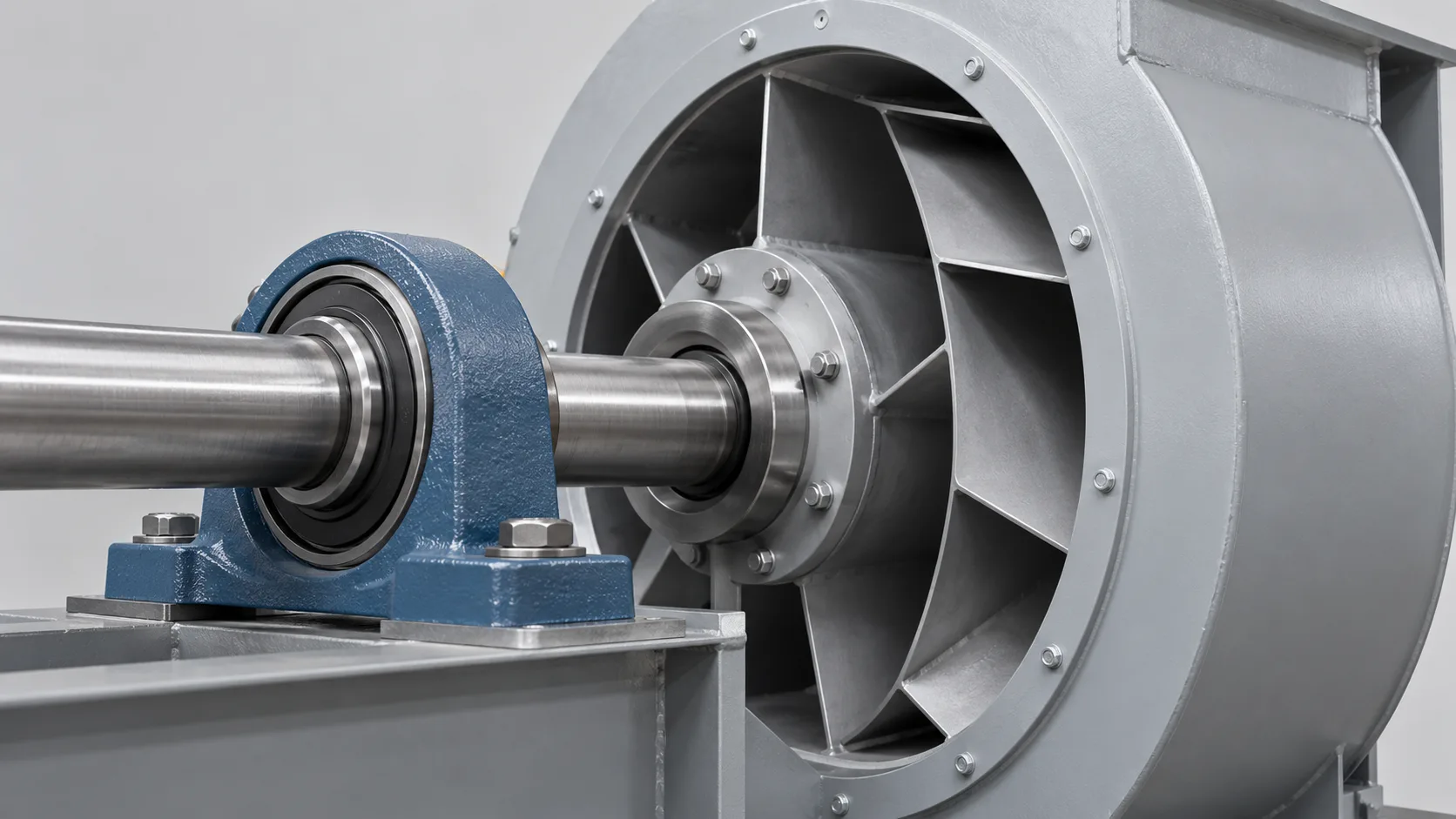
Fan bearing sizes by shaft diameter: 6200 and 6300 series
The bore of the bearing equals the shaft diameter at the bearing seat, so the shaft is where the selection starts. Both series use the boundary dimensions of the ISO 15 general plan, which covers radial bearings of diameter series 2 and 3 among others [5]. That is why a 6204 from one maker fits the same housing as a 6204 from another.
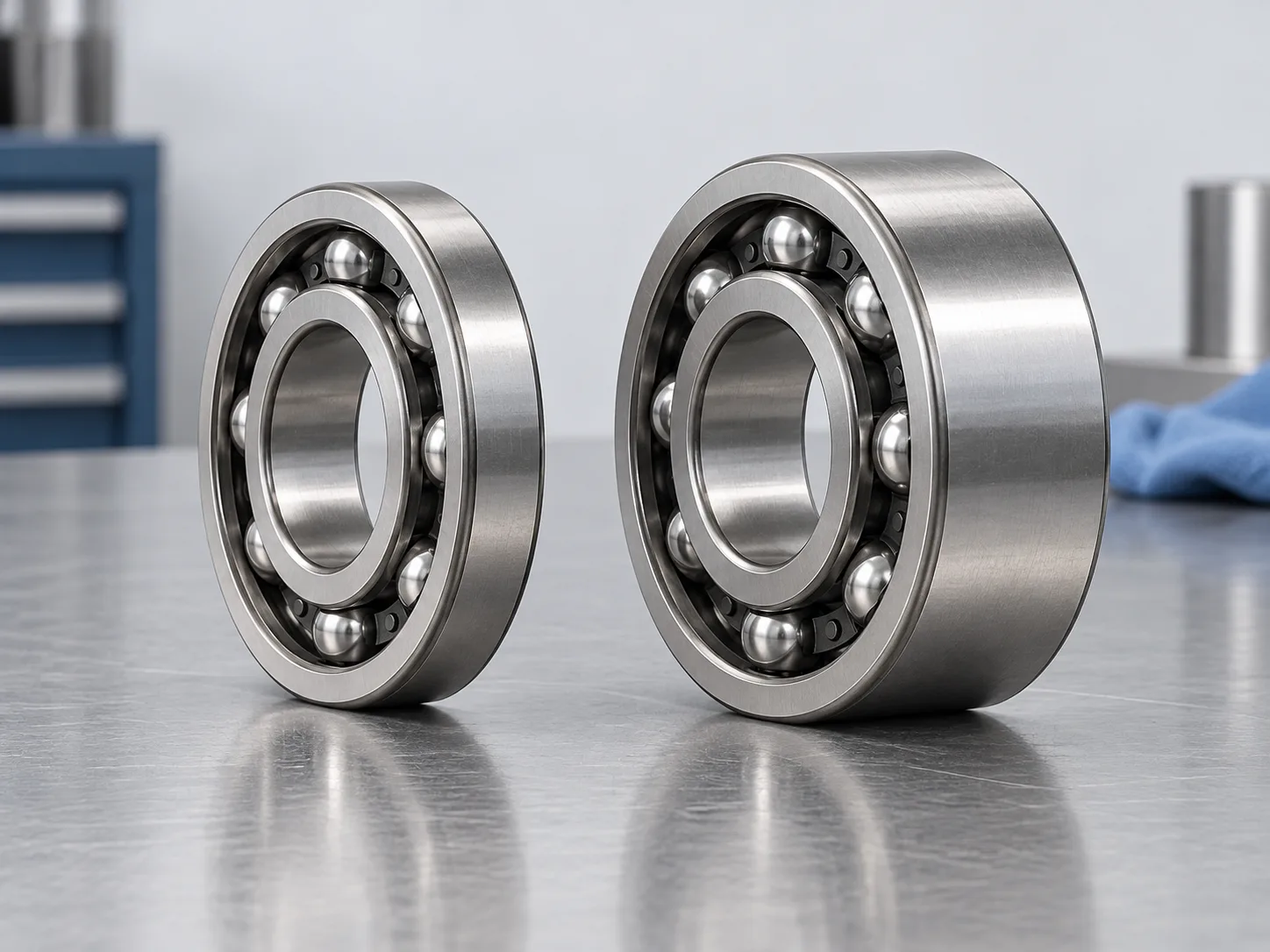
For the same bore, a 6300 bearing has a larger outside diameter and width than a 6200 bearing, and a higher load rating. You cannot swap one for the other in an existing housing, because the housing bore is machined for one outside diameter. The table lists the FULI sizes for shafts from 10 mm to 60 mm.
| Shaft d (mm) | 6200 series | d x D x B (mm) | Cr (kN) | 6300 series | d x D x B (mm) | Cr (kN) |
|---|---|---|---|---|---|---|
| 10 | 6200 | 10 x 30 x 9 | 4.59 | 6300 | 10 x 35 x 11 | 7.38 |
| 12 | 6201 | 12 x 32 x 10 | 5.49 | 6301 | 12 x 37 x 12 | 8.73 |
| 15 | 6202 | 15 x 35 x 11 | 6.98 | 6302 | 15 x 42 x 13 | 10.26 |
| 17 | 6203 | 17 x 40 x 12 | 8.64 | 6303 | 17 x 47 x 14 | 12.15 |
| 20 | 6204 | 20 x 47 x 14 | 11.52 | 6304 | 20 x 52 x 15 | 14.31 |
| 25 | 6205 | 25 x 52 x 15 | on request | 6305 | 25 x 62 x 17 | 19.08 |
| 30 | 6206 | 30 x 62 x 16 | 17.55 | 6306 | 30 x 72 x 19 | 24.03 |
| 35 | 6207 | 35 x 72 x 17 | 23.13 | 6307 | 35 x 80 x 21 | 30.15 |
| 40 | 6208 | 40 x 80 x 18 | 26.19 | 6308 | 40 x 90 x 23 | 36.45 |
| 45 | 6209 | 45 x 85 x 19 | 29.25 | 6309 | 45 x 100 x 25 | 47.70 |
| 50 | 6210 | 50 x 90 x 20 | 31.50 | 6310 | 50 x 110 x 27 | on request |
| 55 | 6211 | 55 x 100 x 21 | 39.15 | 6311 | 55 x 120 x 29 | 64.35 |
| 60 | 6212 | 60 x 110 x 22 | 47.25 | 6312 | 60 x 130 x 31 | 73.80 |
Cr is the basic dynamic load rating. Values from FULI’s catalog; confirm for your application. The 6205 and 6310 load ratings are being checked against FULI’s catalog. Ask for them with the quote.
We recommend reading the number off the old bearing first. It is stamped on the ring face or the shield, for example 6204-2RS or 6304ZZ C3. If the marking has worn off, measure the shaft, the housing bore and the width, and check them against the table or the bearing size finder. Each size has its own model page in the deep groove ball bearing range.
ZZ, 2RS or open: choosing the seal for a blower bearing
Open, ZZ and 2RS versions of a 6200 or 6300 bearing are the same size. What changes is the cover over the gap between the rings, and in a fan that cover decides how the bearing copes with dust, water and speed.
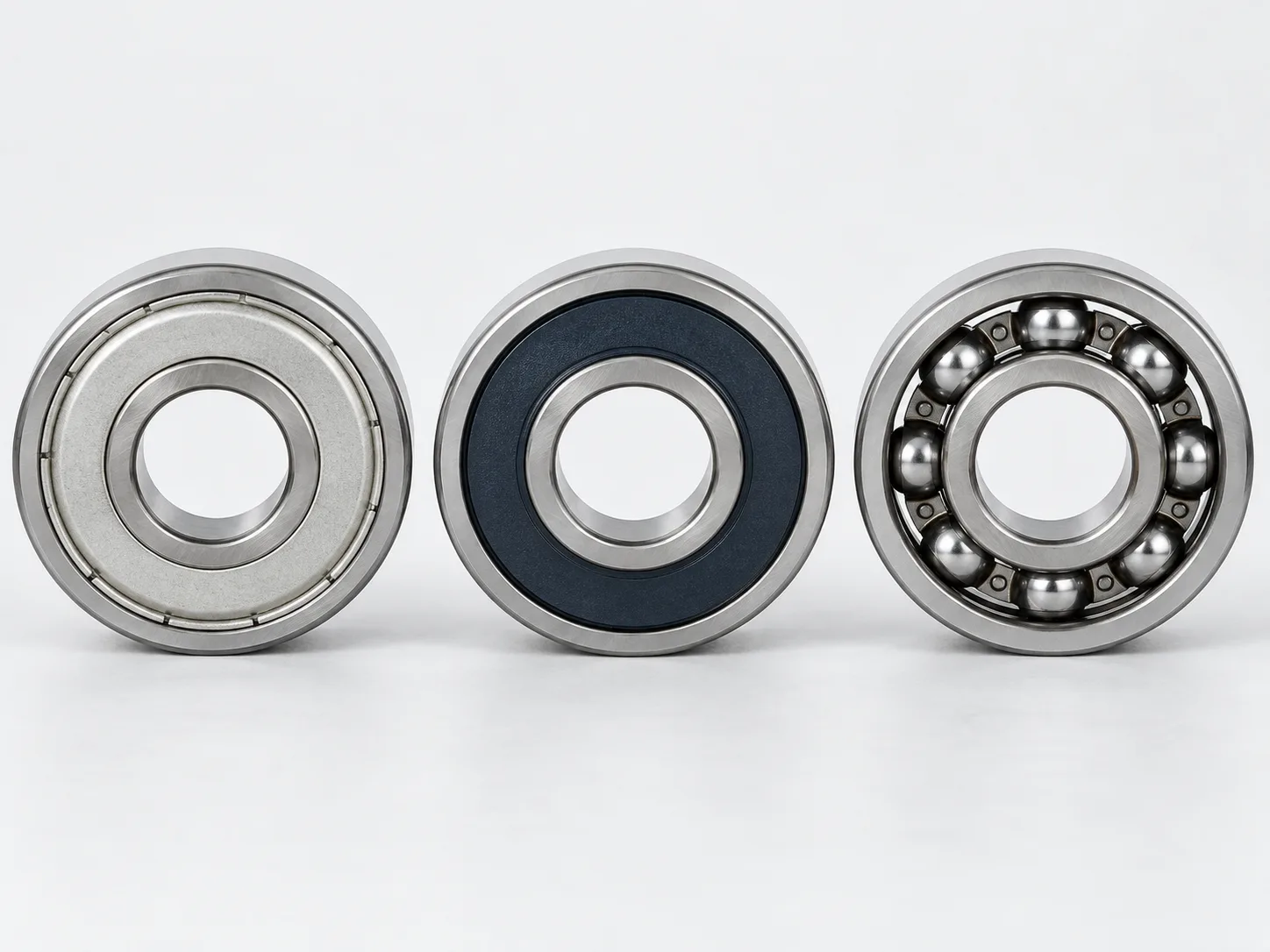
NTN’s catalogue table for sealed ball bearings gives a clear comparison [2]. A ZZ bearing has a metal shield fixed to the outer ring with a small labyrinth gap at the inner ring. Its torque is small, its speed capacity is the same as an open bearing, its dust protection is rated good and its water protection is rated poor [2]. A contact rubber seal, which NTN codes LLU and most catalogues sell as 2RS, touches the inner ring. It has higher torque and a speed limit set by the seal, but dust protection is rated excellent and water protection very good, within a range of -20 to 110 °C [2]. Twin City Fan & Blower describes the same trade-off for fan units: a rubber lip seal rubs on the inner race, the friction makes heat, and that heat limits speed [1].
| Version | Fits this fan duty | Avoid when |
|---|---|---|
| ZZ, two steel shields | Indoor, dry, clean air; direct-drive fans running close to motor speed | Wash-down, rain, condensation or wet exhaust air |
| 2RS, two rubber contact seals | Dusty or damp air, outdoor units, kitchen and workshop exhaust | The fan runs near the speed limit of the size, or the air is hotter than the seal material allows |
| Open | Housings that are regreased on a schedule | Positions with no grease supply or no outer seal |
For a blower bearing in a clean supply-air unit, ZZ is the usual choice. For exhaust and outdoor fans we recommend 2RS, because a little extra friction costs less than water in the raceway. FULI supplies Open, ZZ and 2RS in the 6200 and 6300 series. The seal selector walks through the same questions for other machines. For the full comparison of ZZ and 2RS, and what else to write on the order, read ZZ vs 2RS bearings.
When a cooling fan bearing needs C3 clearance
Internal clearance is the small free movement between the rings and the balls. In a fan it shrinks once the machine runs. Twin City Fan & Blower explains the reason: the inner race warms up, expands and reduces the clearance, so extra internal clearance matters on high speed fans and on fans that handle hot air [1]. Their fan bearings are bought with “air handling” or C3 fits, which have slightly more clearance than off-the-shelf bearings [1].
In practice this means:
- Motor-driven cooling fans and exhaust fans: order C3.
- Fans moving hot process air: order C3 and check the arrangement described in the next section.
- Slow, cool, lightly loaded fans that ran well on normal clearance: normal clearance (C0) is acceptable, but keep what the old bearing had.
FULI supplies radial clearance C0 as standard and C3 on request; bearings in the motor category are C3. Write the clearance in the model, for example 6205-2RS C3, so the quote matches the part. Our guide to bearing internal clearance covers the other cases where C3 is used.
Where the bearing sits: direct-drive fans, belt-driven blowers and exhaust fans
Two fans with the same shaft can still need different parts. It depends on how the fan is driven and what air it moves.
Direct-drive fans. When the impeller sits on the motor shaft, the fan bearings are the motor’s own drive-end and non-drive-end bearings. Treat the job as a motor bearing order; the electric motor bearings page covers it. If the motor runs on an inverter, say so in the inquiry. NSK notes that inverter-controlled fan motors create voltage variations that push current through the bearing and damage it by electrical corrosion [4].
Belt-driven blowers. Here the fan shaft runs in two housed bearing units, usually ball bearing inserts in pillow block housings. The outer ring of the insert and the housing seat are spherical, so each unit can tilt slightly and the pair lines up even on a frame that is a little out of flat, and most inserts lock to the shaft with set screws [1]. Because deep groove ball bearings carry thrust well, most fans of this type use two fixed bearings [1]. For this layout see pillow block bearings rather than a bare 6200 or 6300 bearing.
Hot exhaust fans. When the shaft can grow with heat, one bearing has to let it move. Twin City Fan & Blower uses an expansion bearing for airstreams over 300 °F (about 149 °C), and an expansion bearing is used together with a fixed one, since it carries no axial load [1].
Vertical shafts. Ball bearings with contact seals suit small and medium fans with vertical shafts, while labyrinth seals on vertical shafts let too much lubricant leak [1].
Household ceiling fans. Retail listings in India commonly sell 6201 and 6202 bearings in pairs for ceiling fan repair. Those are the same deep groove sizes shown in the table, but this page is written for industrial fans and blowers.
Why fan bearings fail early: a field case
A case study in Machinery Lubrication describes a chemical plant with belt-driven cooling fans that kept losing bearings [3]. Each failure stopped a fan for 24 to 48 hours and cost about $2,000 to $5,000 in repairs [3]. The smaller fans used deep groove ball bearing units on a 50 mm shaft, locked with grub screws [3].
The failed bearings showed overheating and fatigue spalling, and the wear track sat off the centre of the raceway, a sign of heavy axial load [3]. The cause was in the assembly. Both bearings were located against shaft shoulders, and the distance between the housing flanges never matched the steel frame exactly, so bolting the units down loaded the bearings axially before the fan ever started [3].
The fix cost almost nothing. The upper shoulder was machined off so the lower bearing carried the location and the downward thrust, and the housing flanges were bolted before the grub screws were tightened [3]. After that the sealed-for-life ball bearing units were simply changed on a three-year schedule, and the article reports no further breakdowns of the fan drives [3].
What a buyer should take from this: if a fan bearing fails twice in the same spot, look at the mounting, the belt tension and the axial location before you change the brand or the size. The opposite mistake also exists. Twin City Fan & Blower warns that a bearing chosen far too large for its load can skid instead of rolling, which also ends in failure [1].
Our 2014 fan bearing order that failed on the seal
In 2014 a bearing distributor in Argentina bought fan bearings from our factory for a project. The bearings we shipped had no seal groove at the edge of the inner ring. On site, the project’s engineers judged that the sealing could not keep dust out as it should, and they refused to use the bearings. The distributor then asked us to change the seal design.
The groove is part of the seal. NTN describes a V-shaped groove cut around the inner ring that serves as the running surface for the seal or shield; as the ring turns, the outer face of the groove helps keep dirt out and the inner face helps keep grease in [6]. In NTN’s contact seal the rubber lip presses against the inside of that groove, and NTN rates the design excellent for dust, against good for a steel shield [6]. A non-contact rubber seal sits between the two: its edge follows the groove with a small labyrinth gap, so it keeps dust out better than a shield, but NTN still rates it poor against water [6]. The engineers were judging the whole sealing arrangement, not only the cover they could see.
The requirement did not reach the order: the distributor had not mentioned it before buying. Since it had not been raised before purchase, the distributor made no claim after we talked it through. We recommended a second shipment of bearings with the sealing the project specified, and the distributor was very satisfied with it.
If you buy fan bearings for someone else’s project, get the seal requirement from the people who install them before you order. Write it on the order in words as well as the suffix: shield or rubber seal, contact or non-contact, and whether the inner ring needs a seal groove. Add the site conditions behind it, such as dust, rain or wash-down, so the factory can check the choice. Suffixes differ between makers, as the ZZ, 2RS and LLU codes above show.
How to write a fan bearing inquiry
An inquiry with these seven items can usually be priced in one round:
- The full model with suffixes, for example 6204-2RS C3 or 6306ZZ.
- The quantity for each model.
- If the marking is unreadable: shaft diameter, housing bore and width.
- How the fan is driven: direct drive, belt drive or inverter motor.
- The air: clean, dusty, damp or hot, and the approximate temperature.
- A photo of the old bearing and its position in the fan, if you have one.
- The seal the project requires, in words, if the bearings are for someone else’s installation.
Send your model numbers and quantities. We’ll check any missing specifications and prepare your quote. Before shipment each batch is checked for rotation smoothness, dimensions, grease fill, rust and appearance. An inspection report can cover dimensions, radial clearance, rotation noise, vibration, appearance, material certificate and batch traceability. Rings and balls are GCr15 chrome bearing steel, and the steel maker’s material certificate is available on request for OEM and industrial orders. Export documents are the commercial invoice, packing list and CCPIT certificate of origin, plus an FTA Form COO where the destination country qualifies.
Backed by 20+ years of bearing export experience in Linqing, Shandong. FULI ships to 50+ countries & regions. You can send the list through the contact page, and the full range for this application is on fan and blower bearings.
Sources
- https://tcf.com/wp-content/uploads/2021/12/Fan-Bearing-Selection-FE-1200.pdf
- https://www.ntnglobal.com/en/products/catalog/pdf/2203E_b02.pdf
- https://www.machinerylubrication.com/Read/1122/cooling-fan-bearings
- https://www.nsk.com/eu-en/products/data-sheets/ceramic-ball-bearings-for-fan-motors/
- https://cdn.standards.iteh.ai/samples/69977/9ac39b8b79a94b74b35cba8868eabe4f/ISO-15-2017.pdf
- https://www.ntnglobal.com/en/products/catalog/pdf/3015E.pdf
FAQ
Which bearing is used in a fan?
Most industrial fans, blowers and air handling units use single row deep groove ball bearings from the 6200 or 6300 series, either in the motor or as inserts in pillow block housings. Household ceiling fans in India are commonly repaired with the 6201 and 6202 sizes.
Which bearing type suits industrial fans?
Ball bearings suit small and medium fans because they are economical, run at high speed and carry thrust well. For large, heavily loaded fans, fan makers move to spherical roller bearings when ball bearings do not give enough life.
What happens if a fan bearing fails?
In our experience it starts with noise and heat, and vibration grows as the raceway wears. If the fan keeps running, the shaft and housing seat can be damaged, which turns a bearing change into a shaft repair. Replace it at the first sign of noise and check the mounting before fitting the new one.
Can I replace a ZZ fan bearing with a 2RS one?
Yes, the dimensions are the same. A 2RS bearing seals better against dust and water but has more friction and a lower speed limit, so check the fan speed before switching on a fast direct-drive fan.
Is a blower bearing different from a fan bearing?
Not in type. A blower bearing is the same deep groove ball bearing or pillow block unit; blowers tend to run faster and at higher pressure, so C3 clearance and the seal choice matter more.