Bearing Internal Clearance: Why Tighter Is Not Better
What bearing internal clearance is, the C2, CN, C3 and C4 groups with real numbers, and two orders that show why a tight bearing is not a mark of precision.
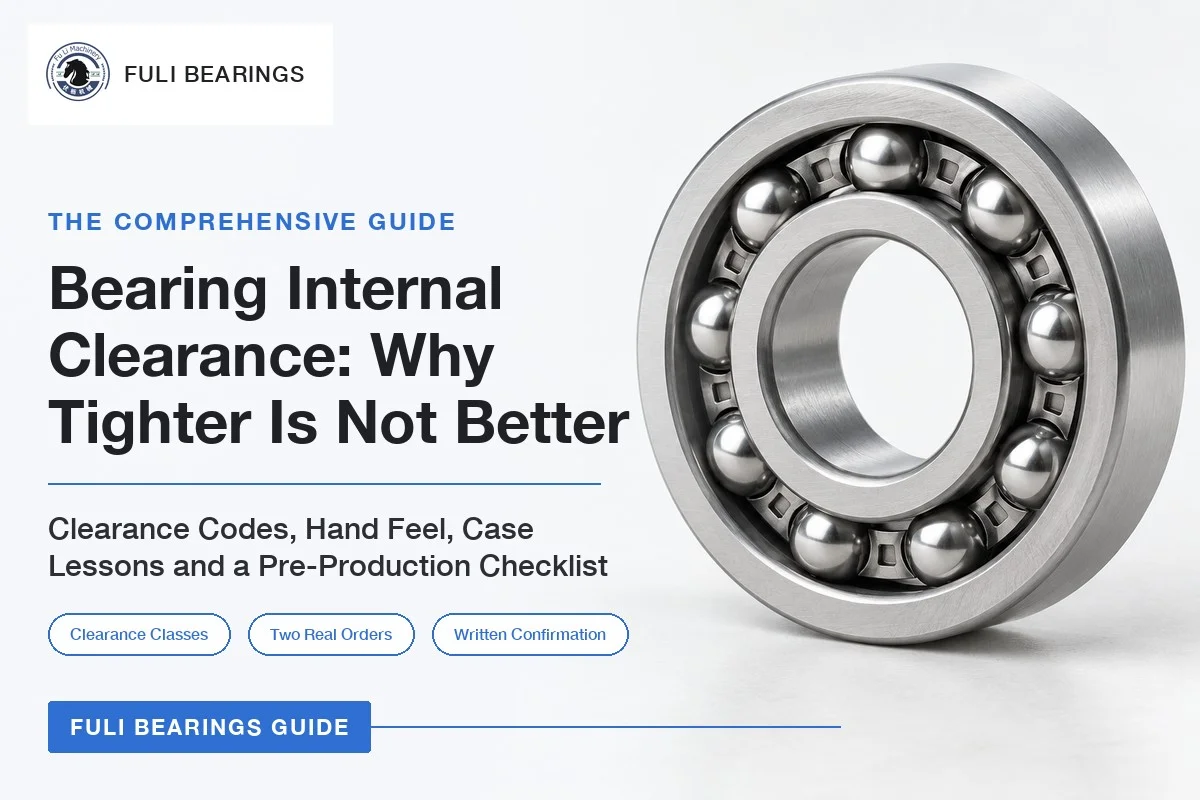
Bearing internal clearance is the specification buyers most often get backwards. A tight bearing feels well made in the hand, a loose one feels cheap, and so the purchase order asks for the smallest clearance on offer. Two orders from our own history show what that instinct costs, and what to check before C2, CN, C3 or C4 goes on a purchase order.
How bearing internal clearance works and what the C codes mean
Internal clearance is how far one ring of a bearing can shift against the other ring, measured across the bearing (radial) or along its axis (axial) [2]. For deep groove ball bearings the figure that matters on an order is the radial internal clearance, and the values are set by ISO 5753-1 [1]. Bearing makers sort those values into groups: C2 is smaller than Normal, CN (also written C0) is Normal, C3 is larger than Normal, C4 is larger than C3 and C5 is larger than C4 [2]. Normal clearance is usually not marked on the bearing at all [7].
The codes describe an application group, not a quality grade. Every group is made to the same dimensional tolerances and inspected the same way; the only thing that changes is the gap between balls and raceways. A C2 bearing is not better made than a C3, and a C4 bearing is not looser because someone was careless.
Clearance also governs how load spreads around the bearing: with little or no clearance, more rolling elements share the load at any instant and load distribution across the raceway is even, while too much clearance leaves only a narrow arc of elements carrying the load. The gap has a direction, too. Radial direction clearance is measured across the bore diameter and the outer ring, and axial direction clearance, also called axial internal clearance, is measured along the shaft; a bearing can have ample radial play and very little axial play, or the reverse. Inside a healthy bearing the rolling elements roll rather than slide against the raceway; once clearance lets a ball or roller slide instead of roll, friction rises and so does heat.
What makes the topic confusing is that the clearance you can feel in a new bearing is not the clearance it will run with. NSK describes three stages: the initial clearance before mounting, the residual clearance after mounting, when the rings have been pressed onto the shaft and into the housing, and the effective clearance in operation [4]. A tight fit expands the inner ring and takes part of the gap; heat takes more, because the housing sheds heat faster than the shaft, so the inner ring runs hotter and grows [4]. That thermal expansion is relative to the shaft, not absolute, and whether the interference sits on the inner or outer ring changes how much each step reduces the clearance by; a tighter fit on both rings needs more clearance headroom to still operate with a small positive gap, which is why matching the clearance code to the application calls for more precision. In almost every application the operating clearance is smaller than the number on the box [2].
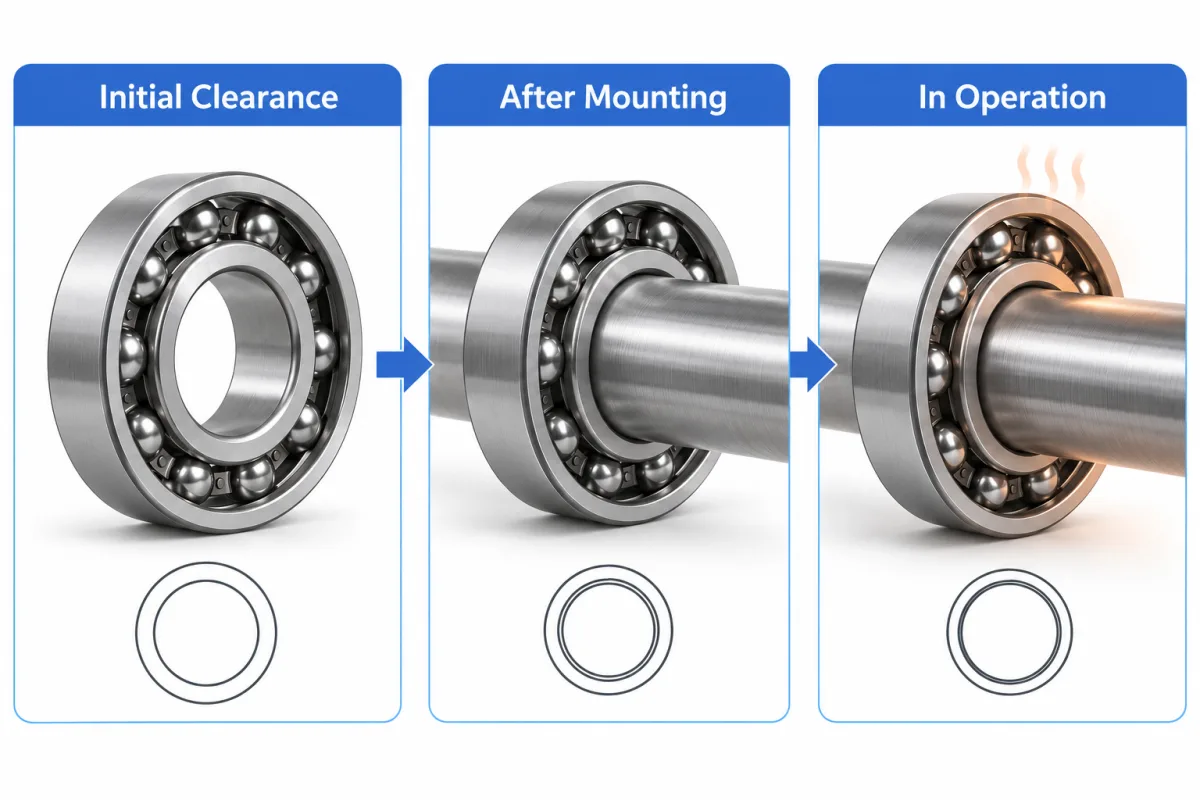
So the clearance code is a decision about the machine, not about the bearing. Our job as the maker is to land inside the group. The buyer’s job is to pick the group that still leaves a small positive clearance once the machine is warm.
Radial internal clearance c0 vs c3: the actual numbers
The difference between C0 and C3 is a few hundredths of a millimetre. The table gives the ranges for deep groove ball bearings in the bore sizes most distributors stock, taken from NTN’s catalog table of radial internal clearance, which uses the same groups as ISO 5753-1 [3].
| Bore (mm) | C2 (μm) | CN / C0 (μm) | C3 (μm) | C4 (μm) |
|---|---|---|---|---|
| over 18 to 24 | 0 to 10 | 5 to 20 | 13 to 28 | 20 to 36 |
| over 24 to 30 | 1 to 11 | 5 to 20 | 13 to 28 | 23 to 41 |
| over 30 to 40 | 1 to 11 | 6 to 20 | 15 to 33 | 28 to 46 |
| over 40 to 50 | 1 to 11 | 6 to 23 | 18 to 36 | 30 to 51 |
Values from NTN catalog 2203-E, Table 8.8 [3]. One micrometre is a thousandth of a millimetre.
Two things stand out. The groups overlap: a C3 bearing at the low end of its range and a CN bearing at the high end are only a few micrometres apart [3]. And the whole spread is smaller than what an interference fit and a warm shaft remove. NTN’s worked example for a 6008 C4 shows the sequence: 28 to 46 μm before mounting, 3 to 44 μm after a k6 shaft fit, and -5 to 36.5 μm once the shaft is turning at 8,000 rpm with the inner ring at 100 °C and the outer ring at 90 °C [6]. A C4 bearing, the “loose” one, can end up with negative clearance in a hot motor. Start the same calculation from C2 and the bearing is preloaded before it reaches speed.
Bearing life is in theory longest when the operating clearance is very slightly negative, but that condition is hard to hold, and when the negative clearance grows the bearing heats up and life falls sharply; for that reason designers aim for an operating clearance slightly above zero, and for ordinary speed, load and temperature the Normal group gets you there [3]. C3 exists for the cases where fit and heat take more than Normal can spare. FULI supplies radial clearance C0 as standard and C3 on request; bearings in the motor category are C3. The size list is on the deep groove ball bearing page.
How to calculate operating clearance
Bearing catalogs reduce the calculation to one equation: operating clearance equals the initial clearance, minus the reduction from the fit, minus the reduction from heat [3]. The result is dependent on the real fit and the real operating temperature.
- Fit. An interference fit on the shaft expands the inner ring raceway; a tight housing fit causes contraction of the outer ring raceway. NTN puts the reduction at 0.70 to 0.90 times the effective interference [3].
- Temperature. The reduction is α × ΔT × Do. Here α is 12.5 × 10⁻⁶ per °C for bearing steel, ΔT is how much warmer the inner ring runs than the outer ring, and Do is the outer ring raceway diameter in mm [3].
A quick figure shows the scale. A 10 °C difference on a 50 mm outer ring raceway gives 12.5 × 10⁻⁶ × 10 × 50 = 0.006 mm, about 6 μm. On its own, that uses up the minimum clearance of the Normal group in the 30 to 40 mm bore range, which starts at 6 μm in the table above. The answer is a theoretical figure, because fits and temperatures vary from machine to machine, so designers keep a margin.
Clearance by bearing type
The tables above cover the most common case on a purchase order. Clearance has the same influence on heat, noise and life in every type, but the rules change with the design.
Cylindrical and spherical roller bearings
Cylindrical roller bearings are separable, so the inner ring can be mounted apart from the outer ring, and ISO 5753-1 gives them their own clearance values [1]. The spherical type has larger clearance values than a ball type of the same bore. With a tapered bore, the clearance falls as the bearing is driven up the sleeve or shaft taper. Fitters measure that drop with feeler gauges to judge the fit, and ISO 5753-1 has separate values for tapered-bore bearings [1].
Tapered roller and angular contact bearings
A single-row tapered roller or angular contact ball bearing has no fixed clearance of its own. The clearance, or a preload, is set when two of them are fitted and adjusted against each other. In automotive and trailer wheel hubs with separate tapered bearings, the hub nut sets the end play. The order specifies the bearing; the drawing specifies the axial setting. Double-row designs and matched pairs come with an axial internal clearance set by the maker.
How to measure radial and axial internal clearance
Clearance is measured, not felt. Radial and axial clearance are measured the same way: one ring is held, the other is moved through its full travel, and a dial gauge reads the movement. A small specified load is applied so the reading is stable. The measured value is therefore slightly larger than the true clearance, by the elastic deformation it causes; for roller bearings the difference is negligible [5]. On a mounted spherical bearing, fitters slide a feeler gauge between the unloaded rollers and the outer ring.
For a purchase, the useful figure is the measured clearance on the inspection report, checked against the minimum and maximum clearance of its bearing clearance class.
Order case one: the distributor who wanted the tightest bearing we could make
More than a decade ago a long-standing distributor in Africa asked our factory for economy deep groove ball bearings with the smallest internal clearance we could produce. He was clear about the reason. In his market, mechanics judged a bearing by hand feel: if the inner ring rocked, the bearing was bad; if it was stiff, it was good. His competitors’ bearings had play, and he wanted his to have none.
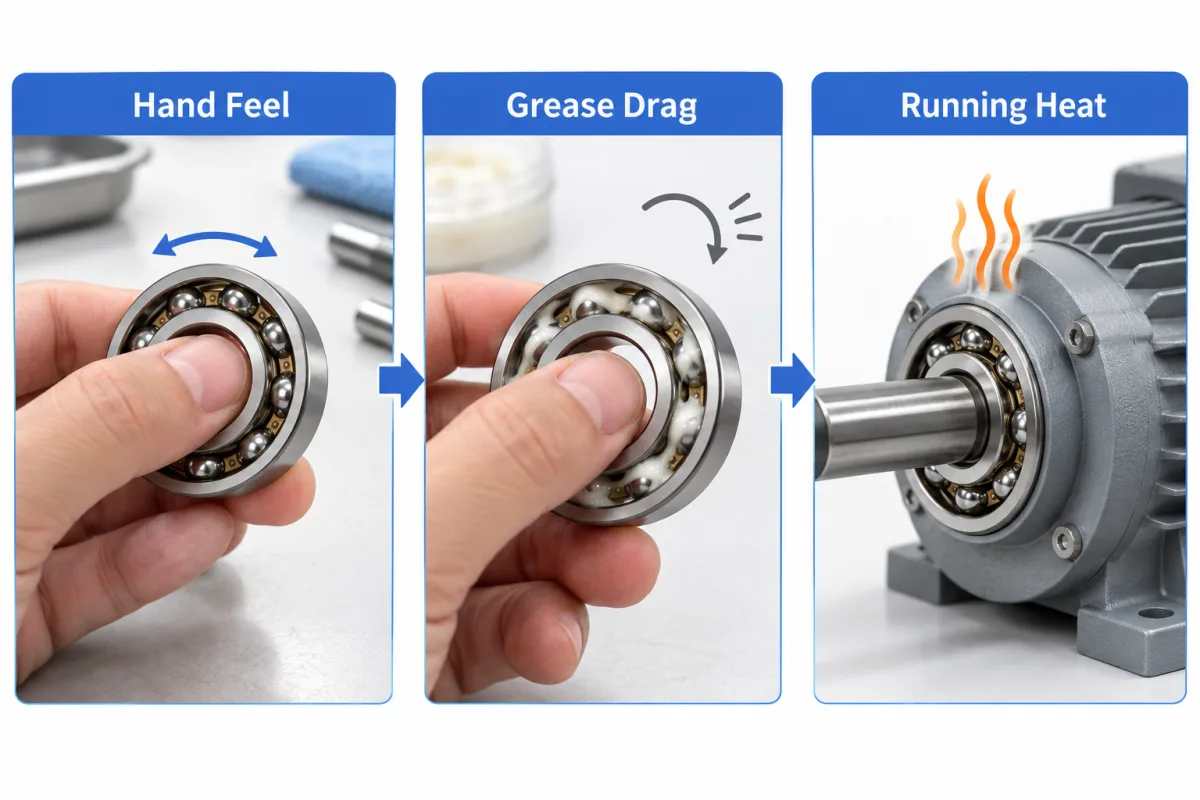
We explained the trade-off: less clearance means more running heat once the bearing is fitted, and a bearing with too little clearance can seize [4]. He asked for samples anyway. We made them at the bottom of the range. After greasing they needed a noticeable push to turn, which is what grease drag in a small gap does. He was pleased. The order went ahead as specified, and he reordered for several years before the volume tapered off and stopped.
No formal complaint ever came back, so we cannot prove what happened in the field. Our reading is that the bearings ran warmer and wore out sooner than the standard-clearance parts he could buy elsewhere, and that the mechanics noticed before he did.
The lesson we took from it is that a customer preference is not an engineering requirement. A rocking inner ring on a bench tells you the initial clearance is at the top of its group; it says nothing about the raceway finish, the steel or the heat treatment. In our experience the hand test is the most common way buyers in the aftermarket rank bearings, and it points the wrong way.
Order case two: the C4 purchase order that the end user rejected
The second order came from an OEM in Southeast Asia that had bought from us many times without a complaint. One purchase order listed cylindrical roller bearings with C4 clearance. For the machine described in the drawing, our engineers expected C4 to leave too much play after assembly, and clearance that is larger than the application needs shows up as noise and vibration [5].
We put that concern in writing before production and asked the buyer to confirm the code with the technical owner on his side. The reply was short: build to the purchase order. So we did. Our factory produced and inspected the batch to C4, kept the measured clearance on record for each lot, and shipped.
The OEM’s end customer rejected the assembled machines for excessive play and claimed lost production time. When we showed the written warning and the buyer’s confirmation, the tone of the conversation changed. The buyer accepted that the specification was theirs. Even so, we shared part of the loss, because a customer relationship of that length was worth more to us than being right.
Two lessons came out of it. A clearance code on a purchase order removes the ambiguity, but not the risk; it only decides who carries it. And “as per PO” from a purchasing desk is not the same as confirmation from the person who designed the housing. When a code looks wrong for the application, we recommend getting the technical owner’s confirmation in writing before steel is cut, and keeping that record in the order file.
Clearance selection: a buyer’s decision guide
Neither case was about product quality. Both were about matching the group to the machine and its operating conditions. This table is how we talk buyers through it; it follows the application examples in NTN’s catalog [3] and the NTN Bearing Wizard [6].
| Option | Use it when | Do not use it when | What it costs you |
|---|---|---|---|
| CN / C0 (Normal) | Distributor stock for general repair; ordinary speed, load and temperature with recommended fits [3] | The shaft runs hot or both rings need tight fits | Nothing extra; it is the default and usually unmarked [7] |
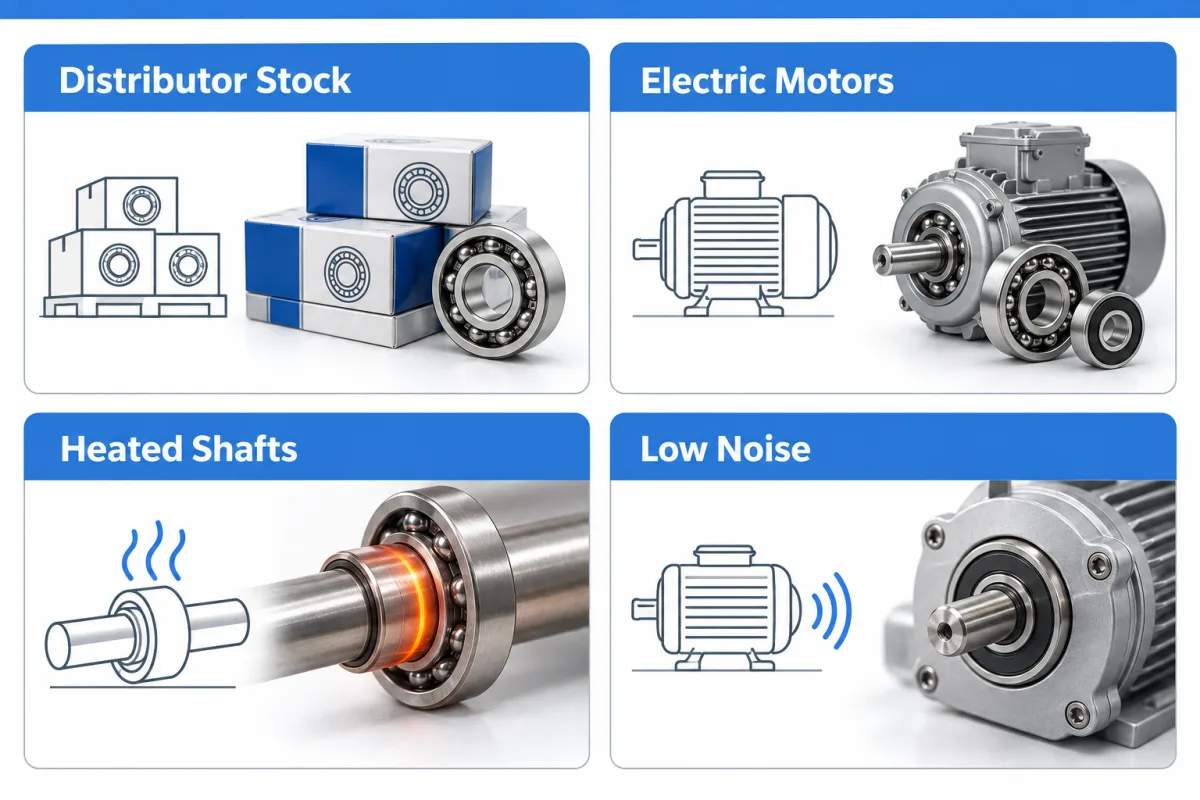
| C3 | Electric motors, pumps and fans where the inner ring runs hotter than the housing; heavy or shock loads with a tight shaft fit [3] | Cold, slow, lightly loaded positions where Normal already leaves room | Slightly more play when cold; state the code on the order |
| C4 | Both rings mounted with interference, heated shafts, traction motors [3] | Ordinary machines where the end user will feel the play at assembly | Noise and vibration if the fit and heat do not absorb the gap [5] |
| C2 | Small motors where low noise is the priority and fits are controlled [3] | Any position without an engineer to calculate the operating clearance | Heat and seizure if fit or temperature remove the remaining gap [4] |
For the two most common buyer situations: a distributor stocking 6200 and 6300 series for general repair should order CN and keep C3 for the motor sizes; an OEM should take the code from the housing drawing and have the designer initial it. If you are still choosing between bearing types as well as clearance, ball bearing vs roller bearing covers that first.
The smaller group has real uses as well. A domestic customer in China once passed a batch of our 6205 bearings to a drum maker whose drums had to run with very little wobble. No clearance group had been agreed, so the batch was C0; the drum maker needed C2, and the bearings came back. Our factory checked the clearance of every bearing in the replacement batch before shipping it. The case is on the 6205 bearing page.
Before production: the clearance check we run on every non-standard order
Since the order from Southeast Asia, a clearance code outside Normal triggers the same four questions from our sales desk:
- What is the bearing going into, and how hot does the housing run?
- What are the shaft and housing fits, or if unknown, is the inner ring pressed on?
- Who on your side owns the specification, and can that person confirm the code in writing?
- Is the same code on the drawing, the purchase order and the box label?
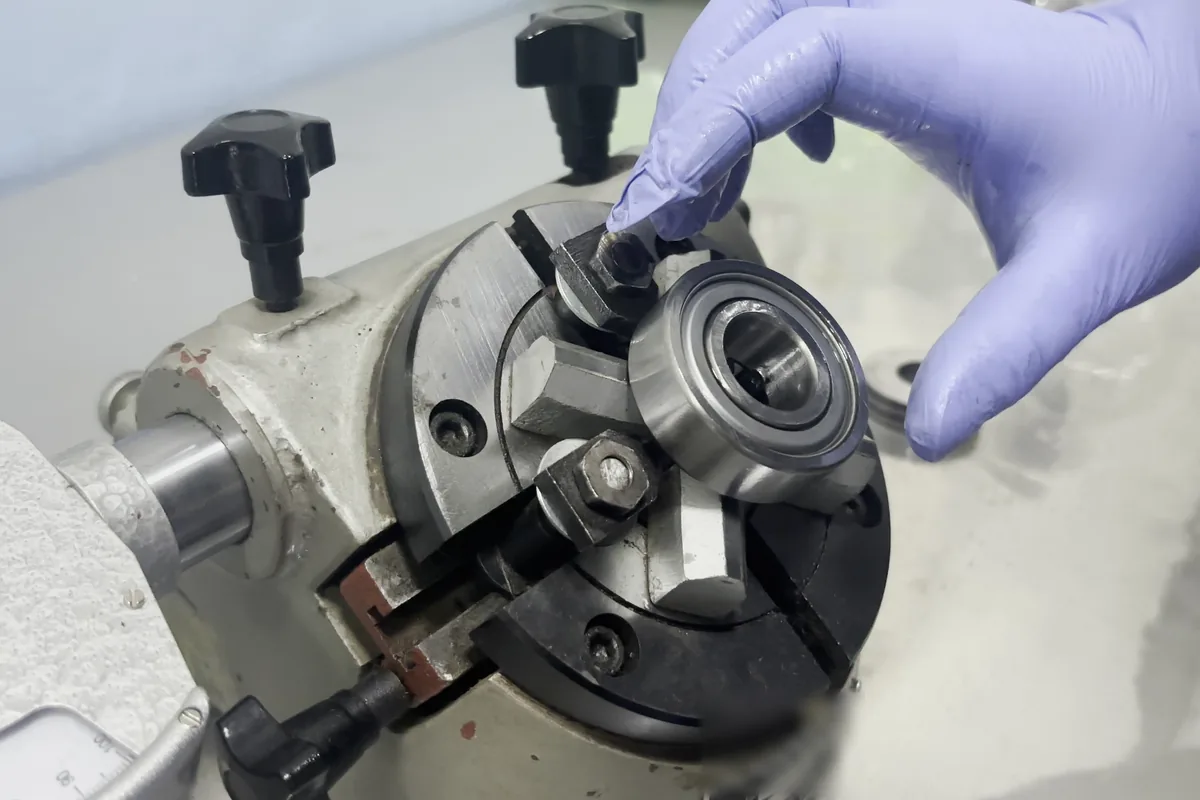
The fourth question sounds trivial. On OEM and private-label orders, though, the problem we find most often is a code copied wrongly somewhere between an old drawing, the buyer’s system and the label.
An inspection report can cover dimensions, radial clearance, rotation noise, vibration, appearance, material certificate and batch traceability, so the measured radial internal clearance of a batch is on record before it ships. Before shipment each batch is checked for rotation smoothness, dimensions, grease fill, rust and appearance. If you want the report attached, say so on the order.
Backed by 20+ years of bearing export experience in Linqing, Shandong. Send the model number with its suffixes, the quantity and one line on the application through the contact page or to sales@fuli-bearings.com, and we will check the clearance code before we quote. Size interchange for the 6200 sizes is on the 6200 series cross reference.
Sources
- https://www.iso.org/standard/44742.html
- https://www.skf.com/in/products/rolling-bearings/principles-of-rolling-bearing-selection/general-bearing-knowledge/bearing-basics/internal-clearance
- https://www.ntnglobal.com/en/products/catalog/pdf/2203E_a08.pdf
- https://www.nsk.com/am-en/tools-resources/knowledge-center/bearing-abcs/fits-and-internal-clearance/
- https://koyo.jtekt.co.jp/en/support/bearing-knowledge/10-0000.html
- https://bearingwizard.com/bearing-selection-calculation-principles/bearing-clearance/
- https://blog.emersonbearing.com/blog/bearing-internal-clearance
FAQ
What is C1, C2 and C3 bearing clearance?
They are radial internal clearance groups. C2 is smaller than Normal, C3 is larger than Normal, and C1 is smaller still than C2. Normal (CN or C0) sits between C2 and C3 and is usually not marked on the bearing.
Is a tighter bearing a better bearing?
No. Clearance is chosen for the fit and the running temperature of the machine, not as a measure of manufacturing quality. A bearing with too little clearance runs hot and can seize; one with too much is noisy and vibrates.
How do I calculate bearing clearance in operation?
Start with the initial clearance from the catalog, subtract the reduction from the interference fit on the shaft and in the housing, then subtract the reduction from the temperature difference between the inner and outer rings. Bearing catalogs give the formulas and fit tables; for a feel of the size of each step, NTN's worked example for a 6008 C4 is a good place to start.
Should I order C3 for an electric motor?
Usually yes. The inner ring in a motor runs hotter than the housing, which closes the gap, so C3 is the common choice and FULI's motor category is supplied as C3. Confirm with the motor maker if the shaft fit is unusual.
Can I check bearing clearance by hand?
You can feel whether a bearing sits at the top or the bottom of its clearance group, but not which group it is in, and not how it will run once mounted. Clearance is measured with a gauge under a small defined load. Ask for the measured values on the inspection report instead.
What is the difference between C3 and C4 bearings?
C4 has more radial internal clearance than C3. For a 30 to 40 mm bore in the table in this article, C3 is 15 to 33 μm and C4 is 28 to 46 μm. C4 is for positions where both rings have tight fits or the shaft runs much hotter than the housing; elsewhere the extra play shows up as running noise and vibration.
What is the difference between diametral and radial clearance?
For rolling bearings they are usually the same figure: radial internal clearance is the total movement of one ring across the bearing, which is a diametral value. In plain journal bearings, such as engine main and rod bearings, diametral clearance is the bore minus the journal diameter, and the radial value is half of that.
What happens if bearing clearance is too small?
A bearing with a very small internal clearance runs hot. As the shaft warms up the clearance can go negative, the bearing becomes preloaded, heat generation rises further, the lubrication breaks down, and it can seize. In an engine main bearing, too small a clearance leaves too thin an oil film, with the same result.
Does every motor bearing need C3 clearance?
No. Normal clearance suits most positions with ordinary speed and temperature. The larger group is for motors, pumps and fans where the shaft runs hotter than the housing, or where the shaft fit is tight.
How much clearance do your bearings need?
Enough to stay slightly above zero once the bearing is mounted and warm. For ordinary conditions that is Normal; for motors and hot shafts it is C3; for both rings pressed with interference it may be C4.