Ball Bearing vs Roller Bearing: How to Choose
Ball bearing vs roller bearing: the practical difference in contact geometry, load direction and speed, and where each one is normally used.
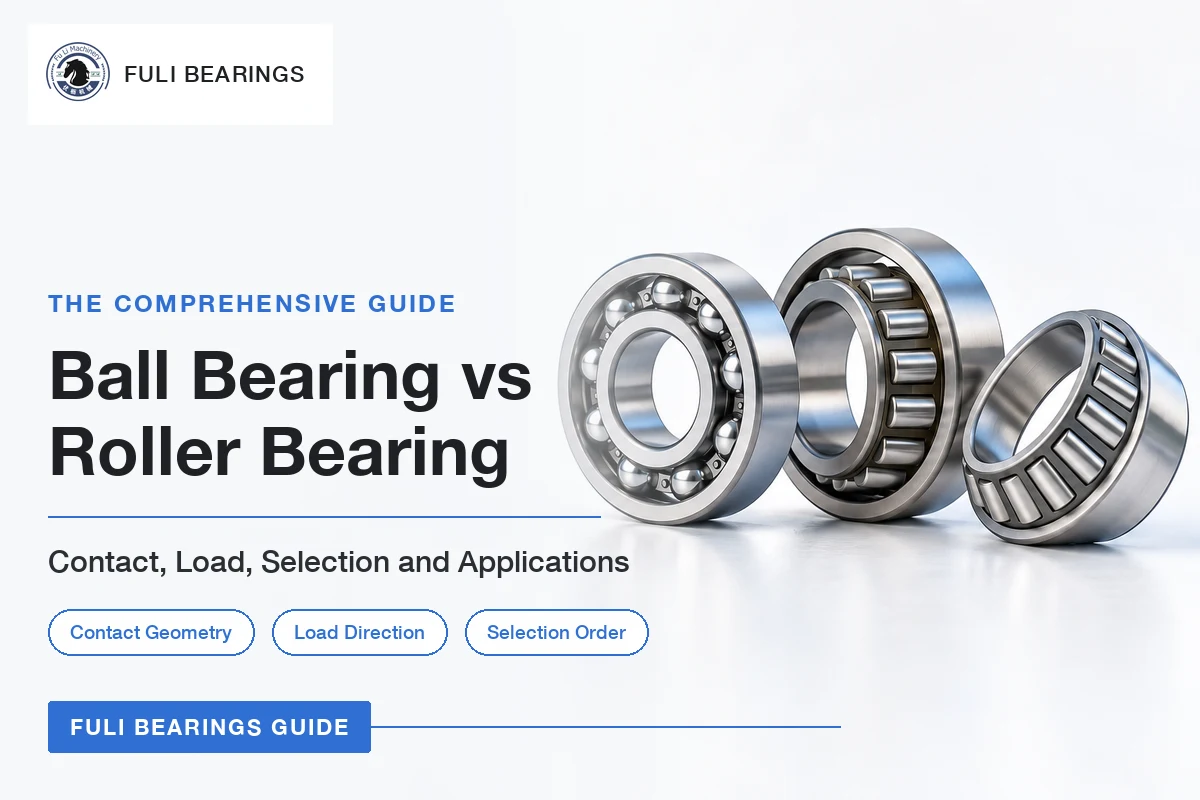
The ball bearing vs roller bearing question comes up in most first inquiries we handle, usually as “can I use a roller bearing here, it looks stronger”. The short answer: a ball bearing gives speed and low friction, a roller bearing gives load-carrying capacity, and the contact shape between rolling element and raceway decides it [1]. This guide covers the differences between roller and ball bearings and the selection steps we use at FULI.
How ball bearings and roller bearings are built
Both are rolling-element bearings. In plain bearings the shaft slides in a bushing or bearing block; here the moving parts roll between the inner and outer races instead, and that is how these bearings reduce friction. Each one has an inner ring, an outer ring, a set of rolling elements and a cage that keeps them apart.
The difference is the rolling element. A ball bearing uses steel balls made to the grades of ISO 3290 [6], as close to perfectly spherical as grinding and lapping allow. The other type uses rollers, and their shape names the family. The simplest type of roller bearing is a cylindrical one, with straight rollers. In a tapered type the rollers and raceways share a taper, so the lines along them meet at one point on the shaft axis. Barrel-shaped rollers in a curved outer raceway make spherical roller bearings, which are self-aligning. Long, thin rollers make needle bearings. The function of a roller bearing is the same as that of a ball bearing: carry the load while the shaft turns.
Ball bearing vs roller bearing: the contact geometry
Each ball sits on the ring raceways in point contact. As load increases the steel elastically deforms and the point becomes a small elliptical area; the small area gives low rolling friction, which lets ball bearings run at high speed but also limits their load-carrying capacity [1]. Roller bearings have line contact instead. Under load the contact line becomes roughly rectangular, and because the area is larger, a roller bearing carries heavier loads at lower speed than a ball bearing of the same size [1].
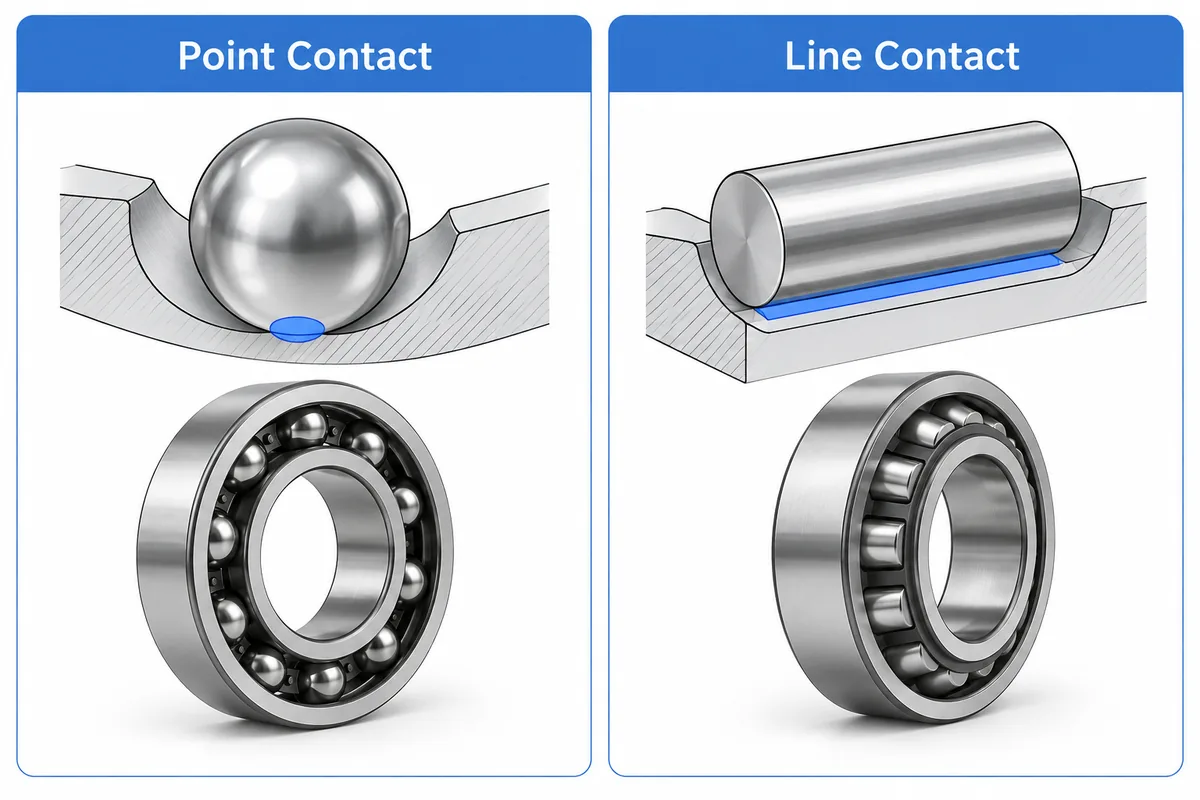
Everything else in the comparison follows from those two sentences. A larger contact area spreads the load, so the steel sees lower stress and the bearing lasts longer at the same load; a smaller contact area rolls with less resistance, so the bearing runs cooler at the same speed. The tradeoff is friction: the friction generated in a ball bearing is lower than in a roller bearing of the same size, so ball bearings are used at higher speeds and lighter loads.
Difference between ball and roller bearing in load and speed
The clearest published summary is the relative operating characteristics table in a major engineering manual, which grades each bearing type on the same scale [3]. The rows that matter for a first selection:
| Characteristic | Deep groove ball | Cylindrical | Tapered | Self-aligning |
|---|---|---|---|---|
| Pure radial load | Good | Excellent | Good | Good |
| Pure axial load | Fair | Unsuitable | Good | Fair |
| Combined load | Good | Fair | Excellent | Good |
| Misalignment | Good | Poor | Poor | Excellent |
| Low friction | Excellent | Excellent | Good | Fair |
| Speed | Excellent | Excellent | Good | Fair |
Source: relative operating characteristics of various bearing types [3].
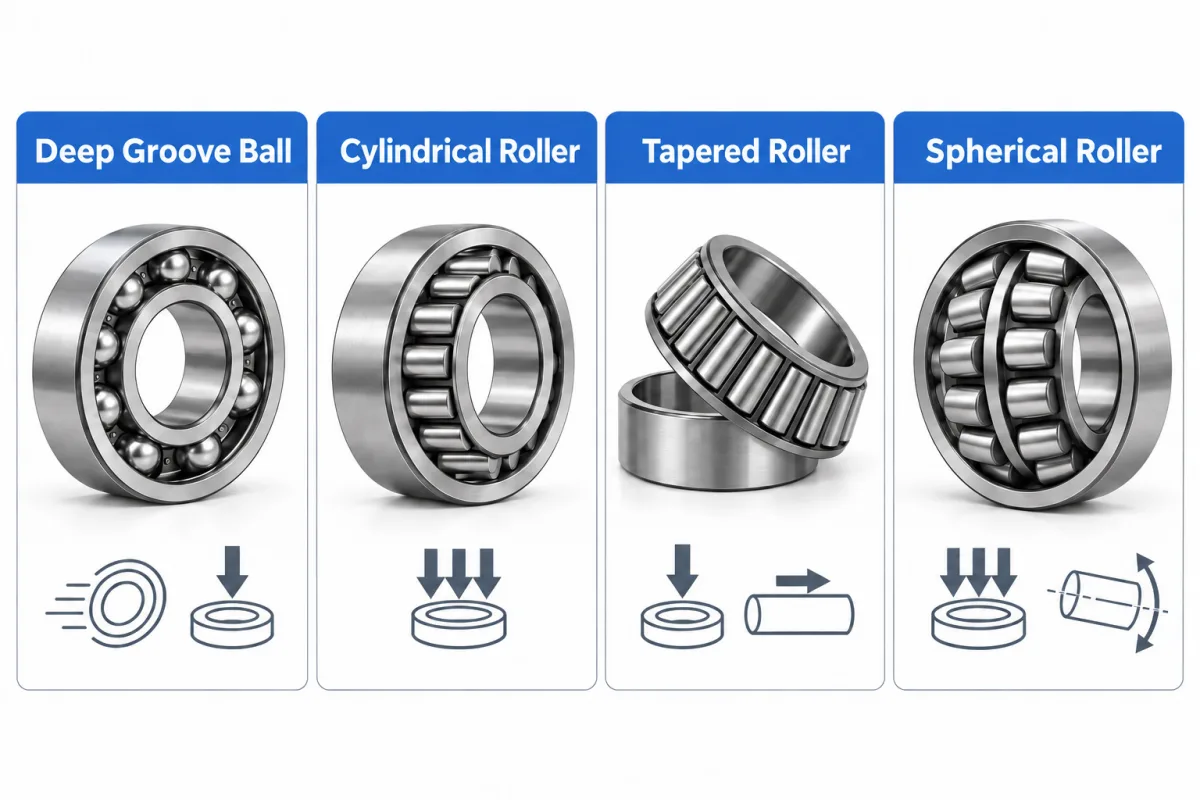
Read across the table and the pattern is plain. The deep groove ball bearing has no Unsuitable rating anywhere, which is why it is the most widely used bearing type [1]. Each roller type is excellent in one column and poor in another: the straight type for pure radial load but no thrust, the tapered type for combined load but little tolerance for tilt, and the self-aligning type for tilt but at lower speed and higher friction [3].
Ball vs roller by load direction
The load direction is the first thing to write down, before the load size.
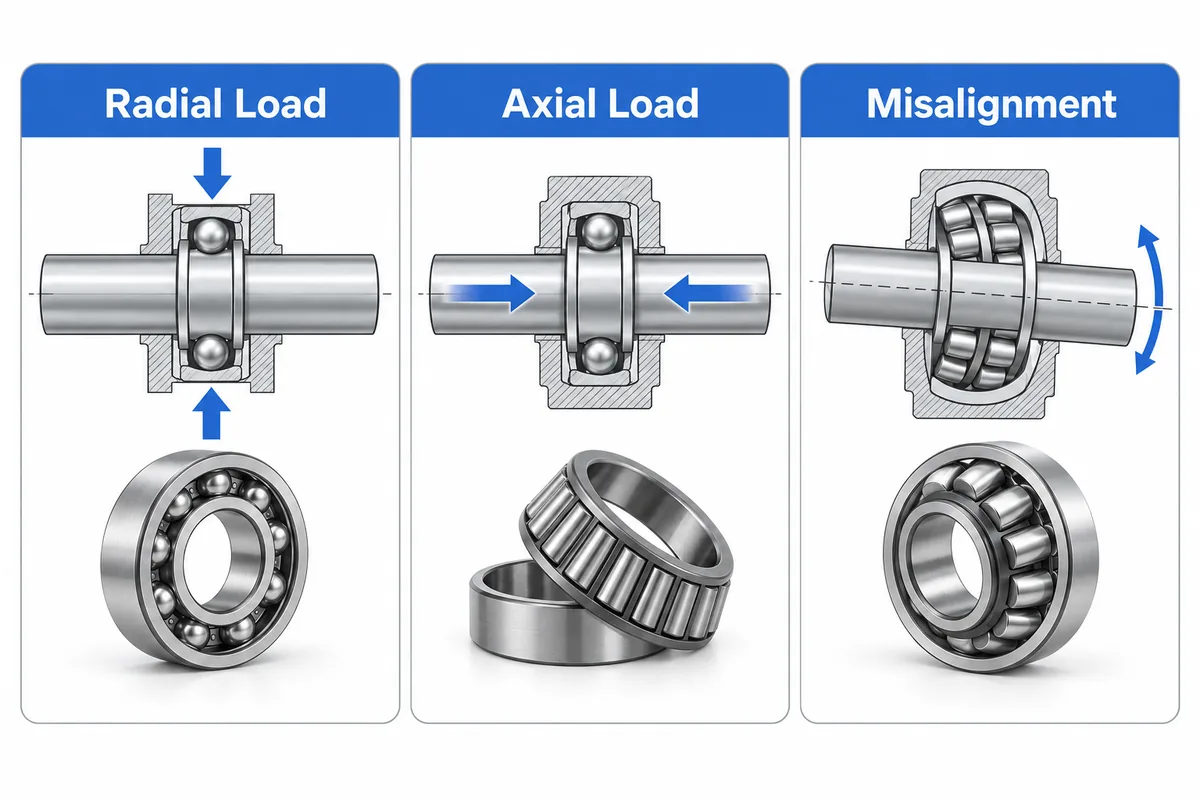
- Radial only, moderate: a deep groove ball bearing carries moderate radial loads and also takes light thrust loads in both directions [1].
- Radial only, heavy: the straight type gives the highest radial load capacity for the envelope but is unsuitable for thrust, so another bearing must locate the shaft [3].
- Combined radial and axial loads in one direction, as in a wheel hub or a bevel gear shaft: a tapered roller bearing carries radial loads, thrust loads or any combination, but the tapered raceways induce a thrust reaction that a second bearing must oppose, so tapered roller bearings are mounted in pairs [3].
- Radial with shaft deflection or a housing out of line: a self-aligning roller bearing, the only type in the table rated Excellent for misalignment [3].
A deep groove ball bearing takes thrust because its grooves are deep; an angular contact ball bearing takes more, but in one direction only [4]. That is the ball-side equivalent of the tapered roller pair. A self-aligning ball bearing has two rows of balls running in two grooves in the inner race and a curved outer raceway, so it tolerates shaft tilt like its roller counterpart, at a lower load rating. Needle roller bearings support radial loads in a cross-section too thin for any other type, which is why they turn up in compact gearboxes and rocker arms.
Thrust ball bearings and roller thrust bearings
Most of the types above are radial bearings. Where the load runs purely along the shaft, as on a vertical pump shaft or a crane hook, a thrust bearing takes it. Ball thrust types, such as the 51100 and 51200 series, suit light to moderate load at moderate speed. Roller versions, with straight, tapered or needle rollers, carry more for the same size. Our thrust bearing guide covers the types and sizes.
When to use ball bearings: the selection sequence we use at FULI
In our experience as a bearing manufacturer, a wrong bearing type is rarely chosen because the buyer misread a catalogue. It is chosen because the shaft diameter was fixed early in the system design and the bearing type was picked to fit the space. We recommend the opposite order:
- Write down the load direction and a rough size. Radial, axial or both, and whether it is steady or shock.
- Write down the speed. High speed with light load points to a ball bearing; low speed with heavy load points to a roller bearing [1].
- Note angular misalignment. Long shafts, welded frames and separate housings all deflect; if you cannot control it, choose a self-aligning ball or roller type [3].
- Only now pick the envelope. In the ball bearing family the 6000, 6200 and 6300 series give three outside diameters for the same bore, so a 6305 at 25 x 62 x 17 mm carries more than a 6205 at 25 x 52 x 15 mm on the same shaft, which often removes the need to change bearing type.
- Decide sealing and clearance. Ball bearings come open or with the option of seals (2RS) or shields (ZZ); most others rely on a seal in the housing.
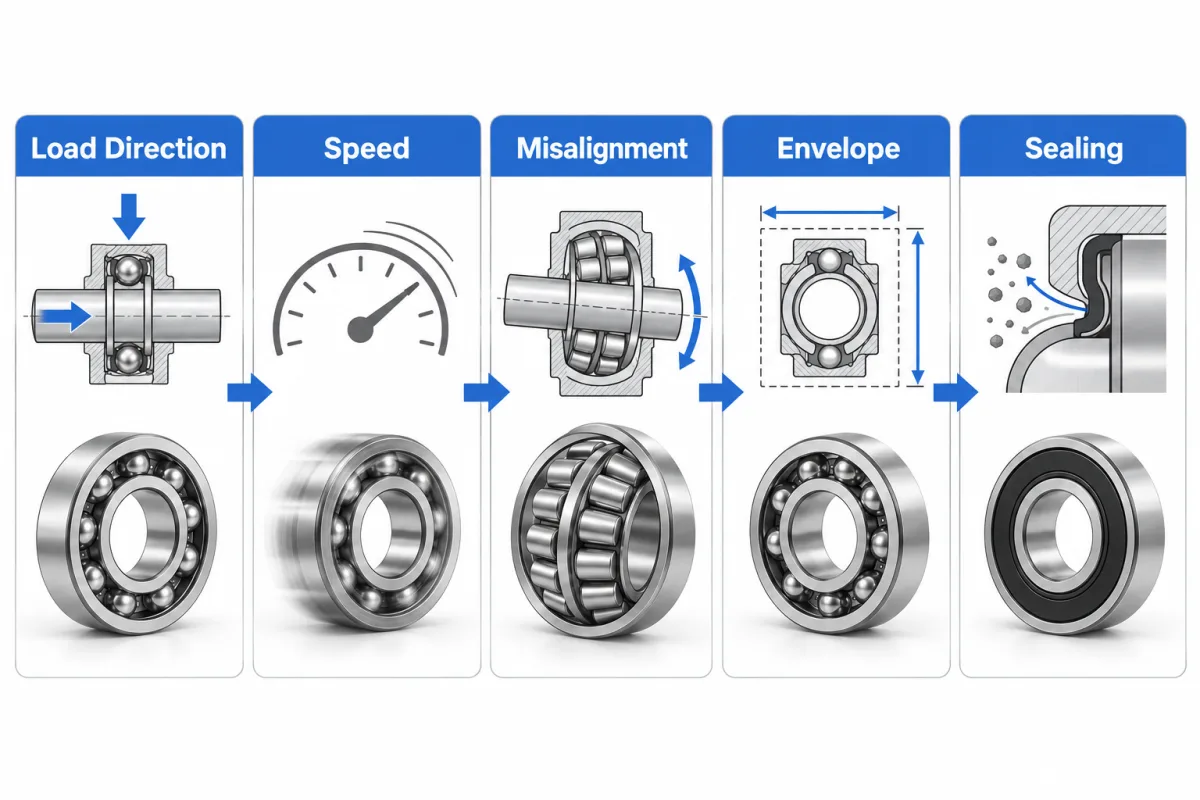
Whether a machine needs ball bearings or roller bearings is settled by steps 1 to 3; steps 4 and 5 pick the part. FULI supplies the deep groove ball bearing side of this decision in the 6000, 6200 and 6300 series (bores 10 to 100 mm, models 6000 to 6320) and the tapered roller bearing side in the 30200 and 30300 series, so the same quotation can cover the whole bearing assembly of a gearbox shaft.
Put simply, ball bearings are designed for moderate loads and higher speeds, and roller bearings for larger loads than a ball bearing of the same envelope can take. Tapered rollers carry radial and thrust load together, which is why they work in matched pairs.
Disadvantages of ball bearings and of roller bearings
Buyers ask about the disadvantages of ball bearings more than about any other point, so here they are without softening.
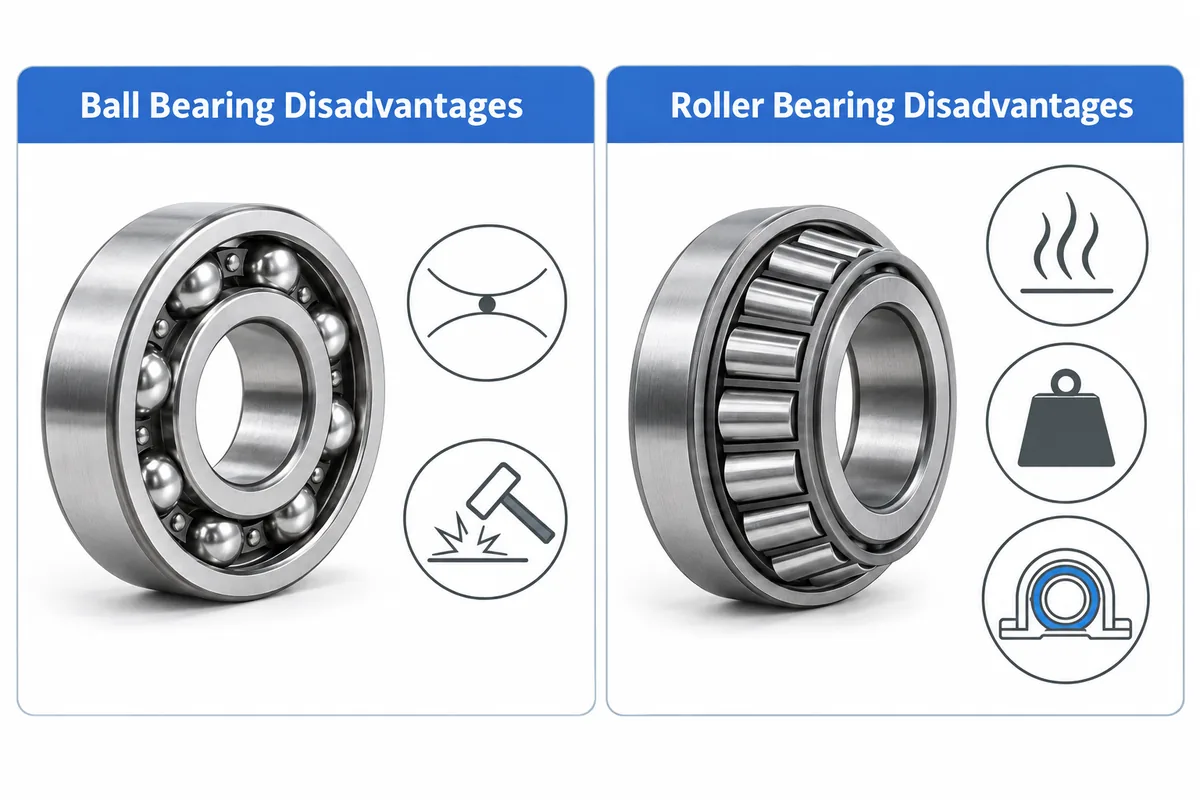
Ball bearing disadvantages: capacity is limited because the point contact area is small [1], and in the standard Conrad construction only slightly more than half the space between the rings can be filled with balls, which caps the number of balls and therefore the maximum load capacity [3]. Shock loads can dent the raceways where each ball touches. Under heavy radial load a ball bearing of the same size will fail earlier than a roller bearing.
Roller bearing disadvantages: more rolling resistance and a lower speed limit for the same size [1]; straight rollers take no thrust and tapered ones need a matched second bearing, because the raceway taper turns part of the radial load into thrust [3]; both of those types tolerate tilt poorly [3]; and the bearing itself costs more, is heavier, and usually needs a housing that provides the sealing.
There is no type that wins the whole table. The engineering manual rates the radial ball bearing Good or Fair in every load row and Excellent for speed, and rates each roller type Excellent in one row and Unsuitable or Poor in another [3].
Where each type ends up in real machines
The application lists for ball bearings and roller bearings in maker catalogues are consistent. Deep groove ball bearings go into industrial motors, servomotors, agricultural machinery, textile machines and conveyors, wherever the load is moderate and speed or quietness matter [4]. Small ball bearings also turn up in bicycle wheels and industrial fans. From our order book the same is true: electric motors, fans, water pumps and small gearboxes take the 6200 series (6201 to 6210 in particular), and the 6205 bearing at 25 x 52 x 15 mm is the single most requested size.
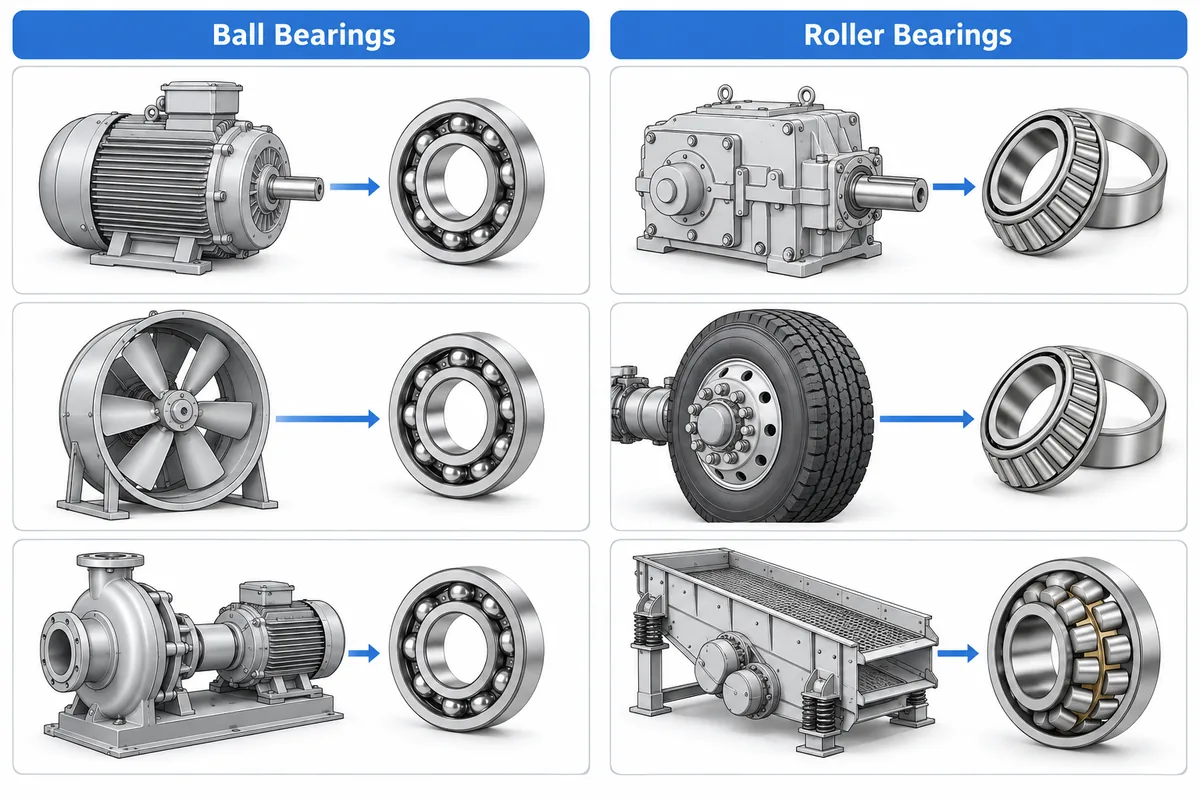
Roller bearings take over where the load goes up. A gearbox output shaft with a helical or bevel gear sees combined load and gets a tapered pair; an input shaft with a light spur gear keeps a deep groove ball bearing. Truck and trailer wheel hubs run tapered roller bearings in pairs. Vibrating screens and heavy conveyor pulleys, where the shaft bends, run self-aligning roller bearings. The bearing types chart lays these out side by side with the mounting forms.
Sources
- https://www.skf.com/binaries/pub12/Images/0901d196802809de-Rolling-bearings---17000_1-EN_tcm_12-121486.pdf
- https://cdn.standards.iteh.ai/samples/69977/9ac39b8b79a94b74b35cba8868eabe4f/ISO-15-2017.pdf
- https://www.timken.com/wp-content/uploads/2016/10/Timken-Engineering-Manual_10424.pdf
- https://www.nsk.com/products/ball-bearings/deep-groove-ball-bearings/
- https://www.timken.com/wp-content/uploads/2018/04/Timken-Ball-Bearing-Catalog_10734.pdf
- https://www.iso.org/standard/60132.html
FAQ
Which is better, a roller bearing or a ball bearing?
Neither is better in general. A ball bearing runs faster and cooler; a roller bearing carries more load for the same size. Match the type to the load direction, load size and speed of the shaft, in that order.
Which type of bearing should I pick if I am unsure?
Start with a deep groove ball bearing. It carries radial load and some thrust in both directions, has no Unsuitable rating in the load table, and is the type most machines already use. Move to a roller type only when the load or misalignment rules it out.
What are the disadvantages of ball bearings?
Limited capacity because of the small point contact area, sensitivity to shock loads that dent the raceway, and a ball count capped by the Conrad assembly method. For heavy radial load a roller bearing of the same size lasts longer.
Can I replace a ball bearing with a roller bearing of the same size?
Sometimes. The straight type in the same envelope carries more radial load but no thrust, so the shaft needs another bearing to locate it. Check the load direction and the housing sealing before you swap; a larger ball bearing series on the same bore is often the simpler fix.
What does a ball bearing look like?
Two steel rings, one inside the other, with a row of steel balls between them and a cage that keeps the balls apart. A shielded or sealed one has a metal or rubber disc on each side that covers the balls.
What are the three main types of bearings?
Plain, ball and roller bearings. A plain bearing is a sleeve the shaft slides in; ball and roller bearings put rolling elements between two rings, so the shaft rolls instead of slides.