UCP, UCF, UCFL and UCT Bearing Full Form: What Each Letter Means
UCP bearing full form: a set screw insert in a P pillow block housing. What UCF, UCFL and UCT mean, plus the series digit, bore code and suffix letters.
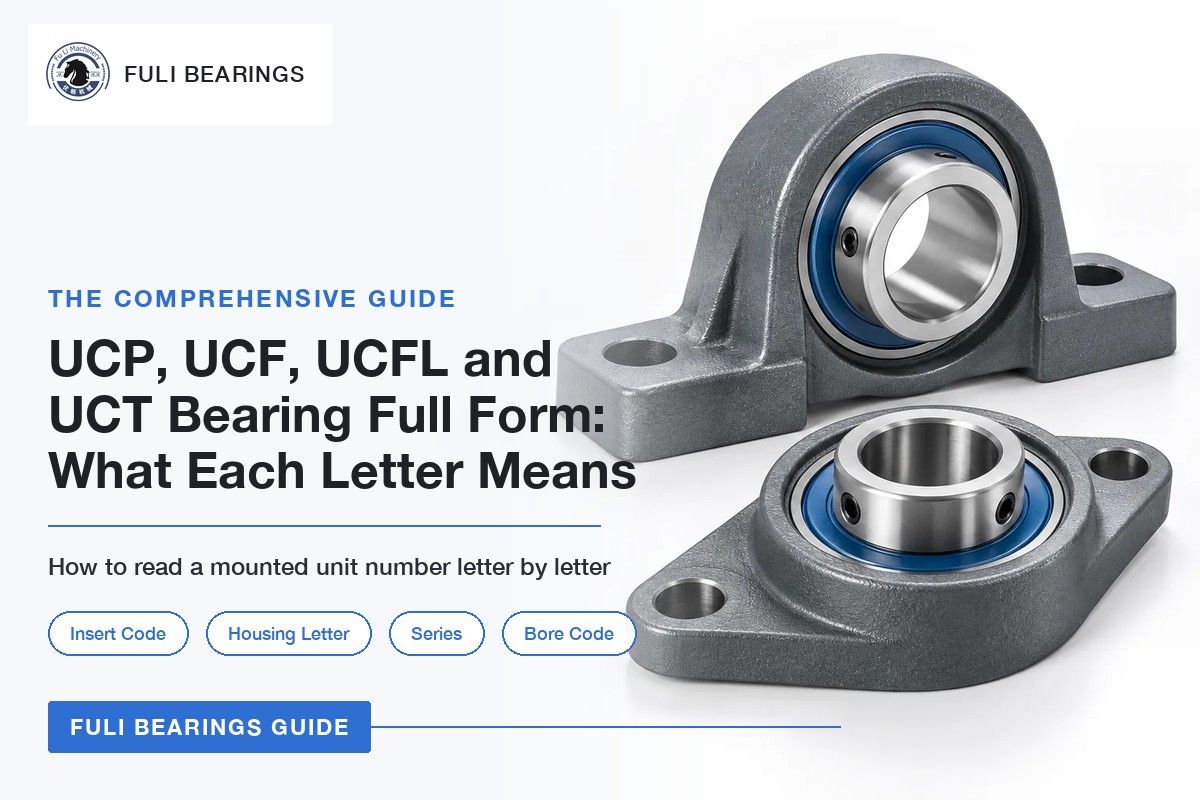
The UCP bearing full form, read the way catalogs read it, is a UC insert in a P housing: an insert ball bearing with a cylindrical bore and set screw locking, fitted in a pillow block. UCF, UCFL and UCT use the same insert in a different body. F is a square flange, FL a two-bolt flange, and T a sliding unit for belt tension. The digits after the letters give the series and the bore code [1][2].
This page reads a mounted unit number from left to right, lists the less common letters that cause wrong orders, and ends with what to send for a quotation. It explains the code only. To decide between a pillow block, a flange and a sliding unit for a machine, use our housing type selector.
UCP bearing full form: how to split a mounted unit number
Koyo’s catalog follows JIS B 1557. It builds the number from a bearing type code, a housing code, a diameter series code, a bore number and any supplementary codes, in that order [1]. SKF splits its UCP205 the same way, into four parts [2].
| Part of UCP205 | Meaning |
|---|---|
| Letters 1–2 | Insert with a cylindrical bore, locked by set screws |
| Letter 3 (P) | Pillow block |
| Digit 2 | Series: 2 is normal, 3 is heavy |
| Digits 05 | Bore code: 05 × 5 = 25 mm [1] |
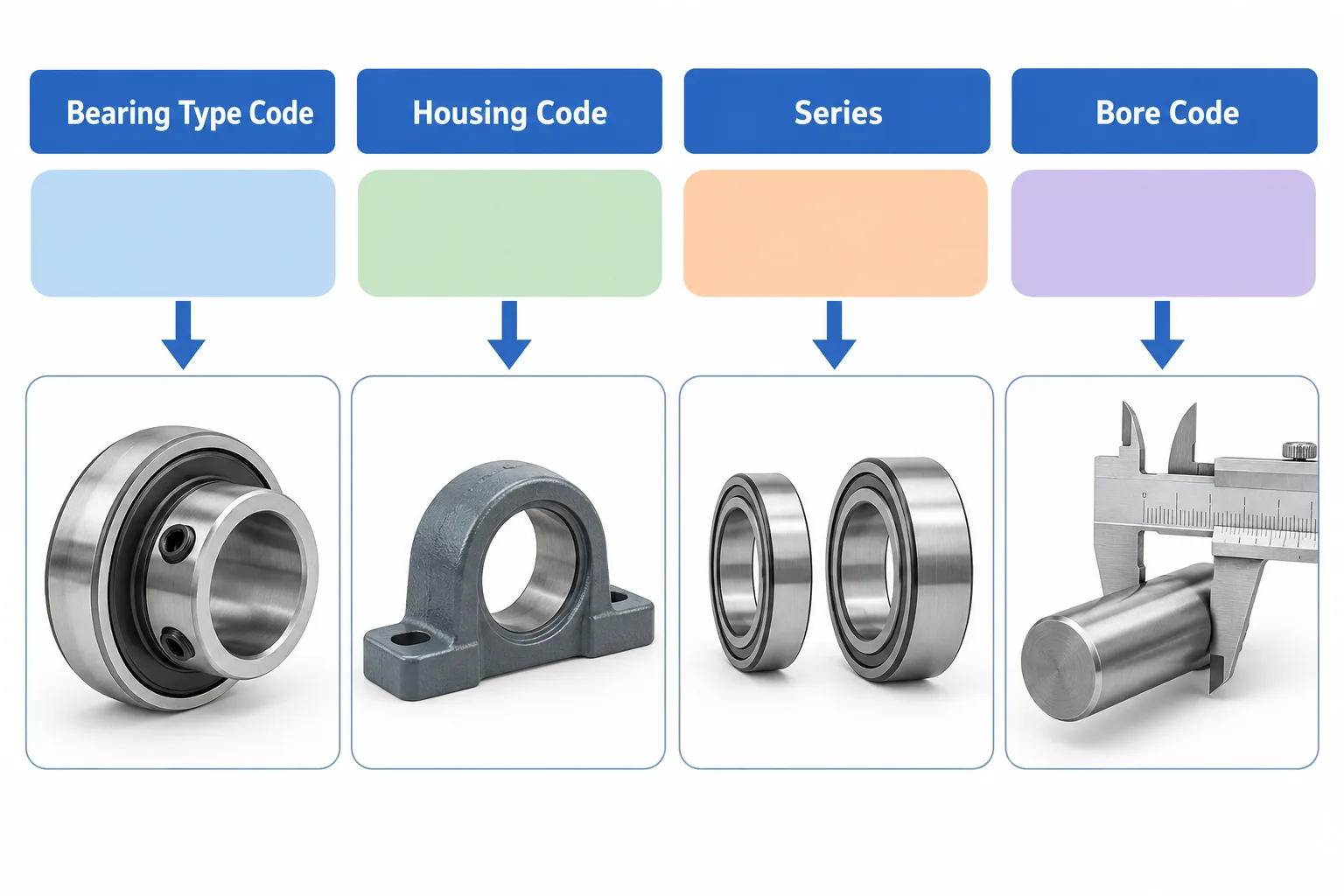
The unit number is also two part numbers joined together. Koyo splits a UCP207 into the insert UC207 and the cast part P207 [1]. NTN lists its UCFL206 as a UC206 insert in an FL206 bearing housing [3]. So when an insert wears out, you can order the insert alone and leave the casting bolted to the machine.
| Unit number | Insert | Casting | Bore |
|---|---|---|---|
| UCP205 | UC205 | P205 | 25 mm [2] |
| UCF205 | UC205 | F205 | 25 mm [1] |
| UCFL205 | UC205 | FL205 | 25 mm [1] |
| UCT206 | UC206 | T206 | 30 mm [1] |
The three 205 units carry the same UC205 insert. It has a 25 mm bore, a 52 mm outside diameter and a 34.1 mm wide inner ring. The UC205 page lists the other sizes in the UCP series and its flanged cousins.
The split works the other way too, and in 2025 it caught out one of our customers. An order came in for “F205”, with the UC left off. F205 is the flange housing alone, so that is what we shipped. The customer opened the cartons and found housings with no bearings in them. We sent the UC205 inserts after them, and recorded an installation video in case the customer had not fitted inserts into housings before. If you want the complete unit, write UCF205, not F205.
What the first two letters stand for
Many websites expand the first two letters as “universal” or “unit, cylindrical”. No catalog we checked does. Koyo defines the code as “cylindrical bore, with set screws” [1]. SKF’s wording is “insert bearing, cylindrical bore with set screws” [2]. It is a label for a design, not an abbreviation.
The neighbouring codes make it easy to remember:
- UK: tapered bore, fitted on an adapter sleeve [1][2].
- NA: cylindrical bore with an eccentric locking collar (Koyo) [1].
- SB: set screws on a narrower ring, a light duty type [1].
- SA: eccentric locking collar on a narrower ring [1].
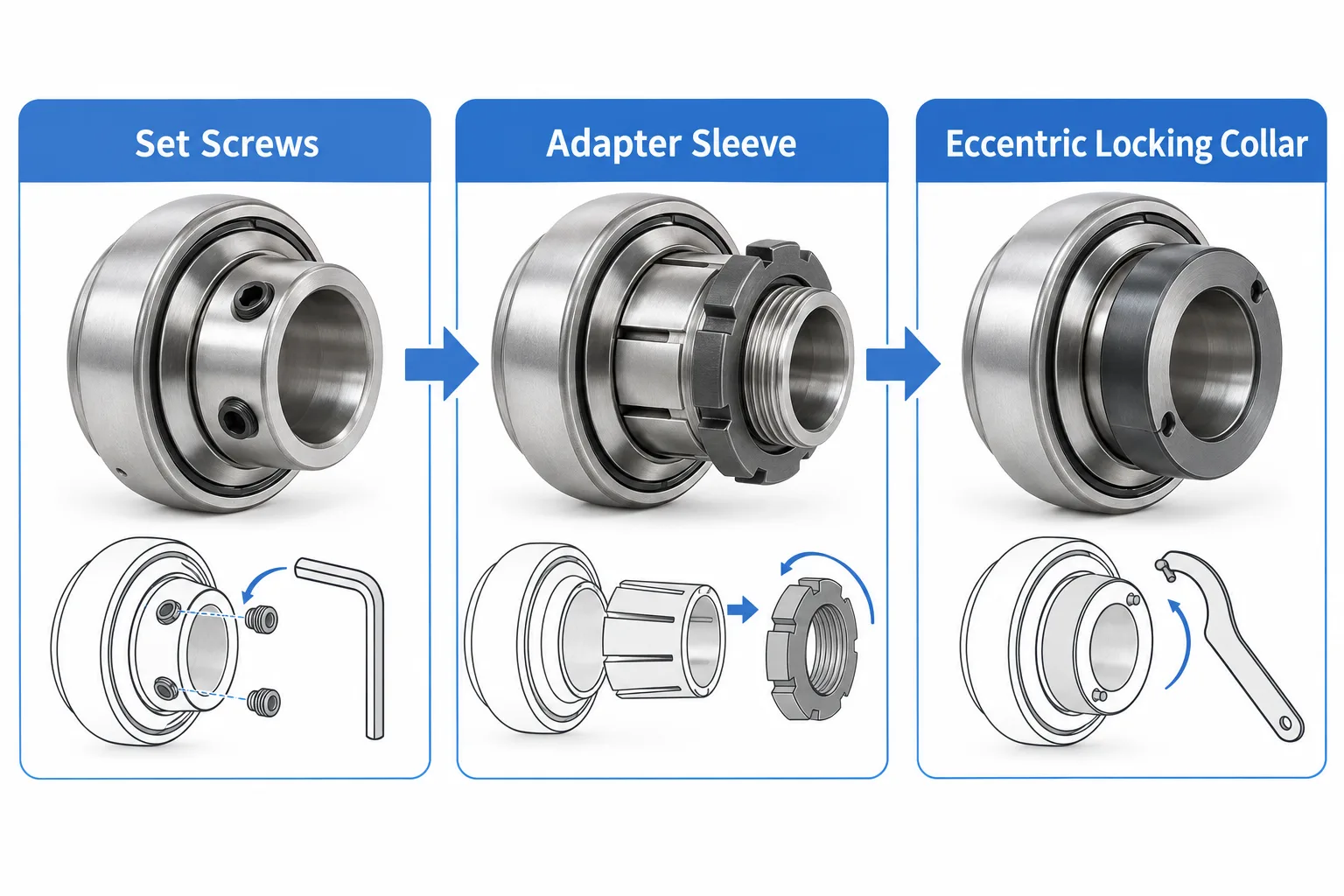
Every one of these inserts has a spherical outside surface. The casting has a matching seat, so the insert can tilt a little and follow a line that is not exact [1]. That is why a mounted unit tolerates small shaft misalignment and still lets the shaft rotate freely. The insert takes mainly radial load, with some axial load.
The width of that extended ring matters more than it looks. We wrote up an order where a cheaper batch arrived narrower than standard: see insert ring size. Our insert bearing pages list the SB and SA sizes we make.
P, F, FL and T: what the housing letter tells you
The letter after the insert code names the casting. Each maker words them a little differently, so one unit can carry three descriptions in three catalogs. The four turn up on conveyors, fans, agricultural machinery, textile and packaging machinery and agitators. The boundary dimensions of these cast housings are set in ISO 3228:2013 [4], and Koyo builds its numbers to JIS B 1557 [1], which is why a unit with the same number from another maker usually lands on the same bolt holes.
P is a pillow block. Koyo and SKF both use that name [1][2]. In Europe the older word is plummer block. The two-bolt base sits on a flat surface. Our pillow block bearing page lists the sizes we make.
F is a square flange. SKF describes it as a square 4-bolt type, mounted using four bolts, one near each corner [2]. Koyo calls it the square-flanged type [1]. You mount it on a wall that is square to the shaft. See flange bearing sizes. Koyo adds an S for stainless steel versions, SF and SFL for the flanges and SP for the pillow block, with a UC-S6 stainless steel insert [1].
FL is an oval flange. Koyo calls it rhombic-flanged, SKF an oval 2-bolt type, and NTN a two bolt rhombus flanged unit [1][2][3]. They are one design family. No catalog we checked spells out the L, so read FL as one code. An FL unit suits a narrow side wall where a square casting will not fit.
T is a sliding unit. SKF lists it as a take-up unit for linear motion [2]. The casting has a slot on each side and slides in a frame. Moving it sets the tension of a belt or chain, which is how many conveyor tail pulleys are adjusted. Our take-up bearing page starts at the UCT206 for 30 mm.
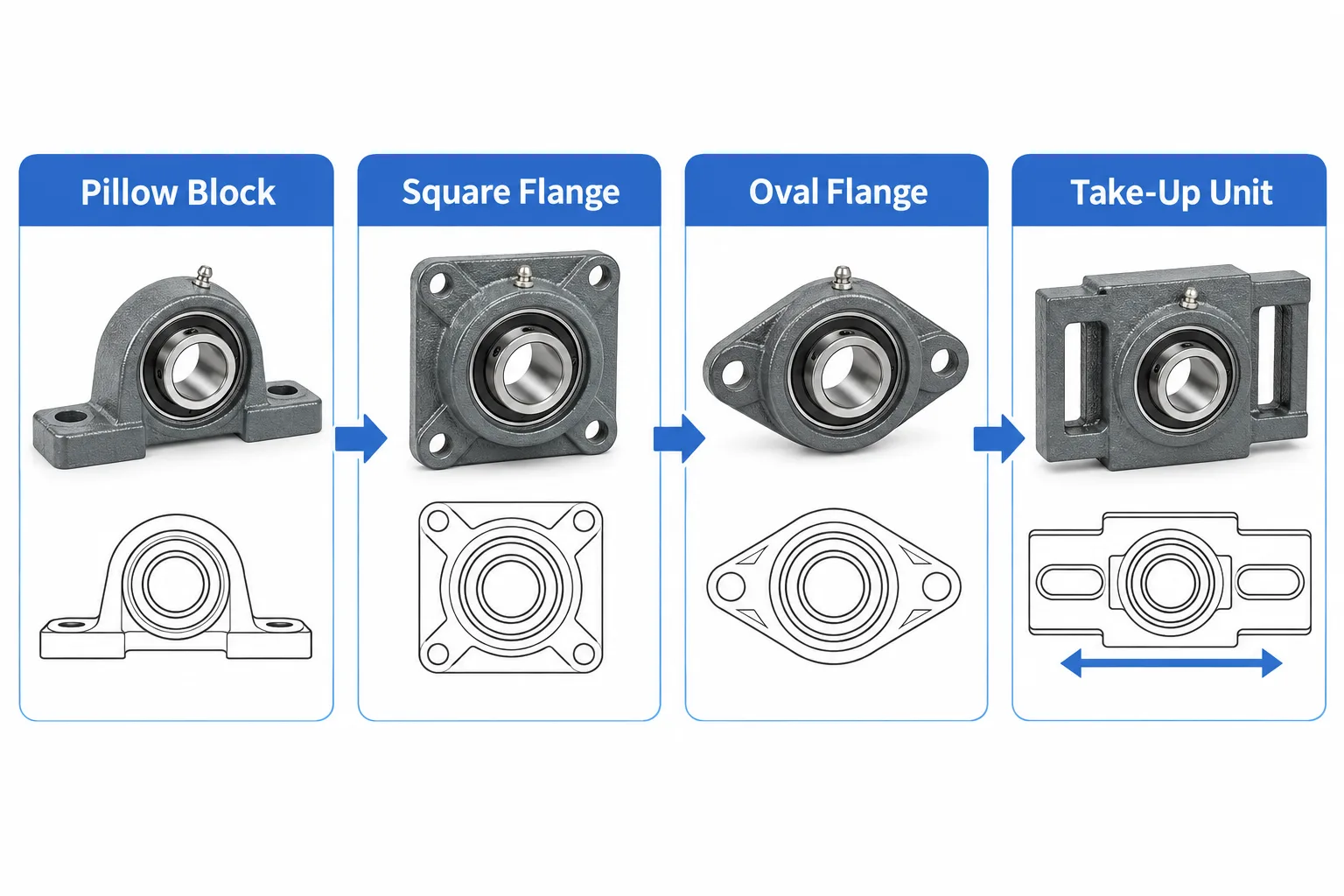
Which of the four suits a machine is a different question. It depends on where you mount the unit, the mounting surface and the space around it, and the housing type selector linked above answers it.
Other letters: PA, PH, FC, FB, FA, C and HA
Catalogs list more letters than the four above. Koyo and SKF agree on most of them [1][2]:
| Letter | Koyo [1] | SKF [2] |
|---|---|---|
| PA | Tapped-base type | Tapped base unit |
| PH | Higher centre height | High center height |
| IP | Thick section | Thick pillow block unit |
| LP | Light duty | Lower center height |
| FC | Round, with spigot joint | Round 4-bolt type |
| FS | Square-flanged type | Square piloted 4-bolt type |
| FB | Three-bolt type | 3-bolt type |
| FA | Adjustable rhombic type | Take-up for swivel motion |
| C | Cartridge type | Cartridge unit |
| HA | Hanger type | Hanger unit |
PA, PH, IP and LP are variants of P [1][2]. Cartridge units fit into a bored hole in a machine frame. Two rows need care. FA is a different part in each catalog, so an order for it should come with a drawing or a photo. FC has two uses in Koyo’s system. Right after the insert code, it is a round casting, as in our UCFC208. At the end of the number, it is a cast iron cover, open type [1].
The numbers: series 2 or 3 and the bore code
One digit follows the letters. SKF calls 2 the normal series and 3 the heavy duty series [2]. Koyo calls both 2 and X medium duty and 3 heavy duty [1]. A 200 series unit suits medium loads. A 300 series unit has a larger insert for the same bore, so a UCP205 and a UCP305 take the same bore size but are not the same casting.
The last two digits are the bore code. From 04 upwards, multiply by five: 05 is 25 mm, 09 is 45 mm, and 28 is 140 mm, so the UCP328 fits 140 mm [1]. Below 04 the codes are fixed: 00 is 10 mm, 01 is 12 mm, 02 is 15 mm and 03 is 17 mm [1].
Inch units add a dash and the bore in sixteenths of an inch. SKF’s example UCF205-15 is 15/16 in, or 23.813 mm [2]. A UCP205-16 is therefore a 205 unit with a 1 in bore. For a full number with a seal or clearance suffix, paste it into the bearing number decoder.
Letters after the size: seals, covers and fit codes
Koyo’s list shows what else can follow the size [1]:
- L2, L3: seal type, double-lip or triple-lip.
- C, D: pressed steel cover, open or closed end.
- FC, FD: cast iron cover, open or closed end.
- J, H, K: tolerance class of the seat in the casting, J7, H7 or K7.
SKF uses different suffixes, for example VZ811 for a housing with a groove for mounting an end cover [2].
A cover keeps out dust and water, but it also limits the tilt. Koyo gives an allowable alignment angle of 3° for a standard unit and 1° for a unit with a cover [1]. Lubrication goes in through the grease fitting on the casting, and the seal and grease together set the operating temperature range.
In our experience, inquiries often leave out the letters before and after the size. Those letters tell the factory which seal, cover and fit the old unit had, so copy the full marking from the casting and from the insert. On mounted units, trouble usually starts at the set screws: the inner ring stops holding on the shaft, often under vibration. Before packing, our workshop checks how the insert fits and turns in its casting, the base-to-centre height across the batch, and the internal clearance.
What to send when you order a mounted unit
A complete inquiry can be quoted in one round:
- The full number, with every letter before and after the size, for example UCFL205 or UCP205-16.
- Metric or inch bore. If the marking is gone, measure the shaft.
- For any letter other than P, F, FL or T, a photo of the unit and the bolt hole spacing.
- The quantity per size.
- Whether you need the complete unit, the insert only or the casting only.
- Any dust, water or temperature conditions that call for a different seal or a cover.
For brand part numbers, our cross reference pages list the UCP 200 series and the flanged unit 200 series side by side. Our inserts are GCr15 chrome bearing steel as standard, and the steel maker’s material certificate is available on request for OEM and industrial orders. Backed by 20+ years of bearing export experience in Linqing, Shandong. Send the list through the contact page or to sales@fuli-bearings.com.
Koyo, SKF and NTN are trademarks of their respective owners. FULI is not affiliated with, authorized by or endorsed by any of them. Their published technical material is cited here as general reference only.
Sources
- https://koyo.jtekt.co.jp/en/support/catalog-download/uploads/catbs006en.pdf
- https://cdn.skfmediahub.skf.com/api/public/0901d19680bd1e86/pdf_preview_medium/0901d19680bd1e86_pdf_preview_medium.pdf
- https://bearingfinder.ntnamericas.com/item/two-bolt-flange-units/mbus-flanged-unit-cast-housing-set-screw-ucfl-type/ucfl206
- https://www.iso.org/standard/53719.html
FAQ
What is the full form of UCP in bearings?
UCP means a UC insert in a P pillow block. The first two letters are the catalog code for an insert ball bearing with a cylindrical bore that locks with set screws. Koyo and SKF define them as a code, not as an abbreviation of two words.
What is the difference between UCT and UCP bearings?
Both carry the same insert for a given size. A UCP pillow block bolts to a fixed base. A UCT unit slides in a frame, so the shaft can be moved to set belt or chain tension, and it needs that frame to work.
What is the difference between UCF and UCFL bearings?
Both are flanged units with the same insert. F is a square casting held by four bolts. FL is an oval or rhombic casting held by two bolts, for a narrower mounting space.
What is the UCP205 bearing unit?
A UC205 insert in a P205 block: 200 series, bore code 05, so a 25 mm bore. Standard tables give a centre height of 36.5 mm and M10 base bolts. The inch version for a 1 in bore is written UCP205-16.
Is there a UCT205?
The code is valid: a UC205 insert in a T205 frame unit for 25 mm. Our sliding units online start at the UCT206 for 30 mm, so for a UCT205 send the number and we will confirm.
Are UCP units from different makers interchangeable?
The main dimensions of cast housings for insert bearings follow one international standard and, in Japan, JIS B 1557, so units with the same number usually swap. Check the suffix letters, the grease fitting position and inch or metric bore before you mix brands on one machine.