Static vs Dynamic Load Rating: What C and C0 Mean on a Bearing Spec Sheet
Static vs dynamic load: what C and C0 mean, how the dynamic load gives L10 bearing life, when the static load decides size, with real catalog rows.
Every bearing table has two load columns in kilonewtons, and the static vs dynamic load rating question is which one limits your job. C, written Cr for radial types, is the basic dynamic load rating. C0, written C0r, is the basic static load rating. Buyers often read them as two versions of the same limit. They are not.
The difference between static and dynamic ratings is the failure each one guards against. C describes fatigue in a bearing that turns under load. C0 describes the permanent dent that forms when it is standing still, moving very slowly or taking a shock [1] [2]. Some catalogs print the same two numbers as static vs dynamic load capacity; the meaning is the same.
This article explains both ratings with real rows from FULI’s catalog. It then works through the L10 life calculation and the static check, and ends with the data to put in an inquiry when the load is the difficult part of the job.
Static vs dynamic load rating at a glance
The table sets static load vs dynamic load side by side, so you can see which one answers which question.
| Dynamic rating: C (Cr, Ca) | Static rating: C0 (C0r, C0a) | |
|---|---|---|
| Failure it guards against | Rolling contact fatigue: flaking after many load cycles | Permanent indentation of raceway and rolling element |
| Typical condition | Rotating under load | Stationary, slow oscillation, under 10 r/min, or peak and shock loads |
| Definition | Constant load at which the basic rating life is one million revolutions [1] | Load that produces a set contact stress at the hardest-loaded contact [2] |
| Used in | L10 = (C/P)^p | s0 = C0/P0 |
| Question it answers | How long will it run? | Will it dent? |
| Standard | ISO 281 [1] | ISO 76 [2] |
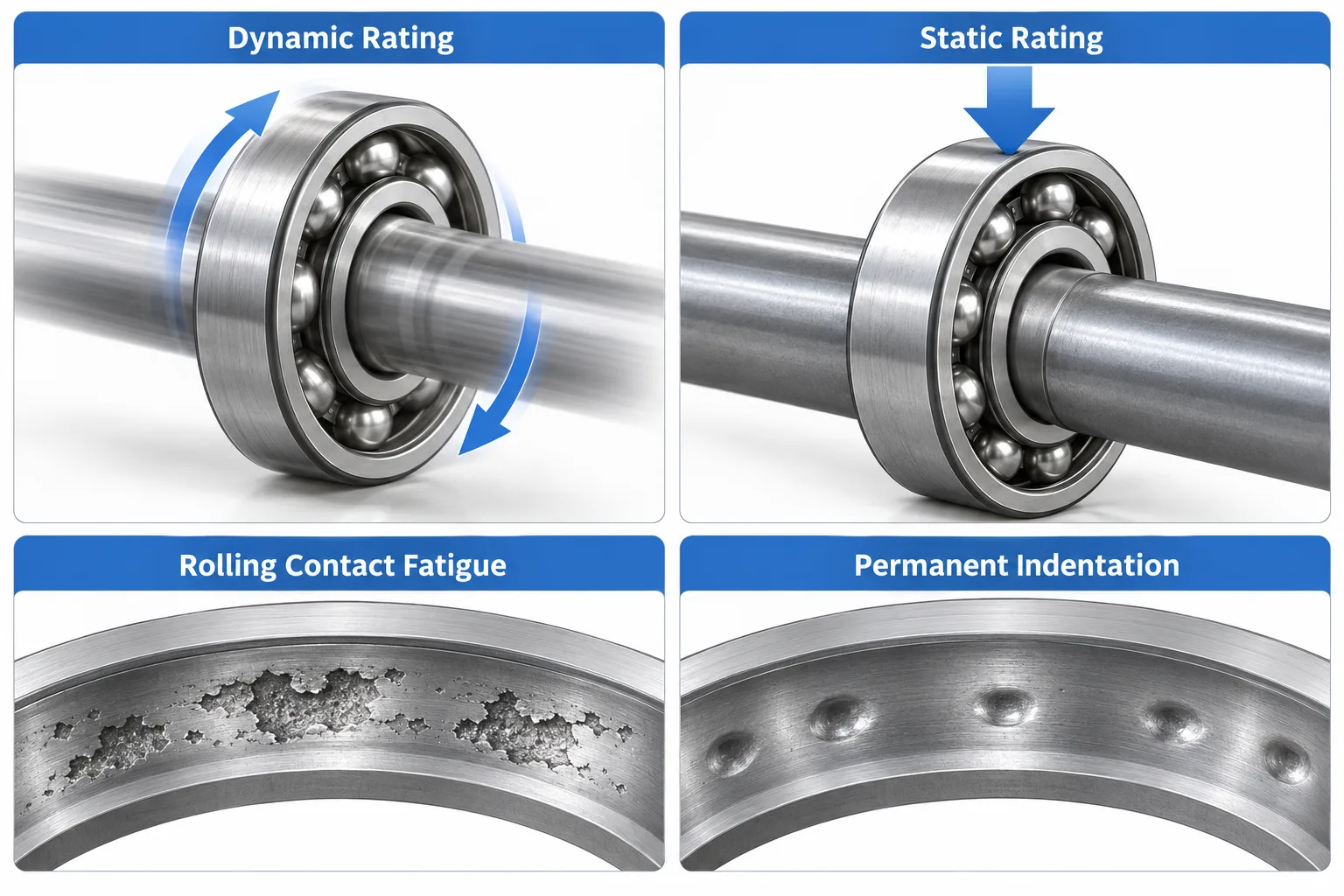
Neither number is a maximum load you can safely apply. A rotating unit loaded at exactly C reaches its rated life after one million revolutions, which is about 11 hours at 1,500 rpm. One loaded to C0 has already taken a small permanent deformation [2]. NTN states that its life formulas no longer apply when the radial load is above C0r or above 0.5 Cr [4]. In practice both ratings are reference values: you compare your real load against them, and the ratio tells you how much margin you have.
Where the two numbers come from: the dynamic and static rating standards
Dynamic rating. ISO 281 defines the basic dynamic radial load rating as a constant radial load, fixed in direction, under which the bearing in theory lasts one million revolutions of basic rating life [1]. Basic rating life is the life reached or exceeded by 90% of a large group of identical bearings under the same conditions [1] [3]. For thrust designs the same idea uses a centric axial load, and the catalog writes it Ca [1] [4].
The calculation assumes high quality hardened steel and good manufacturing practice [1]. SKF states that its ratings apply to chromium steel heat treated to at least 58 HRC [3].
Static rating. ISO 76 sets C0 by the contact stress at the middle of the contact that carries the most load [2]:
- self-aligning ball bearings: 4,600 MPa [2]
- other ball bearings: 4,200 MPa [2]
- roller bearings: 4,000 MPa [2]
At these stresses the total permanent deformation of rolling element plus raceway is about 0.0001 of the rolling element diameter, and experience shows a dent of that size does not impair operation [2] [4]. For a 10 mm ball that is a dent of about 1 µm. Above that level, the dents grow quickly and the running gets rough.
Reading static and dynamic load capacities on a FULI catalog row
These are rows from FULI’s catalog; each model page carries the same figures:
| Model | Type | d × D × B or T (mm) | Cr (kN) | C0r (kN) | C0r / Cr |
|---|---|---|---|---|---|
| 6203 | Deep groove ball | 17 × 40 × 12 | 8.64 | 4.60 | 0.53 |
| 6204 | Deep groove ball | 20 × 47 × 14 | 11.52 | 6.65 | 0.58 |
| 6205 | Deep groove ball | 25 × 52 × 15 | on request | on request | – |
| 6206 | Deep groove ball | 30 × 62 × 16 | 17.55 | 10.85 | 0.62 |
| 6305 | Deep groove ball | 25 × 62 × 17 | 19.08 | 10.46 | 0.55 |
| 6306 | Deep groove ball | 30 × 72 × 19 | 24.03 | 14.40 | 0.60 |
| 6208 | Deep groove ball | 40 × 80 × 18 | 26.19 | 17.09 | 0.65 |
| 30208 | Tapered roller | 40 × 80 × 19.75 | 63.00 | 74.00 | 1.17 |
| 22208 | Spherical roller | 40 × 80 × 23 | 96 | 90 | 0.94 |
Values from FULI’s catalog; confirm for your application.
The 6205 ratings are still being checked against our catalog, so its page does not show them yet. Ask for them with the quote.
Three things stand out in the table.
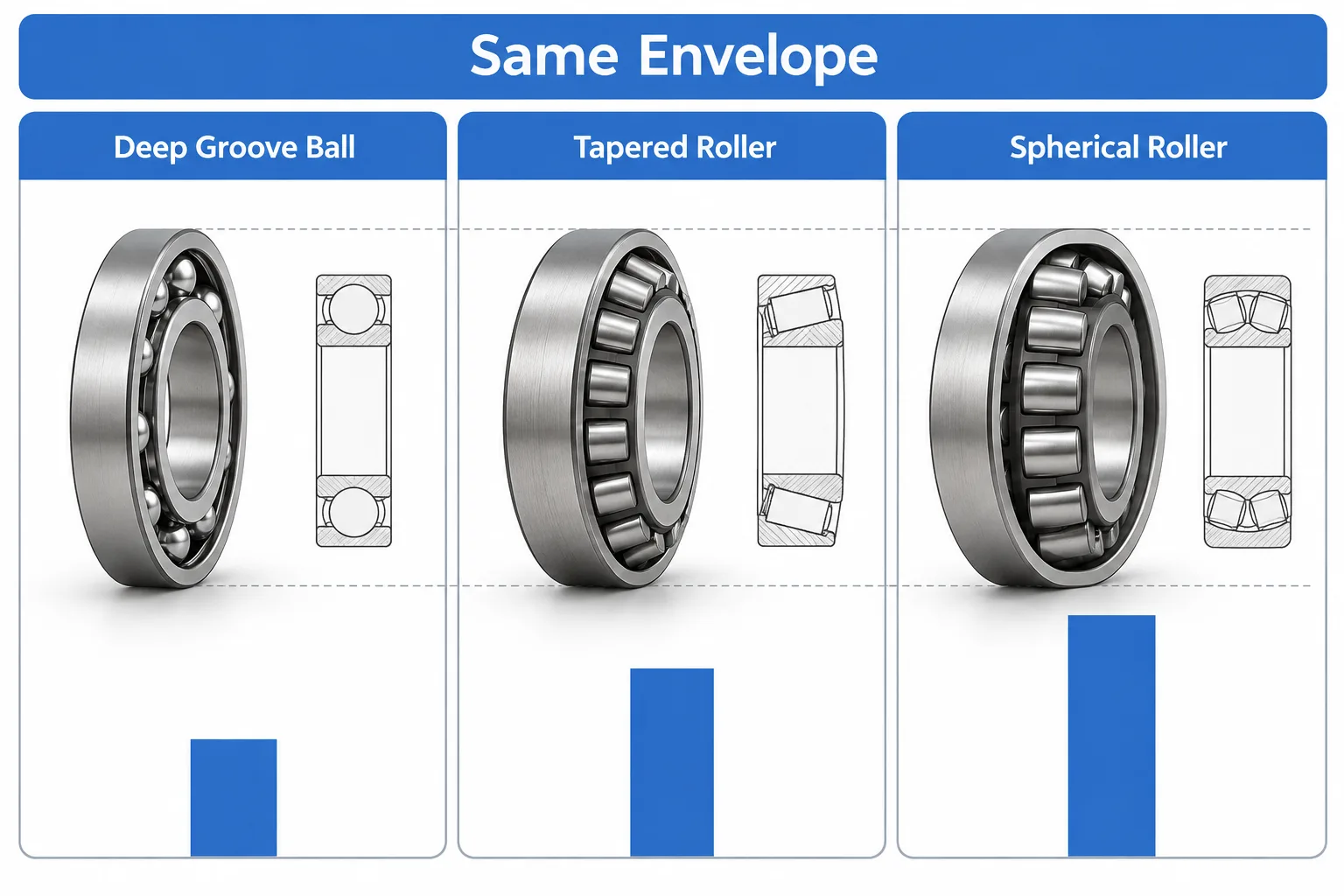
Same envelope, very different capacity. The 6208, 30208 and 22208 each fit a 40 mm shaft and an 80 mm housing bore. The dynamic capacity Cr goes from 26.19 kN for the ball type to 63.00 kN for the tapered roller and 96 kN for the spherical roller. Line contact on rollers carries more than point contact on balls. If the load is heavy and the space is fixed, compare the tapered roller and spherical roller ranges before going to a larger housing.
The two ratings do not move together. The 6206 and 6305 share a 62 mm outside diameter. The 6305 gives up 5 mm of bore and gains about 9% in Cr, but its C0r is slightly lower: 10.46 kN against 10.85 kN. A size that wins on fatigue life can lose on static capacity.
The ratio depends on the type. C0r is 0.53 to 0.65 of Cr for the ball rows and 0.94 to 1.17 for the roller rows. That ratio is not a quality score. C and C0 come from different formulas with different limits, so check each one against its own load case.
Load capacity ratings also differ between catalogs for the same size. The 25 × 52 × 15 mm envelope of a 6205 is standard, but ISO 281 calculates C from the number of rolling elements, their diameter, the material and the internal geometry [1], and each maker sets those for its own design. Compare ratings from one catalog, or check that two catalogs use the same basis. Our deep groove ball range uses GCr15 chrome steel, and a material certificate is available on request.
Catalog ratings also assume hardened chrome steel. In a 2008 order for 51108 thrust ball bearings, the customer used them in a robot arm with very low load that moved only a few times a day. Our factory changed the material from GCr15 to 45 steel and cut rough grinding from six passes to three, and the price came down by about 30%. Those parts no longer carry catalog ratings. That was acceptable only because the real load was far below them. The full order is in our 51108 article.
Dynamic load rating and L10 bearing life calculation
The basic rating life comes from one short formula [3] [4]:
- L10 = (C / P)^p, in millions of revolutions
- p = 3 for ball types, p = 10/3 for roller types
- L10h = 1,000,000 / (60 × n) × L10, in hours, where n is the speed in rpm
P is the equivalent dynamic bearing load. For a deep groove ball bearing with little axial load, P equals the radial load Fr. When Fa/Fr is above the limit e given in the catalog, P = X·Fr + Y·Fa, with X and Y from the catalog tables [3].
Worked example. Take a ball bearing with C = 20 kN, a generic number used only for this calculation, running at 1,000 rpm under P = 2 kN:
- C/P = 10, so L10 = 10³ = 1,000 million revolutions
- L10h = 1,000,000,000 / (60 × 1,000) = about 16,700 hours
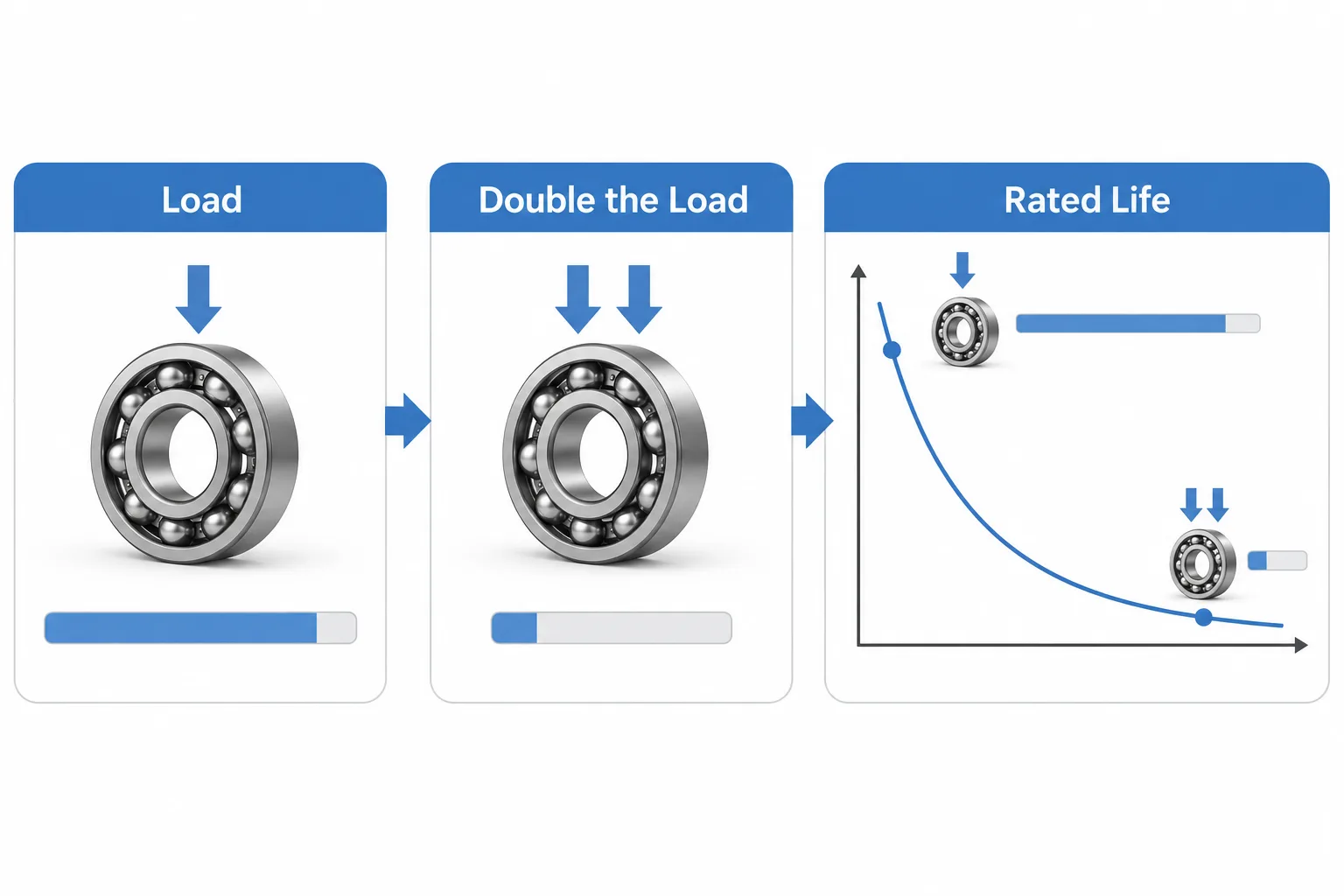
Now double the load to 4 kN. C/P = 5, L10 = 125 million revolutions, and L10h drops to about 2,100 hours, one eighth of the first figure. For a roller bearing, doubling the load cuts the rated life to about one tenth. This is why the load figure in the life calculation matters more than any other input.
Reliability and operating conditions. L10 is the life at 90% reliability [1]. ISO 281 adds a modified rating life, Lnm = a1 × aISO × L10, where aISO covers lubrication, contamination and the fatigue load limit [1] [4]. NTN gives these a1 values [4]:
| Reliability | Life symbol | a1 |
|---|---|---|
| 90% | L10 | 1.00 [4] |
| 95% | L5 | 0.64 [4] |
| 99% | L1 | 0.25 [4] |
How long should it be? That is a design target set by the machine builder. SKF gives guideline values of specification life, for example 300 to 3,000 operating hours for agricultural machines, 10,000 to 25,000 hours for general gear drives and industrial electric motors used 8 hours a day, and 40,000 to 50,000 hours for pumps, compressors and textile machinery in continuous 24-hour use [3]. SKF also notes that the calculated rating life can deviate significantly from actual service life, which also depends on lubrication, contamination and mounting [3]. We do not quote life hours for our products. The calculation belongs to whoever knows the load.
When the static load decides the size
SKF lists four cases where size should be selected or verified on static load capacity, C0, rather than on fatigue life [3]:
- it is not rotating and carries continuous high load or intermittent peak loads
- it makes slow oscillating movements under load
- it rotates under normal loads but must also take temporary high peak loads
- it rotates under load below 10 r/min and only needs a limited life
Equivalent static load. Combined loads are converted into one equivalent value, P0 = X0·Fr + Y0·Fa. For a single-row deep groove design, P0 = 0.6 Fr + 0.5 Fa, and if the result is smaller than Fr, use P0 = Fr [3]. Use the peak load that can occur, not the average.
Static safety factor. s0 = C0 / P0 [3] [4]. NTN gives these minimum values [4]:
| Operating condition | Ball | Roller |
|---|---|---|
| Quiet rotation required | 2 | 3 |
| Impact loads | 1.5 | 3 |
| Normal rotation | 1 | 1.5 |
Worked example with catalog values. A 6206 (C0r 10.85 kN) sees Fr = 4 kN and Fa = 1.5 kN. P0 = 0.6 × 4 + 0.5 × 1.5 = 3.15 kN. That is less than Fr, so P0 = 4 kN and s0 = 2.7, which clears the quiet-running guideline. Now add a shock that lifts Fr to 9 kN for a moment. P0 becomes 9 kN and s0 drops to 1.2, below 1.5 for impact loads. A 6306 on the same 30 mm shaft has C0r 14.40 kN, which gives s0 = 1.6. Values from FULI’s catalog; confirm for your application.
Skipping this check shows up as noise later. A stationary or slowly oscillating unit that has been dented runs with high vibration and friction once it turns continuously, and the internal clearance can grow [3].
Examples of static and dynamic loads in real machines
Mainly dynamic: belt pull on an electric motor shaft, the rotor weight in a fan, the tension on a conveyor pulley. These run for thousands of hours, so C and the L10 calculation set the size.
Mainly static or peak: a hook block that holds its load still, a pivot that swings a few degrees under weight, a crusher or vibrating screen that takes repeated blows, a disc harrow gang that hits stones while it turns slowly. Here C0 and the safety factor often decide the size, even when the fatigue life looks long enough.
Too little load is a problem as well. Lightly loaded rolling elements can skid instead of roll. SKF recommends a minimum load of 0.01 C on ball types and 0.02 C on roller types [3].
Linear bearings and ball screws use their own rules. ISO 14728-1 covers rolling element linear bearings and defines their C for a basic rating life of 100 km of travel [5], and some makers rate their ball-type linear guides on 50 km instead, so the two figures need converting before comparison [6]. Their C figures cannot be compared with the C of a 6206, which is based on one million revolutions. That difference explains why linear guide tables often show C0 above C, which does not happen on a deep groove ball bearing.
What to send when load is the hard part of the job
A model number alone tells us the size. To check static and dynamic load capacities as well, send:
- Radial load Fr and axial load Fa, in kN or kgf, at each position
- Whether the load is steady, or has peaks or shocks, and how large the peaks are
- Speed in rpm, or the swing angle and cycle rate for oscillating motion
- Hours of running per day and the life the machine designer requires
- Operating temperature, lubrication, and shaft and housing details
We will send the catalog C and C0 for the model you name. Where our catalog value is still being checked, as for the 6205 today, we say so instead of filling in a number. The bearing inquiry builder puts these fields into one message, and the bearing size finder on our tools page helps when you have only measurements. For the split between radial and axial jobs, see ball and roller types by load direction.
Send the loads with your quote request and we will reply with the catalog ratings for the sizes that fit.
Sources
- https://cdn.standards.iteh.ai/samples/38102/19bd8675eaa845478e827e04e1e6d893/ISO-281-2007.pdf
- https://cdn.standards.iteh.ai/samples/38101/14dc866ce6be4190900c69582d079868/ISO-76-2006.pdf
- https://www.skf.com/binaries/pub12/Images/0901d196802809de-Rolling-bearings---17000_1-EN_tcm_12-121486.pdf
- https://www.ntnglobal.com/en/products/catalog/pdf/2203E_a03.pdf
- https://cdn.standards.iteh.ai/samples/66682/2a9adf0ff19f434389c044e82d12b587/ISO-14728-1-2017.pdf
- https://tech.thk.com/en/products/pdf/en_b01_073.pdf
FAQ
What is the difference between static load and dynamic load?
A dynamic load acts while the shaft rotates, so every point on the raceway is loaded again and again until the steel fatigues. A static load acts while the shaft stands still or barely moves, and the risk is a permanent dent. That is why a catalog gives two numbers: C for fatigue life and C0 for denting.
What is an example of a static load?
A crane hook block holding a load while it hangs still, a pivot that swings a few degrees under weight, or a stopped shaft that takes a heavy blow. In each case the rolling elements press on the same spots of the raceway, so the check is against C0, not C.
Can you give me an example of a dynamic load?
Belt pull on an electric motor shaft, the weight of a fan rotor, or the tension on a conveyor pulley. The load acts while the shaft turns at hundreds or thousands of rpm, so the size comes from C and the L10 life calculation.
Why is C0 lower than C on a ball bearing?
The two numbers come from different formulas with different limits. C is the load for a rated life of one million revolutions, and C0 is the load that brings contact stress to 4,200 MPa on a ball. In FULI's catalog, C0r is about 0.53 to 0.65 of Cr for the deep groove ball rows and about 0.94 to 1.17 for the spherical and tapered roller rows.
How do I calculate L10 life?
Divide the dynamic rating C by the equivalent load P and raise the result to the power 3 for ball types or 10/3 for roller types. The answer is in millions of revolutions. Multiply by 1,000,000 and divide by 60 times the speed in rpm to get hours.
Can you run above the dynamic load rating?
Not in normal service. At a load equal to C, the rated life is only one million revolutions, about 11 hours at 1,500 rpm. NTN also states that its life formulas do not apply when the radial load is above C0r or above half of Cr.