Bearing Brinelling: Mounting Damage, Transit Damage or a Bad Batch?
Bearing brinelling leaves dents at ball spacing. How to tell mounting dents from false brinelling and a bad batch, and how to mount the next bearing.
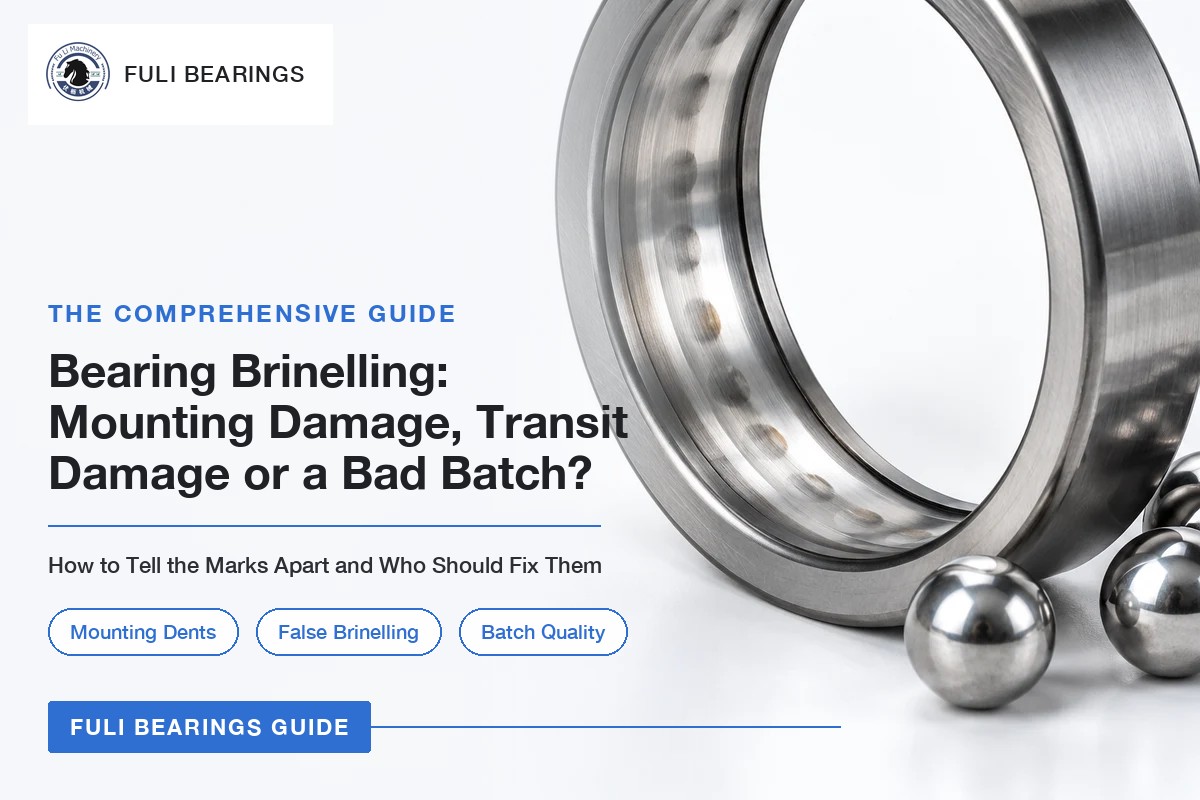
Bearing brinelling is a row of indentations in the raceway of a rolling element bearing, spaced like the balls or rollers, left when a load goes through the rolling elements and dents the steel [1] [2]. When a new bearing runs noisy, the cause is one of three things: mounting impact, vibration in transit or at standstill, or a batch that left the factory out of spec.
Each one has a different fix and a different owner. Below: how each kind of mark forms, how to tell them apart, what to check when the raceway shows no marks, and how to mount the next bearing without denting it.
Bearing brinelling from mounting impact
True brinelling is plastic deformation. The contact stress between a ball and the raceway goes past the yield strength of the steel, and the dent stays [5]. The name comes from the Brinell hardness test, which presses a hard ball into a surface and measures the mark [5].
In a bearing, the dents sit at rolling element spacing [1]. SKF groups static overload, shock loads and rough handling into one failure mode, because the damage looks the same whatever the cause [1]. Schaeffler lists the usual causes: a hammer used to fit the bearing, dropping or striking the assembled parts, or pressing the bearing onto a shaft through the outer ring [2]. In each case the force crosses the balls or rollers on its way to the ring that has the tight fit.
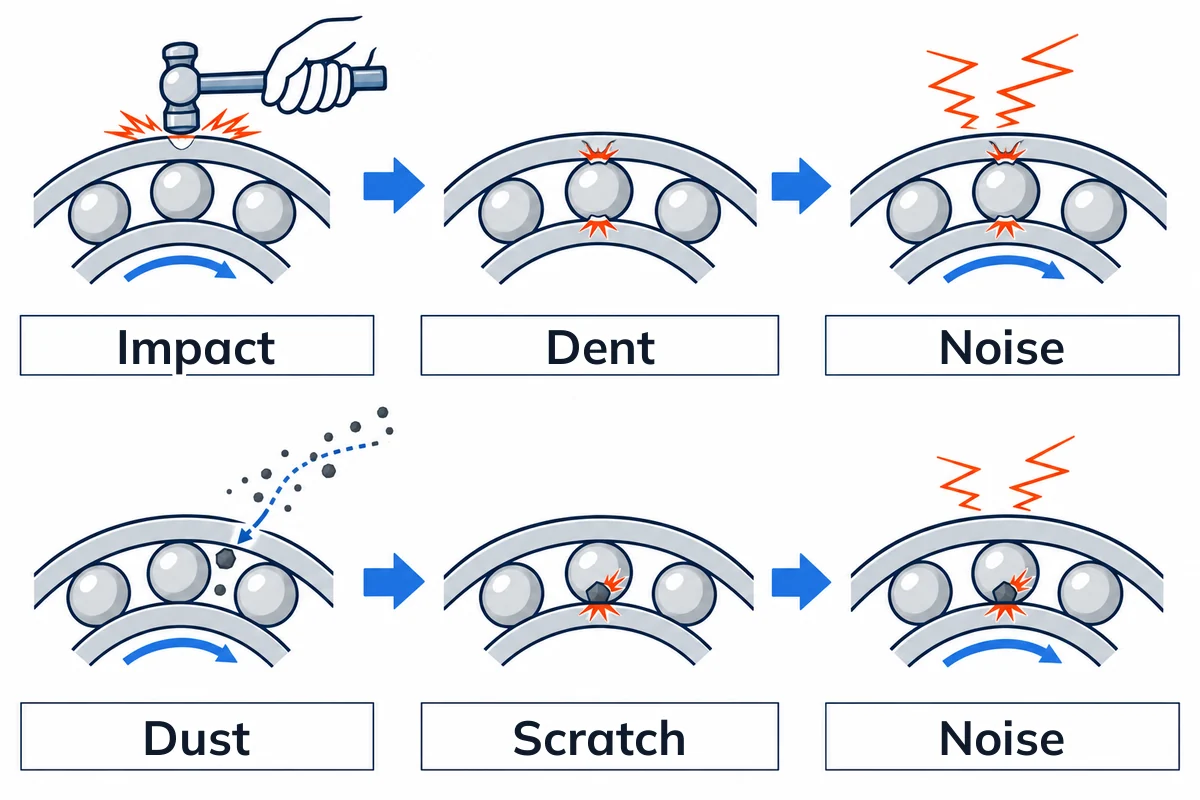
A dent made at mounting stays with the bearing. Schaeffler links these marks to increased vibration and noise, and severe dents to early fatigue or fracture [2]. SKF adds that the damage can raise noise, vibration and temperature, and lead to early bearing failure [1].
Dust and dirt do the same kind of damage on a smaller scale. Hard particles that get into the bearing during mounting are rolled into the raceway and leave dents and scratches; SKF traces them to a lack of cleanliness, and Schaeffler to dirty hands, tools and work areas [1] [2]. The raised edges around such a dent are where fatigue starts [1]. Particle dents follow the dirt, so they do not line up at ball spacing.
False brinelling from transit and standstill vibration
False brinelling occurs when the bearing is not turning but the machine around it vibrates. The balls or rollers rock over a tiny distance, no lubrication film forms, and the contact surface wears [1] [2]. NSK describes it as wear from vibration and swaying at the contacts between the rolling elements and the raceway [3]. It is wear and fretting corrosion, not a dent pressed into the steel.
Two situations cause most of it:
- Machines shipped with the bearings already fitted. NSK names vibration of a stationary bearing during transport as a cause [3].
- Standby equipment next to running machines. SKF reports noise in standby equipment that stays idle for long periods while other machines shake it [1].
The marks on a stationary bearing are shallow depressions at rolling element spacing in the loaded zone: round on ball bearings, long and narrow on roller bearings [1]. In grease they are usually reddish-brown; in oil they look very shiny [1]. There is often rust at the bottom of each mark [1]. Unlike mounting dents, they have no raised edges [2]. Several sets of marks means several standstill periods [1].
To prevent false brinelling, NSK recommends securing the shaft and housing during transport, shipping the inner and outer rings packed separately where the design allows, preload to cut the vibration, and a suitable lubricant [3]. Schaeffler adds damping of external vibration and lubricants with anti-wear additives [2]. For standby machines, SKF suggests turning the shaft from time to time [1].
For bearings shipped loose, agree the packing and rust protection with your supplier before production. Our page on bearing packaging and export marking lists what to specify.
Brinelling and false brinelling: how to tell the marks apart
False brinelling marks look much like brinell marks at first glance. Open the bearing, clean one raceway, and compare what you see with this table.
| Check | Mounting dents (true brinelling) | False brinelling | Particle dents |
|---|---|---|---|
| Spacing | At rolling element spacing [1] | At rolling element spacing on a stationary bearing [1] | Scattered |
| Edges | Raised edges, which false brinelling lacks [2] | No raised edges [2] | Raised edges [1] |
| Colour | Look at the edges, not the colour | Reddish-brown in grease, shiny in oil, often rust at the bottom [1] | Look at the edges |
| When it happens | Mounting, dropping, rough handling [1] [2] | Transport or standstill with vibration [1] [3] | Mounting or running with dirt inside [1] [2] |
| What changes it | Fitting method and tools | Fixing, damping and lubricant | Cleanliness at mounting |
Brinelling damage at ball spacing points to the way the bearing was fitted or moved. If you find no marks at ball spacing and the bearing is still noisy, the next section applies.
When the batch is the problem, not the mounting
In our experience at FULI, noise in a new bearing seldom starts at installation. When a new bearing is noisy, it was usually out of spec when it left the factory. That is for the supplier to answer for, and it applies to our bearings as much as anyone’s.
In our factory, noise from assembly comes mostly from knocks while the bearing is being put together. That is why bearings with special noise or vibration requirements are tested one by one on vibration and noise instruments before they are packed.
The most common cause on the user’s side is a grade mismatch: a lower-grade bearing fitted in a machine that needs a higher grade, which then wears and fails. Noise grades and precision classes are separate specifications; our guide to Z2V2 noise grades and precision classes shows how to write both in an order. Our standard shipment grade is Z3V3. If your machine needs another grade, write it in your inquiry.
Before shipment we check rotation smoothness, dimensions, grease fill, rust and appearance, and our inspection report covers rotation noise and vibration. If noisy bearings show no dents at ball spacing, ask the supplier for the inspection report of that lot, ours included, and test a sample with an incoming bearing inspection checklist.
Mounting a bearing without brinelling damage
The rule is short: apply the mounting force to the ring being mounted, and never let it pass through the rolling elements [1] [4]. Three steps keep the next bearing free of dents.
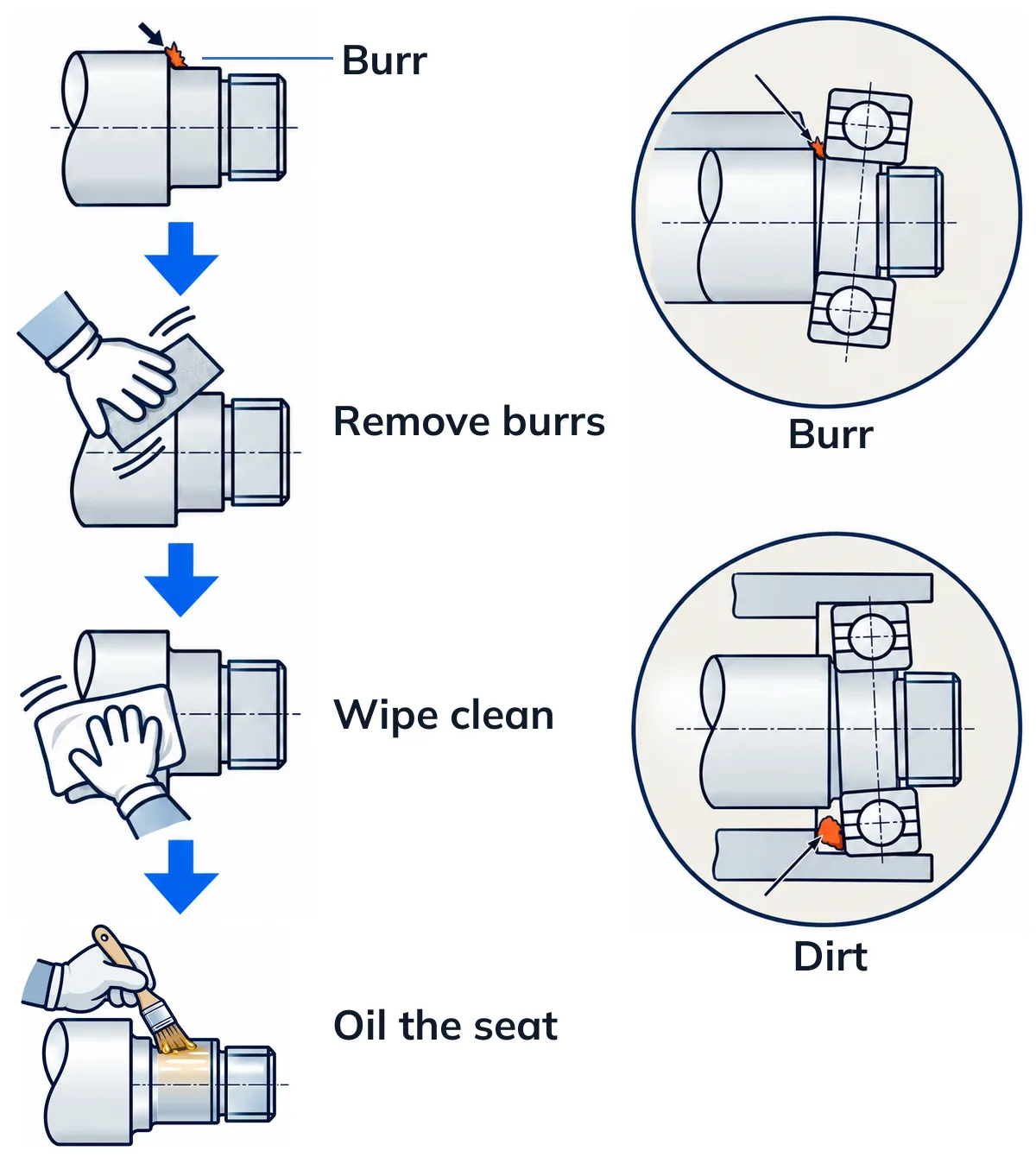
- Remove burrs and wipe clean. Leave bearings in their original packaging until you fit them [2] [4]. Remove burrs from the shaft and housing and clean the seats [4]. Burrs or dirt on a shoulder can stop the bearing from seating square [2]. Do not wash a new bearing; it is already clean [4].
- Oil the seat. Lightly oil the seating surface with thin oil before mounting [4].
- Push the ring with the tight fit. If the bearing is tight on the shaft, push the inner ring with a mounting sleeve. If it is tight in the housing, push the outer ring. If it is tight on both, use a tool that bears on both rings at once, with its contact faces level [4].
Never hammer the bearing directly [1]. If you use a hammer, strike a sleeve placed against the ring with the interference fit, and spread the blows evenly [4]. Pushing the wrong ring sends the force through the balls, which is exactly how mounting dents form. The correct ring is the one with the tight fit.
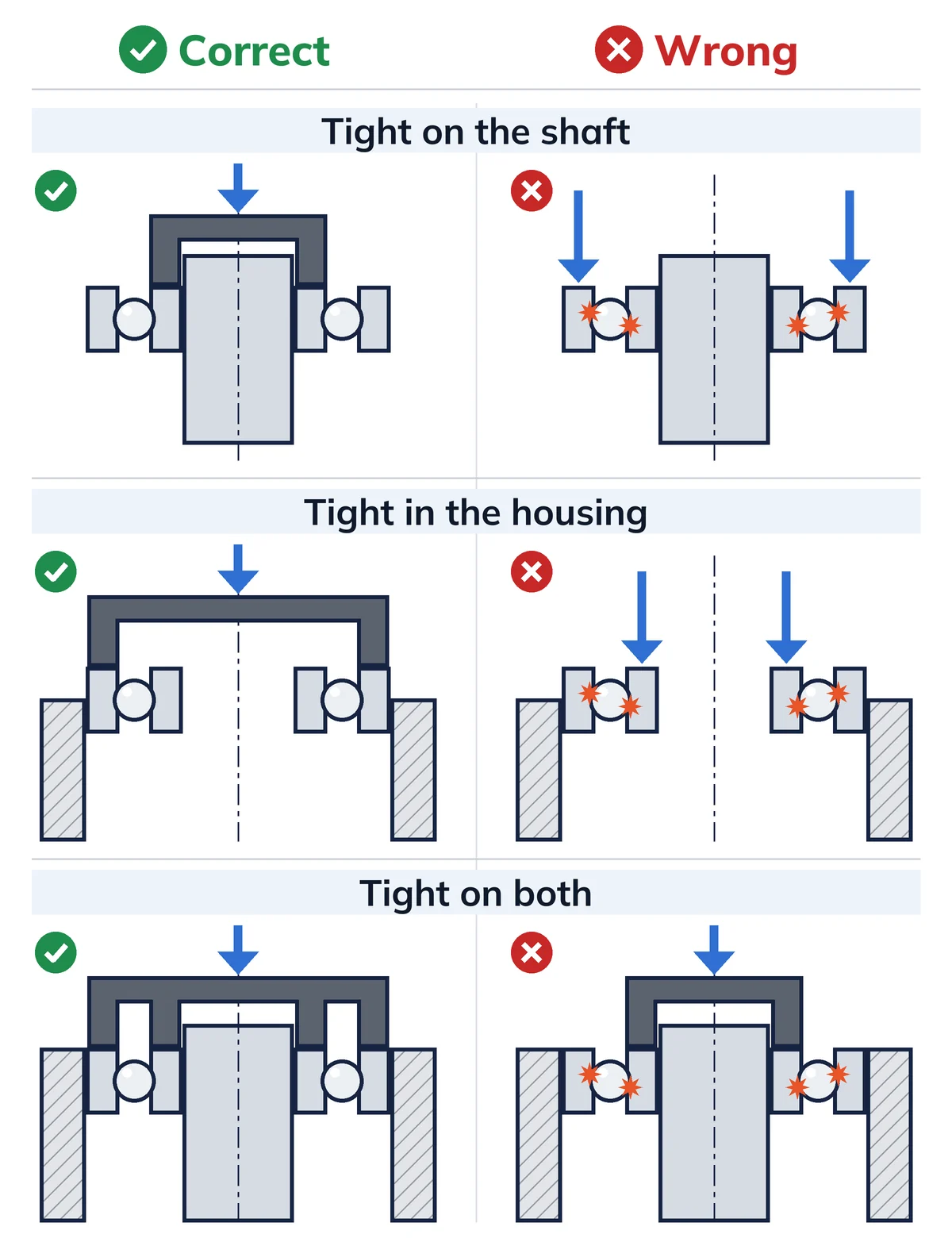
Which ring is tight depends on the shaft and housing tolerances; the shaft and housing tolerance chart lists the common fits. For mounted units, our pillow block bearing installation checklist covers the same checks step by step.
What to send your supplier with a brinelling claim
A claim that says only “noisy” takes several rounds of questions. Send these with the first message:
- photos of the bearing damage that show the spacing between marks on the raceway, and a close-up of one mark with its edges and colour;
- the bearing number and the lot number from the box;
- how it was mounted: press, sleeve, heater or hammer, and which ring took the force;
- how it travelled and how long it stood: fitted in a machine or loose, and any long standstill;
- the machine, its speed, and the noise grade you ordered;
- how many bearings in the lot show the problem.
With these, the supplier can match the bearing wear to a cause on the first reply. Send questions about our deep groove ball bearings or a claim on a FULI lot to sales@fuli-bearings.com or through the contact page. Backed by 20+ years of bearing export experience in Linqing, Shandong. FULI ships to 50+ countries & regions.
SKF, Schaeffler and NSK are trademarks of their respective owners. FULI is not affiliated with, authorized by or endorsed by any of these companies. Their published technical material is cited here as general reference only.
Sources
- https://cdn.skfmediahub.skf.com/api/public/093168a92d25cc46/pdf_preview_medium/093168a92d25cc46_pdf_preview_medium.pdf
- https://www.schaeffler.com/remotemedien/media/_shared_media/08_media_library/01_publications/schaeffler_2/poster/downloads_19/dws_de_en.pdf
- https://www.nsk.com/eu-en/tools-resources/troubleshooting/damage-by-type/false-brinelling/
- https://cdn.skfmediahub.skf.com/api/public/0901d1968024f02a/pdf_preview_medium/0901d1968024f02a_pdf_preview_medium.pdf
- https://en.wikipedia.org/wiki/Brinelling
FAQ
What is brinelling on a bearing?
Permanent dents in the raceway at rolling element spacing. They form when a static or shock load goes through the balls or rollers, for example a hammer blow during mounting.
What is the difference between brinelling and false brinelling?
Brinelling is a dent pressed into the steel by overload. False brinelling is wear from vibration while the bearing stands still. False brinelling marks have no raised edges and are often reddish-brown or shiny.
Can false brinelling happen during shipping?
Yes. NSK names vibration of a stationary bearing during transport as a cause, and recommends securing the shaft and housing while the machine travels.
Does a noisy new bearing mean it was mounted wrong?
Not usually. In our experience a noisy new bearing was out of spec when it left the factory, or is a lower grade than the machine needs. Check for marks at ball spacing before you decide.
How do you prevent brinelling when mounting a bearing?
Push only the ring with the tight fit, keep the force away from the balls, and use a sleeve instead of hitting the bearing.
How do you pronounce brinelling?
BRIN-uh-ling. The word comes from the Brinell hardness test.