Z2V2 Bearing Codes: Noise Grades Are Not Precision Classes
A z2v2 code grades bearing vibration and noise, not precision. What Z1V1, Z2V2 and Z3V3 mean. Why a P class is a separate spec, and how to write both.
A z2v2 bearing carries two vibration grades from Chinese national standards: Z2 for vibration acceleration and V2 for vibration velocity [1] [2]. Its precision class, such as P0 or P6, is a separate specification. A bearing has one of each, and our standard shipment grade is Z3V3.
Below: how to read the code, how the grades are measured, what a precision class controls, why one does not convert into the other, and how to put both in an inquiry.
Reading the code on a z2v2 bearing: Z2, V2 and the other groups
Z and V grades come from Chinese national standards for rolling bearing vibration. GB/T 32333-2015 sets acceleration groups for deep groove ball bearings, written Z, Z1, Z2, Z3 and Z4 [1]. GB/T 32325-2015 sets velocity groups, written V, V1, V2, V3 and V4 [2]. So a Z2V2 bearing meets group Z2 for acceleration and group V2 for velocity.
In both standards the plain group, Z or V, is the basic requirement for general bearings. Groups 1 to 4 are for bearings with higher vibration requirements [1] [2]. Two more acceleration groups, ZF3 and ZF4, add a limit on peaks: the bearing has to reach Z3 or Z4, and its peak level may be no more than 15 dB above its acceleration level [1].
The higher the group number, the lower the limit. For deep groove ball bearings in diameter series 2 with an outside diameter over 50 up to 60 mm, which takes in the 6205, the acceleration limits are [1]:
| Group | Acceleration level limit, dB [1] |
|---|---|
| Z | 46 |
| Z1 | 43 |
| Z2 | 40 |
| Z3 | 37 |
| Z4 | 34 |
The Z in a shield code is a different thing. In 6205-ZZ or 6205-2Z, the Z stands for a shield; one maker’s designation list gives -Z and -2Z as a shield on one or both sides [8]. A vibration group is a separate field at the end of the designation, as in the sample 6204-2RZ/P6 CM V2 [3]. In that sample, 2RZ means a non-contact rubber seal on both sides [3]; a 2RS seal is the contact type. On a sealed ball bearing, the seal code and the vibration group are still two separate fields.
Z/V grades are Chinese terminology. Makers outside China use their own noise specifications. SKF’s electric motor quality, for example, includes a “QE6 noise specification”, and QE6 is not marked on the bearing [8].
How bearing vibration is measured for Z and V grades
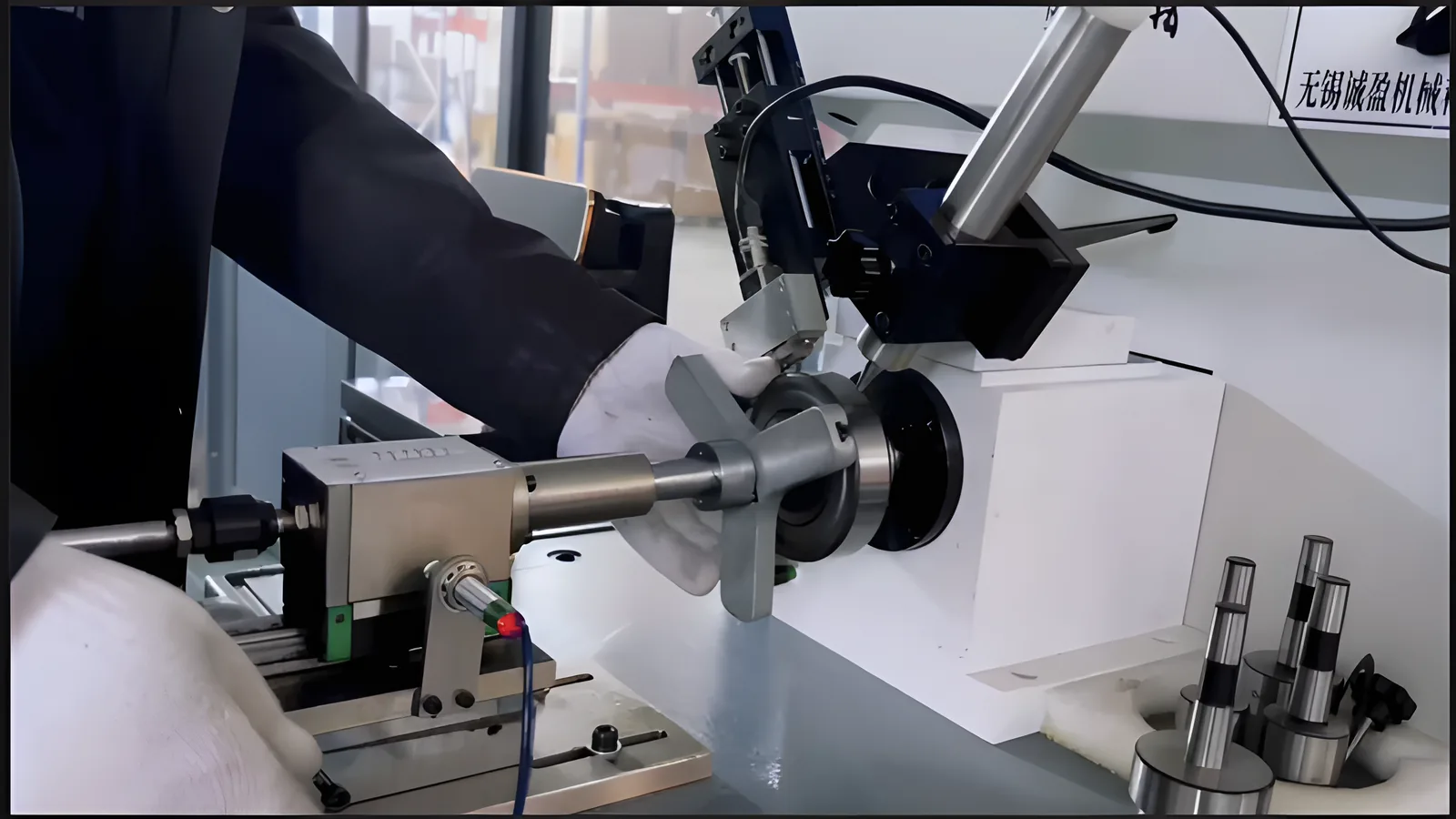
Both grades are measured on a single bearing turning on a test rig, not in the machine it goes into. For deep groove ball bearings with an outside diameter over 10 up to 200 mm, the spindle turns at 1,800 r/min [1]. The outer ring is held under a set axial load; for an outside diameter over 25 up to 50 mm, that load is 63 to 77 N [1]. A sensor reads the radial vibration on the outside surface of the outer ring [1].
The Z grade is a level in decibels. The instrument reads acceleration across 50 to 10,000 Hz, and the level is L = 20 lg(a/a0), with the reference a0 = 9.81 × 10⁻³ m/s² [1]. The V grade is read as vibration velocity [2].
A single bearing above the limit for its group is a reject [1]. For a batch, GB/T 32333 sets sampling with an acceptance quality limit (AQL) of 1.5 for the acceleration level [1].
Testers used by makers outside China also read the radial vibration of the outer ring at 1,800 r/min, and show the results in μm/s or Anderon units [7]. An anderon reading and a Z/V group are different scales, so ask which one a test report uses before you compare figures. For the frequency bands and what each band picks up, see how bearing noise is measured in our compressor bearing case.
Which ball bearings and roller bearings Z grades cover
GB/T 32333 has two parts, and they reach different bearings [1]. Its test method covers radial bearings, the types built mainly for radial loads, with a cylindrical bore and outside surface: single row and double row deep groove ball bearings, self-aligning ball bearings, single and double row angular contact ball bearings, spherical roller bearings, tapered roller bearings and cylindrical roller bearings [1]. Its grade limits, Z to Z4, are given only for deep groove ball bearings [1]. Thrust ball bearings are not in its scope.
The spindle speed depends on the bearing type and size [1]:
| Bearing type [1] | Outside diameter D, mm [1] | Spindle speed, r/min [1] |
|---|---|---|
| Deep groove, self-aligning and angular contact ball bearings | over 10 up to 200 | 1,800 |
| Spherical roller and tapered roller bearings | over 30 up to 200 | 900 |
| Cylindrical roller bearings | over 30 up to 100 | 1,800 |
| Cylindrical roller bearings | over 100 up to 200 | 900 |
The table stops at 200 mm. For a big size bearing, or another speed, the standard lets the maker and the user agree on the test conditions [1]. So if a supplier writes Z2 against a tapered roller bearing or a cylindrical roller bearing, ask which limit the code refers to.
The mandrel that carries the inner ring is at least 58 HRC, and mandrel and spindle together may run out by no more than 5 μm [1]. The loading device leaves the outer ring free to vibrate, so the reading comes from the bearing as it runs, not from the fixture [1]. SKF lists raceway waviness, dirt particles, roughness and cage problems among the causes its testers pick up [7].
Bearing precision class: P0 to P2 and the abec rating
A precision class, also called a tolerance class, grades how accurately the bearing is made. ISO 492 specifies the dimensional and geometrical characteristics, deviation limits and tolerance values of radial rolling bearings [4]. Its classes for radial bearings are Normal, 6, 5, 4 and 2; tapered roller bearings use Normal, 6X, 5, 4 and 2 [4]. Precision rises from the ordinary class through 6, 5 and 4 to class 2 [6]. China uses the same tolerances: GB/T 307.1-2017 is an identical adoption of ISO 492 [5].

The tolerances fall into two groups [6]:
- Dimensional accuracy: bore, outside diameter, width and their variation. It matters when you fit the bearing on a shaft and in a housing.
- Running accuracy: radial and axial runout of the inner and outer rings, and related items. It matters for how true the shaft turns.
The P codes and the abec rating are names for the same classes in other standards. NTN’s bearing catalog lays them out side by side [6]:
| ISO 492 class [6] | DIN 620 class [6] | ABEC class, ANSI/ABMA [6] |
|---|---|---|
| Normal | P0 | 1 |
| 6 | P6 | 3 |
| 5 | P5 | 5 |
| 4 | P4 | 7 |
| 2 | P2 | 9 |
The comparison is close, not exact. The same catalog notes that ABMA tolerances differ slightly from the JIS series, which sits at the same level as ISO 492 and DIN 620 [6]. ABEC 1 to ABEC 9 apply to ball bearings; roller bearings use RBEC [6].
The precision class we hold as standard on our deep groove ball bearings, and the classes on request, are listed on the deep groove ball bearing page.
Why Z2V2 is not P6, and Z1V1 is not P0
Z and V grades and precision classes are two separate evaluation systems. A precision class controls how the bearing is made: dimensional tolerances and running accuracy. A Z or V grade is a different standard. It describes how much the bearing vibrates when it runs.
The Chinese standard for electric motor bearings shows the split. Its sample designation 6204-2RZ/P6 CM V2 carries the tolerance class and the vibration group as two separate fields [3]. Its requirements also sit in two separate clauses: tolerances no lower than class 6, and vibration no lower than group V1 or Z1, with higher groups when the motor needs them [3].
Because the two are graded separately, they do not convert into each other. A P6 bearing can be graded anywhere from Z1 to Z4. There is no table that turns a Z/V grade into a P class.
High precision does not by itself mean low noise. In high-end applications, though, buyers usually ask for both at a high level. The two go together there because both are specified, not because one follows from the other.
When we discuss quality with customers, the Z/V grade is usually what comes up first. Customers often ask whether a Z1V1 grade and a P0 class are the same thing, or a Z2V2 grade and a P6 class. They are not. Write each one down as its own requirement.
Z1V1, Z2V2 and Z3V3 from a China bearing supplier
In the Chinese bearing industry, Z/V grades are the usual way a quote states noise on a standard ball bearing. A bearing manufacturer may quote one deep groove ball bearing as Z1V1, Z2V2 or Z3V3. Those are three different products, so compare a bearing price for Z2V2 with another Z2V2 price, not with a Z3V3 one.
FULI is in Linqing, Shandong, one of China’s main bearing manufacturing areas, and our standard shipment grade is Z3V3. Whether the order is for auto bearing and motorcycle bearing parts, such as motorcycle bearings, or for electric motors, the grade goes on the order in writing.
If you are replacing an SKF, NSK, NTN or Koyo bearing, the original will not carry a Chinese Z/V group. Our NSK, NTN, Koyo and Nachi cross reference matches the bearing number; the vibration grade and the precision class still go on separate lines.
Specifying a low noise deep groove ball bearing in your inquiry
A low noise bearing is specified by its vibration grade, and the precision class is a second line. Our standard shipment grade is Z3V3. Z3V3 is a vibration grade, not a precision class. If you need another grade, write it in your inquiry and we confirm it when we quote.
Put these on separate lines:
- the full bearing number including suffixes, for example a 6205 bearing with its seal or shield code;
- the precision class, such as P0 or P6;
- the vibration grade as a Z/V group, or, if your incoming inspection uses another scale such as Anderon, the scale and the limit;
- the radial internal clearance, which is a third separate specification (see bearing internal clearance);
- the application, such as an electric motor, a household appliance or fan and blower bearings.
The same two specifications matter well beyond one application. A small deep groove ball bearing such as a 6004, machined from standard bearing steel, can carry a different vibration grade and precision class depending on the buyer’s industry and brand standards: an automotive customer in India sourcing bearings rated for a specific speed often asks for both specifications at their tightest level, with the bore, outside diameter and width held to the same dimension tolerances across every piece in the batch.
The inspection report from our factory covers rotation noise and vibration. If you check vibration on arrival, ask for the report with the shipment and test with the same scale.
FULI ships to 50+ countries & regions. Send your inquiry through the contact page or to sales@fuli-bearings.com.
SKF, NSK, NTN and Koyo are trademarks of their respective owners. FULI is not affiliated with, authorized by or endorsed by any of these companies. Their published technical material is cited here as general reference only.
Sources
- https://www.sactc98.com/uploads/1/UploadFiles/2024111617354226.pdf
- https://ndls.org.cn/standard/detail/6dc348a0ca97da5eb330a8e8f168fcb0
- https://www.sactc98.com/uploads/1/UploadFiles/2024111610241548.pdf
- https://www.iso.org/standard/80376.html
- https://www.ndls.org.cn/standard/detail/bb20be5cb5fe83c098fc67e1fabac2f1
- https://www.ntnglobal.com/en/products/catalog/pdf/2203E_a06.pdf
- https://cdn.skfmediahub.skf.com/api/public/0901d1968016feca/pdf_preview_medium/0901d1968016feca_pdf_preview_medium.pdf
- https://cdn.skfmediahub.skf.com/api/public/0901d19680056c36/pdf_preview_medium/0901d19680056c36_pdf_preview_medium.pdf
FAQ
What does Z2V2 mean on a bearing?
It means the bearing meets vibration acceleration group Z2 and vibration velocity group V2 under Chinese national standards. It says nothing about the precision class, which is a separate specification.
Can a Z/V grade be converted into a P class?
No. They are two separate evaluation systems. A P6 bearing can be graded anywhere from Z1 to Z4, so write the precision class and the vibration grade as two separate items.
Is Z4 quieter than Z1?
On the test rig, yes. Z4 has a lower acceleration limit than Z1, and the limit drops with each group from the basic Z group to Z4.
Are Z2V2 bearings good?
Z2V2 is two groups above the basic Z and V groups, which are the requirement for general bearings. Whether it is enough depends on the machine. The Chinese standard for electric motor bearings asks for at least Z1 or V1, with higher groups when the motor needs them.
Does a V1 rating mean the bearing is bad?
No. V1 is one group above the basic V group for general bearings, and it is the minimum the Chinese motor bearing standard sets. It is a lower vibration grade than V2 or V3, not a reject.
Does a higher ABEC rating guarantee a quieter bearing?
No. ABEC and P classes grade dimensions and runout. Noise is graded separately, by Z/V groups or a maker's own noise specification. A P6 bearing can be anywhere from Z1 to Z4.
Do Z/V grades apply to tapered or cylindrical roller bearings?
The GB/T 32333 test method covers them, at 900 or 1,800 r/min depending on size, but the standard sets Z group limits only for deep groove ball bearings. For a roller bearing, agree the limit with the supplier.
Is a Z3 or V3 bearing always necessary?
No. The right group depends on the machine. The basic Z and V groups are the requirement for general bearings, and the Chinese standard for electric motor bearings starts at Z1 or V1. Higher groups are for machines where noise matters, such as electric motors.
What grade do you ship as standard?
Our standard shipment grade is Z3V3. If you need another grade, write it in your inquiry and we confirm it when we quote. The precision class is stated separately.
Do bearing makers outside China use Z/V codes?
Z/V grades come from Chinese national standards. Other makers use their own noise specifications, for example SKF's QE6, and testers that report in μm/s or Anderon units. Ask which scale a report uses before you compare figures.