
Thrust Ball Bearing
Thrust ball bearings from Linqing, China, supplied to order: 51100 and 51200 size chart, single vs double direction, and which washer goes on the shaft.
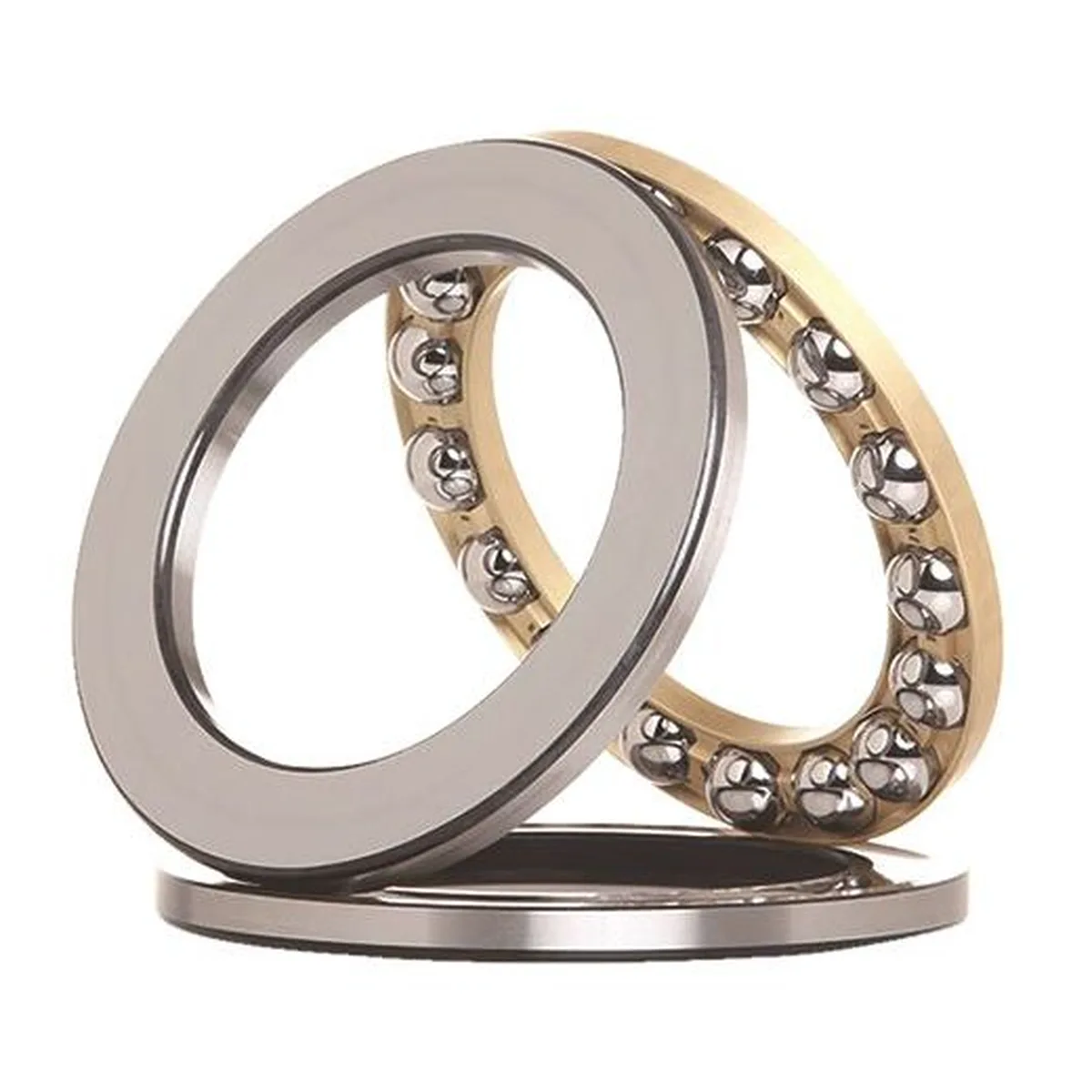
A thrust ball bearing is a type of bearing designed to support axial loads: the force that acts along the shaft, not across it. Small metal balls run between two washers. Each washer is grooved to form a raceway, so the parts rotate freely while the bearing takes the push, reducing friction between the moving parts. We supply thrust ball bearings such as the 51108 to order, in the 51100 and 51200 sizes below. Each type of thrust bearing, with balls or with rollers, is compared in our thrust bearing types guide.
Thrust ball bearing size chart: 51100 series
The thrust bearing size chart below gives the bore (d), the outside diameter (D) and the height of the assembled bearing (T), all in mm. Values are from the FULI catalog and match the ISO 104 metric sizes in the SKF tables [1]. For one size in full detail, see 51108 bearing dimensions.
| Bearing | d (mm) | D (mm) | T (mm) |
|---|---|---|---|
| 51100 | 10 | 24 | 9 |
| 51101 | 12 | 26 | 9 |
| 51102 | 15 | 28 | 9 |
| 51103 | 17 | 30 | 9 |
| 51104 | 20 | 35 | 10 |
| 51105 | 25 | 42 | 11 |
| 51106 | 30 | 47 | 11 |
| 51108 | 40 | 60 | 13 |
| 51109 | 45 | 65 | 14 |
| 51110 | 50 | 70 | 14 |
| 51111 | 55 | 78 | 16 |
| 51112 | 60 | 85 | 17 |
| 51113 | 65 | 90 | 18 |
| 51114 | 70 | 95 | 18 |
| 51115 | 75 | 100 | 19 |
| 51116 | 80 | 105 | 19 |
| 51117 | 85 | 110 | 19 |
| 51118 | 90 | 120 | 22 |
51200 series sizes
For the same bore, a 51200 bearing is wider and taller than a 51100. It has bigger bearing balls and carries more axial load.
| Bearing | d (mm) | D (mm) | T (mm) |
|---|---|---|---|
| 51200 | 10 | 26 | 11 |
| 51201 | 12 | 28 | 11 |
| 51202 | 15 | 32 | 12 |
| 51203 | 17 | 35 | 12 |
| 51204 | 20 | 40 | 14 |
| 51205 | 25 | 47 | 15 |
| 51206 | 30 | 52 | 16 |
| 51207 | 35 | 62 | 18 |
| 51208 | 40 | 68 | 19 |
| 51209 | 45 | 73 | 20 |
| 51210 | 50 | 78 | 22 |
| 51211 | 55 | 90 | 25 |
| 51212 | 60 | 95 | 26 |
| 51213 | 65 | 100 | 27 |
| 51214 | 70 | 105 | 27 |
| 51215 | 75 | 110 | 27 |
| 51216 | 80 | 115 | 28 |
| 51217 | 85 | 125 | 31 |
| 51218 | 90 | 135 | 35 |
The last two digits are the bore code. From 04 up, multiply by 5 to get the bore in mm, so 51208 has a 40 mm bore. Weights and load ratings are not listed here. Ask for them with the quote.
Single direction vs double direction
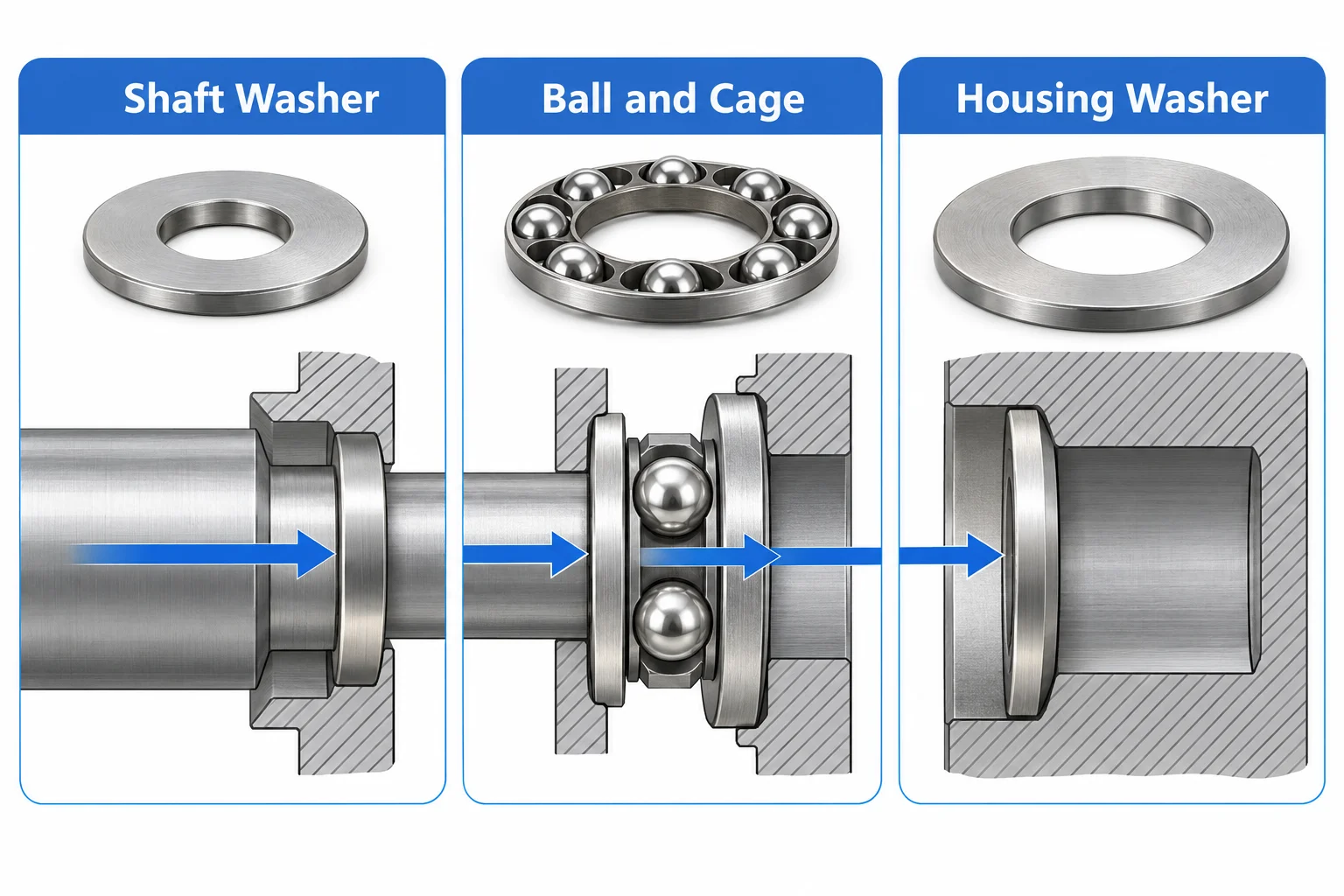
A single direction bearing has three parts: a shaft washer, a housing washer, and a ball and cage assembly between them [1]. It takes axial thrust one way only. When you compare samples, weigh the ball and cage assembly too, because a light brass cage can be hollow inside.
A double direction bearing has five parts. A central washer sits in the middle, with a ball set and a housing washer on each side [1] [2]. It holds the axial position both ways, so use it where the axial forces can reverse. Its bore code does not follow the single direction rule: a 52208 has a 30 mm bore, not 40 mm [1]. For a double direction bearing, send the full number and we will confirm the size.
Ball thrust or roller thrust
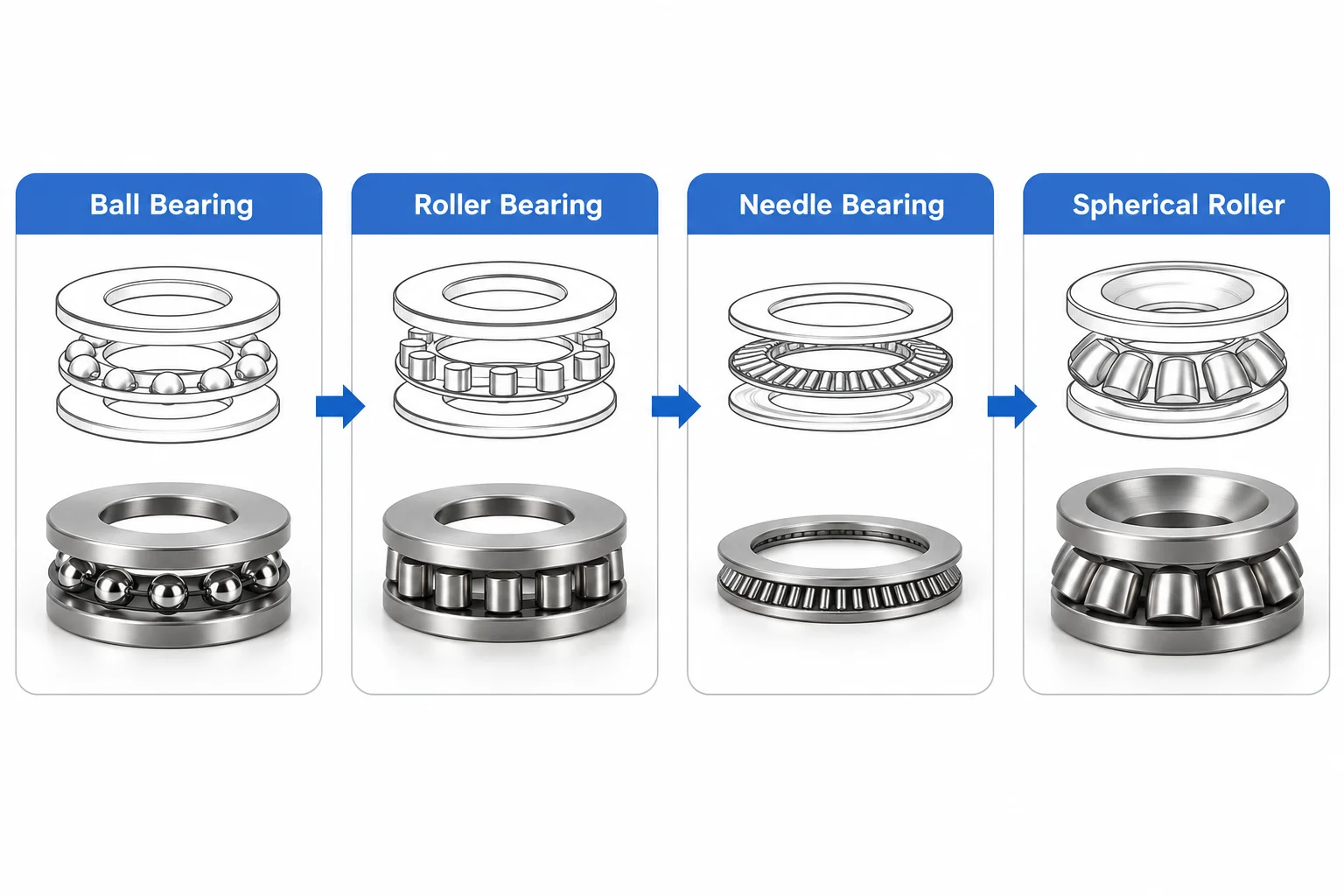
A ball thrust bearing uses steel balls as the rolling elements. Point contact keeps friction low and lets it run faster. Roller thrust bearings carry thrust loads on rollers, which give line contact and more capacity in the same space:
- Cylindrical roller types take high axial load and shock at low speed.
- Thrust needle types use needle rollers and fit where axial space is very short.
- Spherical roller types also take some load across the shaft and tolerate misalignment [1].
A tapered roller bearing is not a thrust bearing, but its taper lets it carry combined loads. Where most of the load acts across the shaft, a deep groove ball bearing is the usual choice. These roller types are not listed on our product pages. Send the number and we will tell you whether we can supply it.
How to choose a thrust ball bearing
Three points to consider when choosing one.
Load direction. A thrust ball bearing must not take radial load [1]. If there is radial loading as well, fit a second bearing for it. Common uses are vertical spindles, turntables and screw jacks, where the main force runs along the axis.
Speed. Thrust bearings cannot run as fast as radial bearings of the same size [1]. They also need a minimum axial load, or the balls skid instead of rolling [1]. They suit low-speed applications and moderate rotational speeds.
Which washer goes on the shaft. The shaft washer has the smaller, ground bore. Fit it against a shoulder. The housing washer has a larger bore and sits in the housing [1]. If they are swapped, the loose washer rubs and wears fast.
A 51108 order for a light-duty robot arm
In 2008 a customer in the United States bought 51108 thrust ball bearings from us. They went into a robot arm with a very light load that turned a few times a day. For that duty the material changed from GCr15 chrome bearing steel to 45 steel, close to C45 or AISI 1045, and rough grinding went from six passes to three. The price came down by about 30%, and there were no returns. The full story is in the 51108 bearing dimensions article.
What to send for a quote
- The bearing number, with any prefix and suffix, or the d, D and T you measured.
- Single or double direction.
- The quantity per size.
- The axial load and the speed in r/min, even rough figures.
- The destination port.
Send it to sales@fuli-bearings.com or use the request a quote form. Other bearing types are on the products page.
Backed by 20+ years of bearing export experience in Linqing, Shandong.
Bearings produced under an ISO 9001:2015 quality management system. Certificate number and scope available on request.
Sources
FAQ
What is a thrust ball bearing?
It is a rotary bearing with balls held in a cage between two washers. One washer turns with the shaft, the other sits in the housing. It carries axial load in one direction or, in the double direction design, in both, and no radial load.
Can ball thrust bearings handle radial loads?
No. Thrust ball bearings cannot transmit radial load. It pushes the balls up the side of the raceway and the bearing fails early. Where there is radial loading as well, fit a second bearing for it, or choose a tapered roller bearing, which takes both loads.
What are the downsides of thrust bearings?
A thrust ball bearing takes no load across the shaft, accepts no tilt with a flat housing washer, and has a lower speed limit than a deep groove ball bearing of the same size. It also needs a minimum axial load, or the balls skid instead of rolling.
How do you measure a thrust ball bearing?
Measure the smaller bore (d), the outside diameter (D) and the height of the whole stack (T). Count the parts: three means single direction, five means double direction. Then compare the three figures with the size chart on this page.
Is 51108 the same size as 51208?
No. Both have a 40 mm bore, but the 51108 is 60 mm across and 13 mm high, while the 51208 is 68 mm across and 19 mm high. The 51208 is a heavier series and will not fit a 51108 seat.
Do car engines use thrust ball bearings?
Most automotive engines do not. The crankshaft runs in plain journal bearings, and its end float is set by plain thrust washers or a flanged bearing shell. Thrust ball bearings are more common in industrial applications with a slow shaft and a steady push along it.