ZZ vs 2RS Bearings: Which Seal to Write on Your Order
ZZ metal shields or 2RS rubber seals? What each suffix means, how they differ on dust, water and speed, and what else to write on the order.
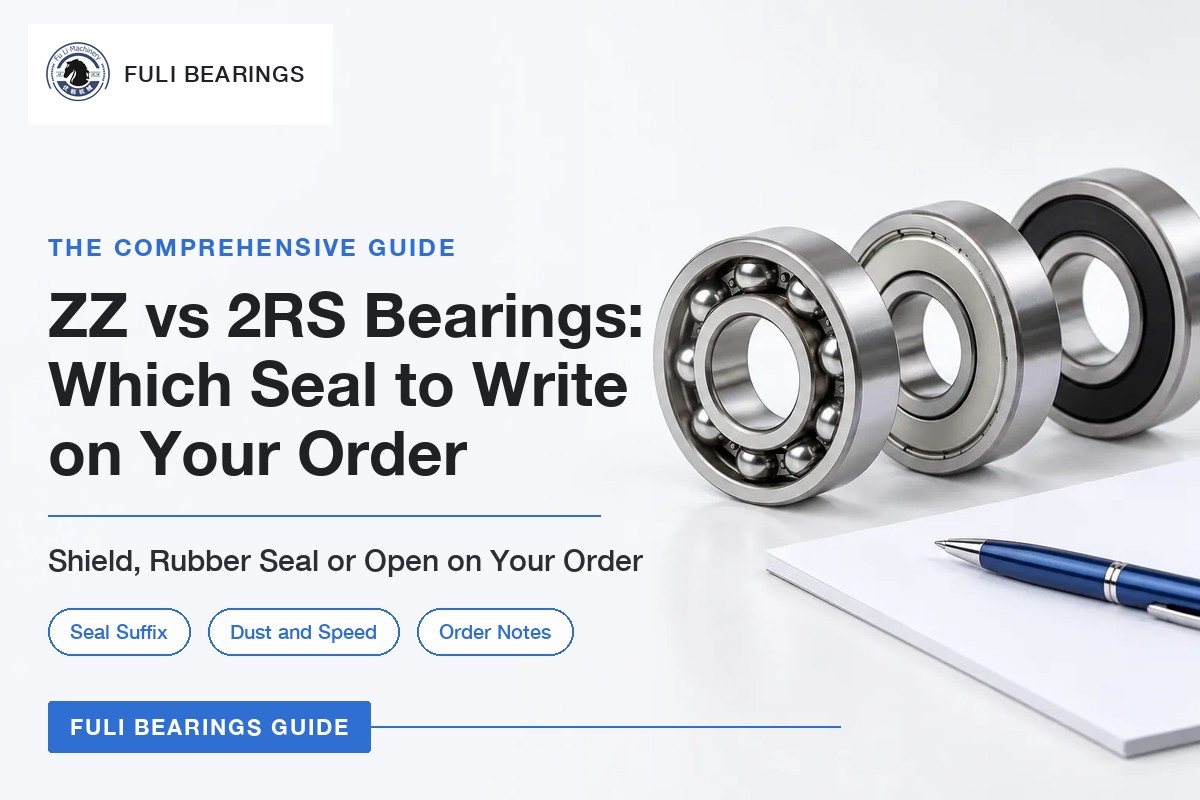
The ZZ vs 2RS tradeoff is low friction against better sealing. ZZ puts a thin metal shield on each side of the bearing. 2RS puts a rubber seal on each side that touches the inner ring and keeps out more dust and water. ZZ shielded bearings suit fast, clean machines. Rubber sealed bearings suit dirty or wet ones. Pick the one that fits the machine, then write it on every order line.
The choice comes up on deep groove ball bearing orders, such as a 6205 bearing or a 6203 bearing. Other bearing types use the same closures, but the examples here are deep groove ball bearings.
ZZ vs 2RS: the short answer for your order
ZZ and 2RS bearings come in the same sizes, and NTN’s catalogue shows how each one is built. On a ZZ bearing, a pressed metal plate sits in the outer ring and leaves a narrow gap at the inner ring. On a contact-sealed bearing, rubber is bonded to a steel insert, and the rubber lip rides on the inner ring [2].
- ZZ (two metal shields): low friction, low torque and the same speed capability as the open bearing. It keeps out larger particles but not fine dust [2] [4].
- 2RS (two rubber contact seals): better protection against contamination and moisture. It has higher friction and torque and a lower speed limit, because the seal lip rubs on the inner ring [2] [3].
- Open: no shield and no seal. The user adds the lubricant [3].
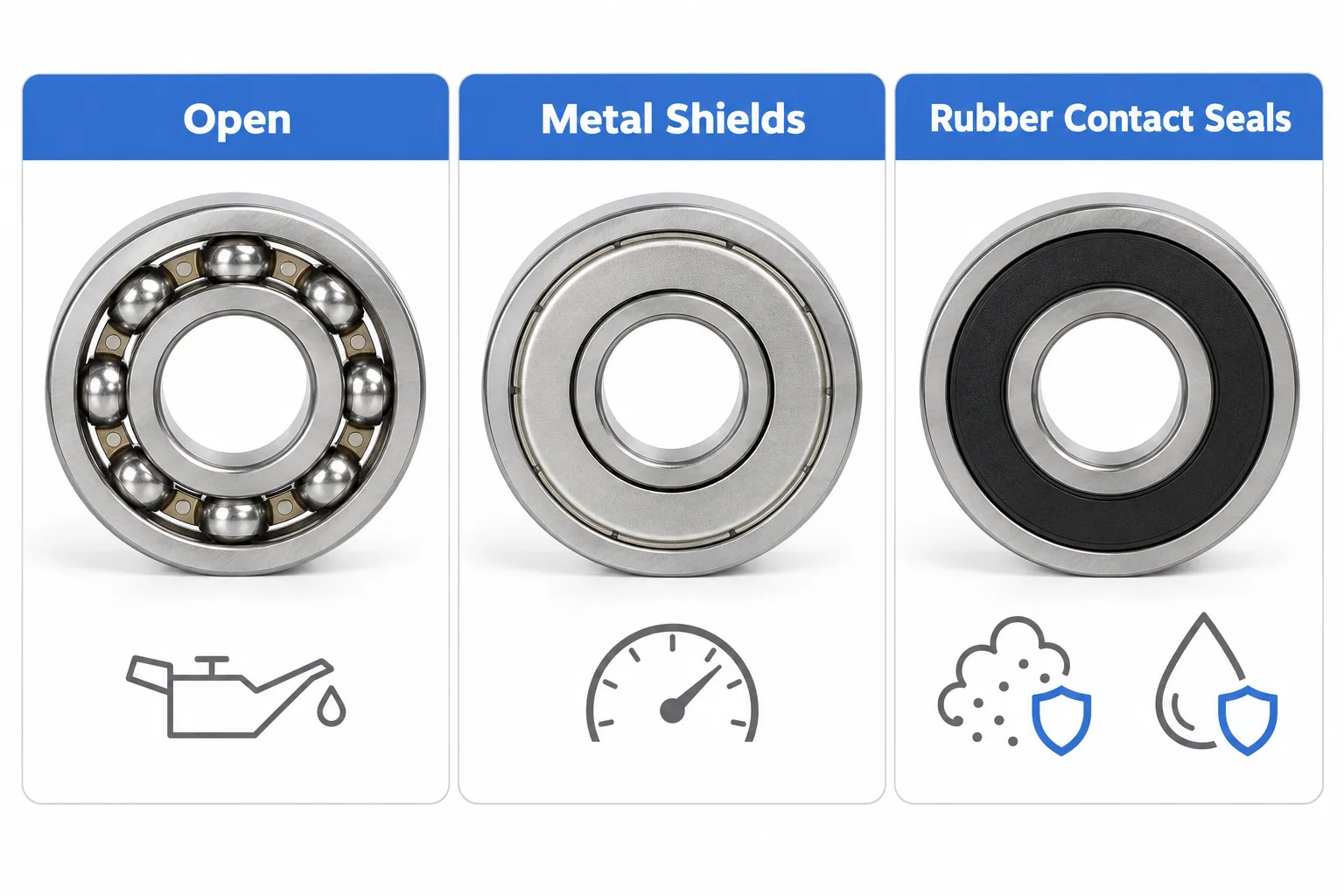
A simple rule for the order line:
- Fast, clean and enclosed: choose ZZ.
- Dust, water or outdoor work at moderate speed: choose 2RS.
- The machine has its own seals and its own lubrication: write open.
Our open, ZZ and 2RS seal selector walks through the same choice one question at a time.
Bearing codes: what Z, ZZ, 2Z, RS and 2RS mean
The letters tell you the closure type. The number in front tells you how many sides are closed.
| Suffix | What it means | Other catalogues |
|---|---|---|
| Z | Metal shield on one side | SKF: -Z [1] |
| ZZ | Metal shields on both sides | SKF: -2Z [1] |
| RS | Rubber contact seal on one side | SKF: -RS1 [1] |
| 2RS | Rubber contact seals on both sides | SKF: -2RS1 [1]; similar contact seals: NSK DDU [5], NTN LLU [2] |
| RZ / 2RZ | Non-contact rubber seal that does not touch the inner ring | SKF: -RZ / -2RZ [1] |
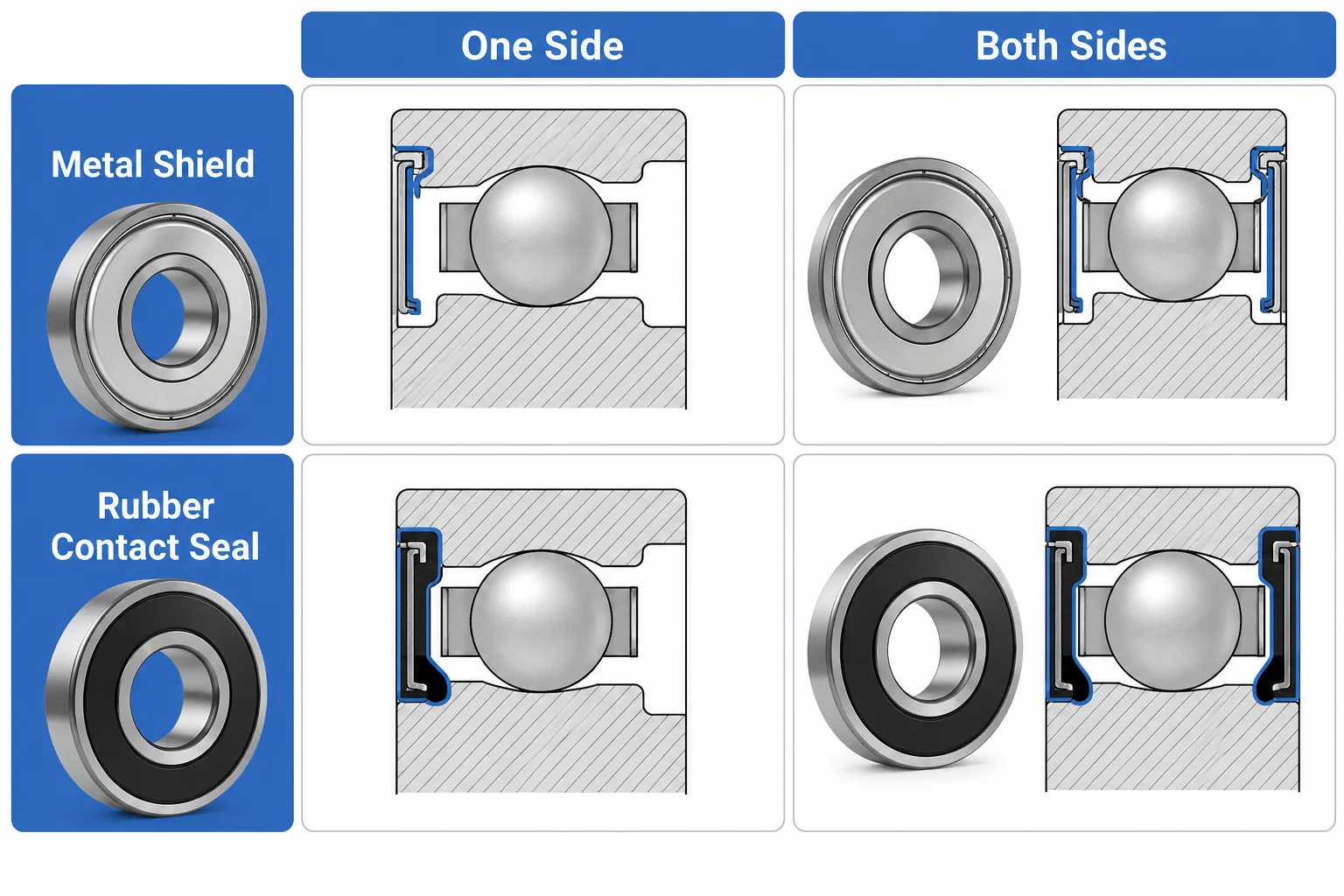
Timken lists one shield as Z and two shields as ZZ, and one contact seal as RS and two as 2RS [3]. SKF writes -2Z for shields on both sides and -2RS1 for NBR contact seals on both sides [1]. So ZZ and 2Z are the same closure written two ways, and they mean the same thing on an order.
A single Z or RS closes one side only. A 6205-Z has a shield on one side, and the other side is open. We keep single-sided Z and RS bearings in stock, so write the single letter only when you mean one side. If both sides of the bearing are exposed, write ZZ or 2RS.
Bearing seal difference: dust, water and speed
Makers rate the difference between 2RS and ZZ in much the same way. This is NTN’s comparison for its deep groove ball bearings [2]:
| Rating in NTN’s table | ZZ (metal shield) | LLU (rubber contact seal, like 2RS) |
|---|---|---|
| Running torque | Low | Higher than ZZ |
| Keeping dust out | Rated good | Rated excellent |
| Keeping water out | Rated poor | Rated very good |
| Speed | Matches the open bearing | Held back by the seal lip |
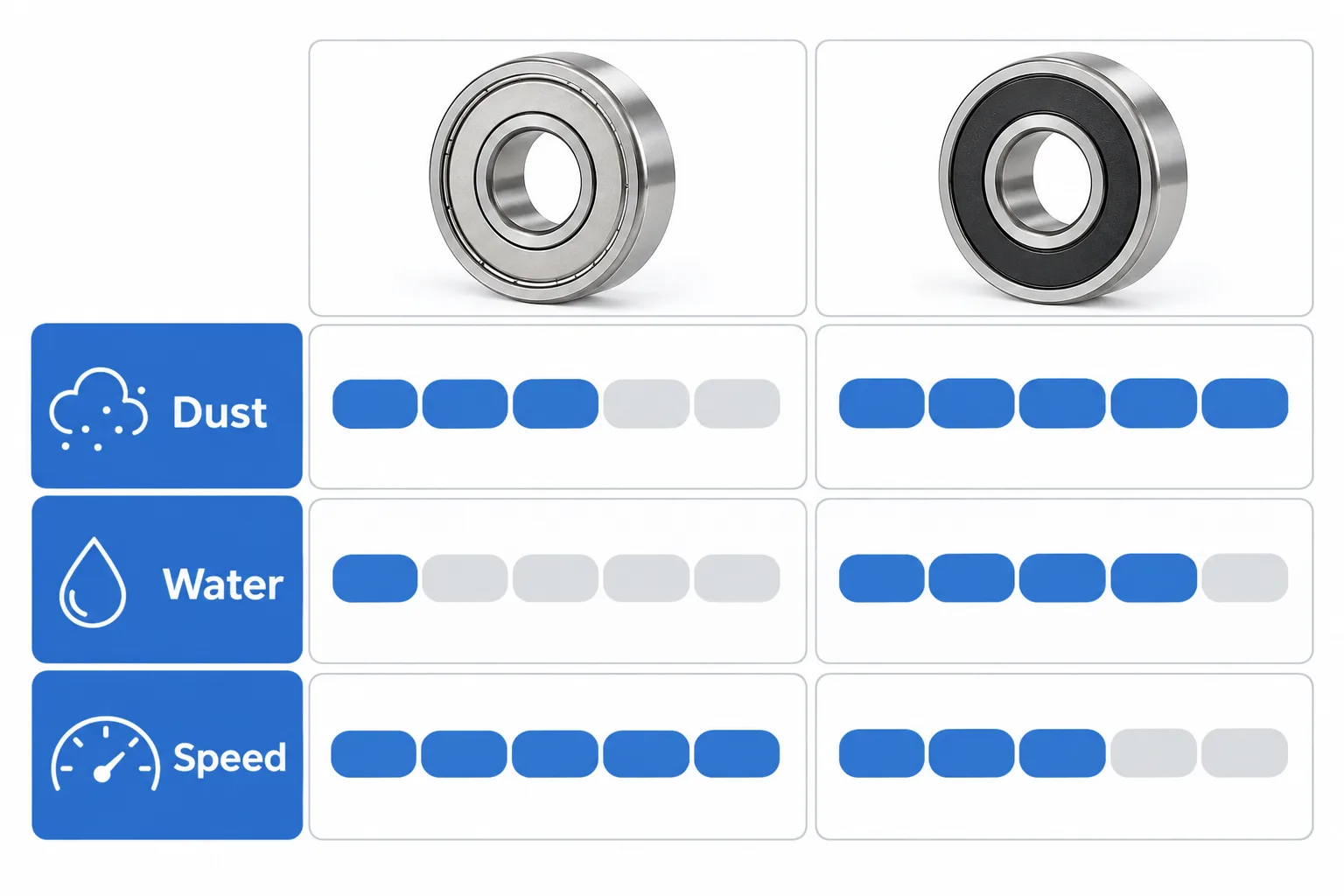
NSK says the same about shields. They protect the bearing from large contaminants but do not stop small particles. NSK rates a shielded bearing as fast as an open bearing running on grease, and notes low torque and a small rise in temperature [4].
A contact seal costs speed. Timken advises using 50 to 60 percent of the open bearing’s speed rating for bearings with contact seals [3]. NTN’s table shows it on a 6205: with grease, the ZZ version is listed at 13,000 min-1 and the LLU contact-sealed version at 8,900 min-1 [2].
Choosing the right closure for each line on the order:
- High-speed electric motors and fans in a clean housing: ZZ keeps drag and heat down [4].
- Machinery that works in dust, mud, moisture or splashing water at moderate speed: 2RS keeps more out [2].
- High speed and a dirty site together: send us the speed and the conditions before you choose.
Check each size against the machine it goes into, from a small 6302 bearing to a 6206 bearing or a 6305 bearing, because two machines on the same order can need different closures.
Open vs sealed bearing: when to order open
An open bearing has no shield and no seal. Timken supplies its open ball bearings with only a rust preventive on the surfaces, and the end user picks and adds the lubricant the application needs [3]. Timken’s double-shielded and double-sealed bearings leave its factory already greased [3].
So open is the right order when the bearing sits in a gearbox, an oil bath or a housing that has its own seals and its own grease point. There, the machine’s own seals and lubrication do the job a shield or seal would do.
One buyer wrote to us about the 6205 in four words: “I need only open.” If your customer says the same, write “6205 open” on the order line, not the bare number.
Who decides the seal on a fan bearing order
In 2014 we shipped fan bearings with no seal groove on the inner ring to a distributor in Argentina, and the project’s engineers refused them because the sealing was too weak to keep dust out. The distributor had not asked for that kind of seal before the order, so ask the end user which closure the machine needs before you write the suffix. The full story is on our fan and blower bearings page.
What to write on the order besides the suffix
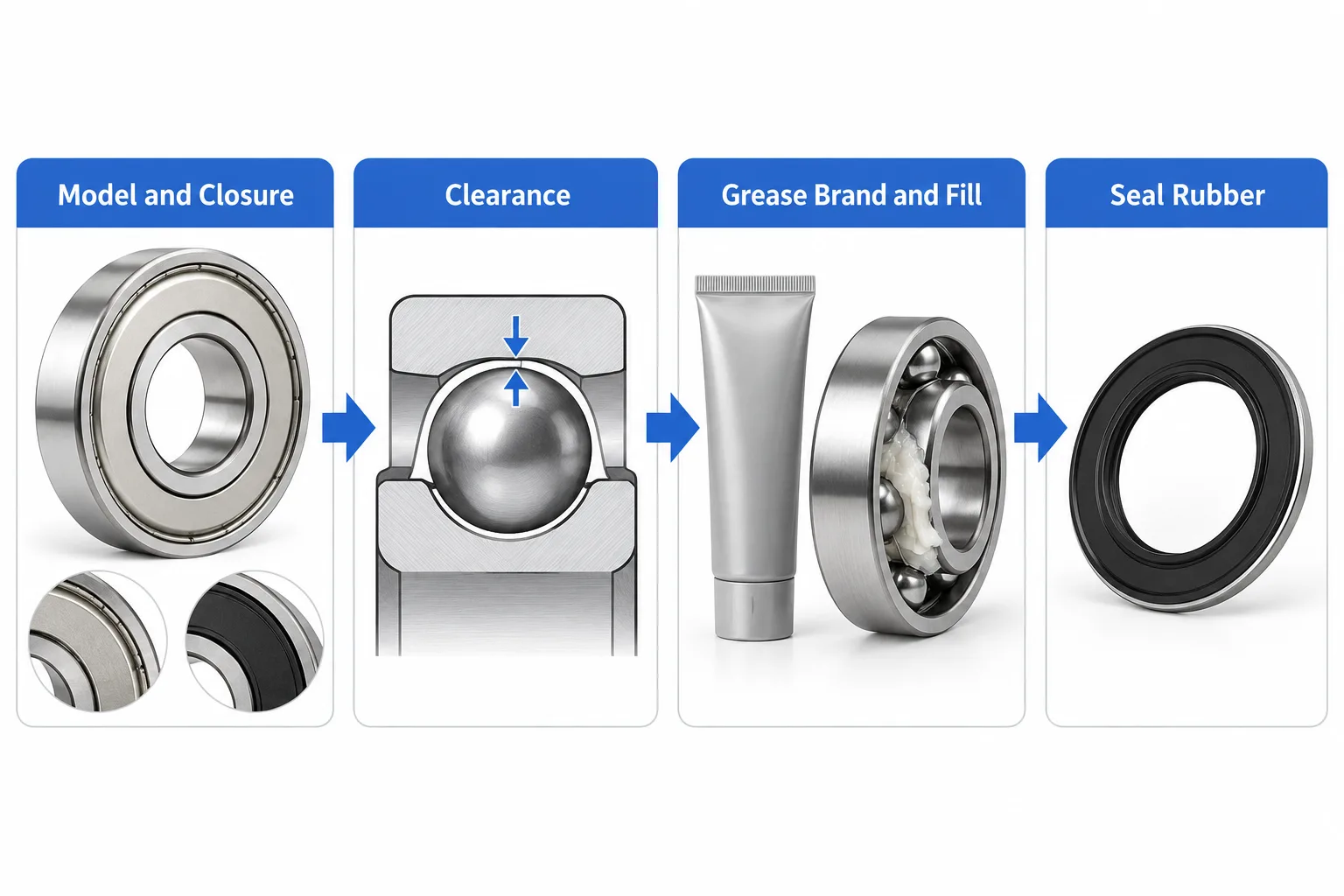
The suffix is one field. A complete line for a sealed deep groove ball bearing has a few more.
- Model and closure. For example 6203-2RS or 6305-ZZ. When an inquiry leaves out the prefix or suffix letters, it is harder for the factory to judge the quality you need.
- Clearance. C0 is standard. We can also make C2 (tighter) or C3 (looser) when the application calls for it.
- Grease brand and fill. On our sealed deep groove ball bearings, the standard grease inside the bearing fills about 30% of the free space. If you need a named grease brand or a different fill, write it on the order and we fill to that.
- Seal rubber. Our 2RS seals are nitrile rubber (NBR).
A buyer in Bangladesh asked us about bulk 6202 bearings and 6205 bearings with 2RS seals for the local market. The buyer asked for two things: enough grease inside, and bearings that are tight, not loose. Grease fill is one of the items we check on each batch before shipment, together with rotation smoothness, dimensions, rust and appearance.
A tight bearing is one with small internal clearance, the play between the rings and the balls. The clearance grades run from C2 (tight) through C0 (normal) to C3 (loose) [3], and the clearance is set when the bearing is assembled. C0 is our standard, and we can make C2 for a tighter bearing or C3 when the application needs it. If your market wants a tight feel, write C2 on the order line, not the word “tight”, and we confirm it before production.
Based on our experience, we recommend one line per model with every field filled in, for example “6203-2RS, C3, grease brand, fill”. You can check a line like that against the goods when they arrive.
Backed by 20+ years of bearing export experience in Linqing, Shandong. Send your model list, with the closure, clearance and grease for each line, to sales@fuli-bearings.com.
Sources
- https://www.skf.com/group/products/rolling-bearings/ball-bearings/deep-groove-ball-bearings/designation-system
- https://www.ntnglobal.com/en/products/catalog/pdf/2203E_b02.pdf
- https://www.timken.com/wp-content/uploads/2017/10/Timken-Deep-Groove-Ball-Bearings-Catalog_10857.pdf
- https://www.nsk.com/content/dam/nsk/eu/en_gb/documents/P_TI-0003_EN.pdf
- https://www.nsk.com/am-en/tools-resources/knowledge-center/bearing-abcs/deep-groove-ball-bearings/
FAQ
What is a 6205-Z bearing?
A 6205-Z is a 6205 deep groove ball bearing with a metal shield on one side. The other side is open. NTN notes that single-shielded and single-sealed bearings should be used with grease lubrication. Timken notes that a single-shielded bearing can be relubricated from the open side.
Is 2Z the same as ZZ?
Yes. Both mean a metal shield on each side. SKF writes -2Z, while Timken and NSK write ZZ. When you compare quotes across brands, treat them as the same closure.
What is the difference between RS and 2RS?
RS is a rubber contact seal on one side. 2RS has a contact seal on both sides. If the bearing is exposed on both sides, order 2RS.
Which is better for an electric motor, ZZ or 2RS?
It depends on the speed and where the motor works. Shields give low torque and low temperature rise, and their speed matches an open greased bearing. A contact seal keeps out more dust and water but has a lower speed rating, about 50 to 60 percent of the open bearing in Timken's guidance. Send us the motor speed and the working conditions and we will suggest one.
What rubber do you use for 2RS seals?
Our 2RS seals are nitrile rubber (NBR). If the bearing runs in unusual conditions, describe them in the inquiry and we can give our advice.