Pillow Block vs Plummer Block: Which One to Order
Pillow block vs plummer block: a one-piece UCP unit, or a split housing with a spherical roller bearing on a sleeve. Shaft, center height and RFQ lines.
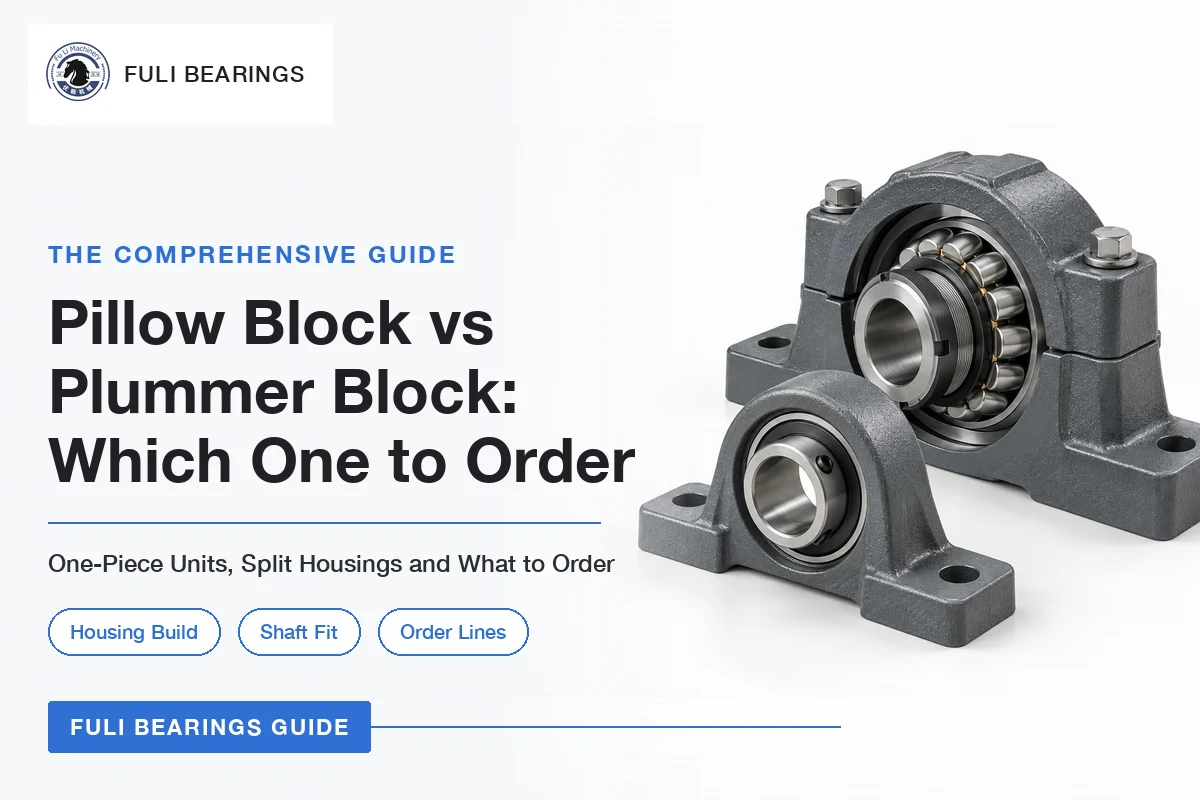
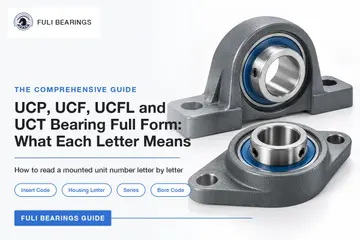
Pillow block vs plummer block decides how the housing is built and which parts go on the order. In most catalogs today, a pillow block means a one-piece unit, such as a UCP pillow block bearing. A plummer block means a split housing, such as an SN or SNL, with a self-aligning bearing on an adapter sleeve.
Both bolt to a flat base and hold a turning shaft parallel to it. The pillow block arrives as a ball bearing insert already fitted in a cast iron housing. The plummer block arrives as several parts, so the order lists each one.
So if an old parts list says plummer block and a quote says pillow block, do not order by the size number. Check the series code first. A UCP208 and an SN 508 both end in 8, but with the usual H 308 sleeve they fit different shafts.
This guide is for buyers and maintenance teams who replace mounted bearings on conveyors, fans and farm machines. It covers how the two are built, why the same size number can mean a different shaft, what to write on the RFQ, and when a dusty machine does not need a split housing.
Pillow block vs plummer block: same job, different build
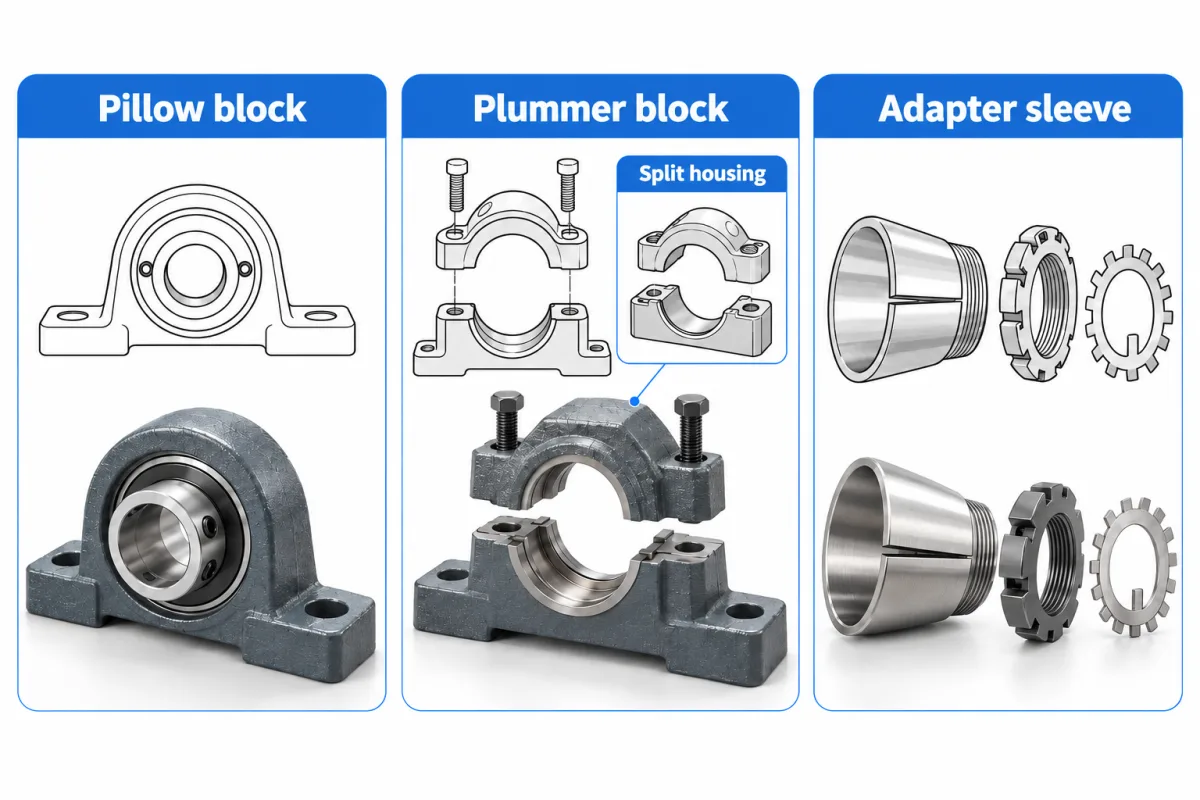
In NSK’s description, both hold a bearing so that the outer ring stays still and the inner ring turns with the shaft. The design is similar, but the bearing types are different [1]. NSK says plummer blocks are used for high power and heavy industrial loads. Pillow blocks support shafts and couplings in power transmission and are meant for lighter duty [1].
| Pillow block (UCP type) | Plummer block (SN / SNL type) | |
|---|---|---|
| Housing | One piece, cast iron | Split housing: a cap and a base bolted together [1] [3] |
| Bearing | UC insert: a sealed ball bearing with a spherical outside diameter | Self-aligning ball bearing or spherical roller bearing [1] |
| Fixing to the shaft | Two set screws on the inner ring; some series use an eccentric locking collar | Usually a tapered bore bearing on an adapter sleeve, or on a stepped shaft with a withdrawal sleeve [3] |
| Holding the shaft axially | The insert locks to the shaft | Locating rings in the housing at the fixed end [1] [3] |
| Lubrication | Sealed insert; a grease fitting on the housing for relubrication | Grease, with relubrication points on the housing [1] |
| How it arrives | One bearing unit, insert fitted | Housing, bearing and sleeve as separate parts; seals ordered with the housing (for example SNL 508 TG, housing complete with two seals) or as separate seal designations [3]; locating rings come with the housing at some makers [1] |
| Typical duty | Lighter loads: conveyors, farm machines, fans | Heavy loads and high power [1] |
The two names are not used strictly. SKF’s web address for its SNL range says split pillow block housings [4]. Its SNL catalog and datasheets call the same housings plummer block housings [2] [3]. Some one-piece pillow blocks also use an adapter sleeve. FULI’s catalog lists UKP208 with an H2308 sleeve, for example. The name tells you less than the series code.
Same size number, different shaft: UCP208 vs SN 508
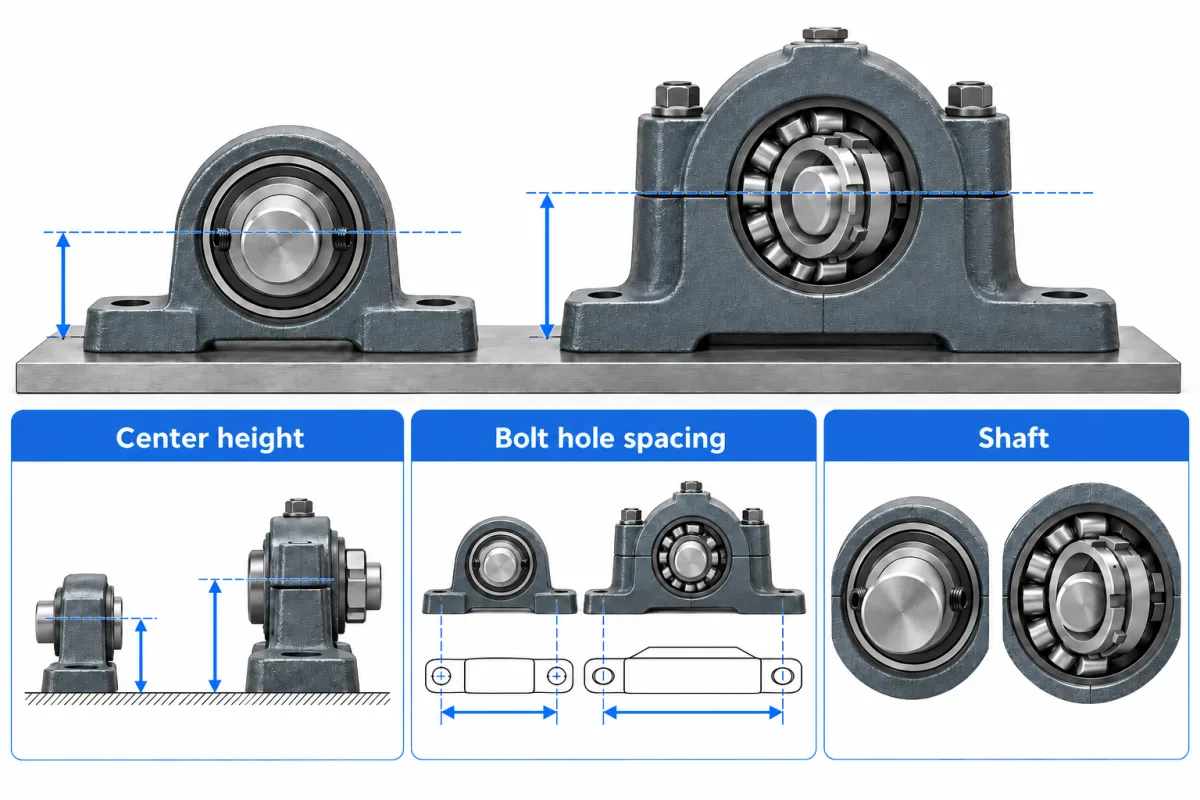
The number in a UCP designation codes the insert bore. In UCP208, the code 08 means a 40 mm shaft. In SN 508, the 08 is the bearing bore code, the same code as in a 22208 bearing. The SE and SNL 508-607 housings hold a 22208 K bearing on an H 308 adapter sleeve. The sleeve bore is 35 mm, so the shaft is 35 mm [2].
The mounting dimensions are different too:
| UCP208 pillow block | SNL 508-607 + 22208 K + H 308 | |
|---|---|---|
| Shaft diameter | 40 mm | 35 mm [3] |
| Center height (base to shaft center) | 49.2 mm | 60 mm [3] |
| Bolt hole spacing | 137 mm | 170 mm [3] |
| Overall length | 184 mm | 205 mm [3] |
| Parts to order | 1 unit | Housing, bearing, sleeve, 2 locating rings (fixed-end housing only), seals [2] |
UCP208 values are from FULI’s catalog; confirm for your application.
An older SN 508 table from a distributor lists the same 35 mm shaft, 60 mm center height and 170 mm bolt spacing. So SN 508 and SNL 508 mount the same way, and a UCP208 does not: it sits lower, its bolt holes are closer together, and it needs a bigger shaft. Changing from one type to the other means a new shaft size or sleeve, new bolt holes, and a check of the center height on both ends of the shaft. If the old SN 508 has no sleeve, measure the shaft seat.
What to write on the RFQ for each type
For a pillow block, one line is enough: the full designation, the shaft size and the quantity. Write the whole code. In 2025, an order reached our factory as F205, with the UC dropped. We shipped the housings only. The inserts went out in a second shipment, with an installation video. UCF205 on the order would have avoided that.
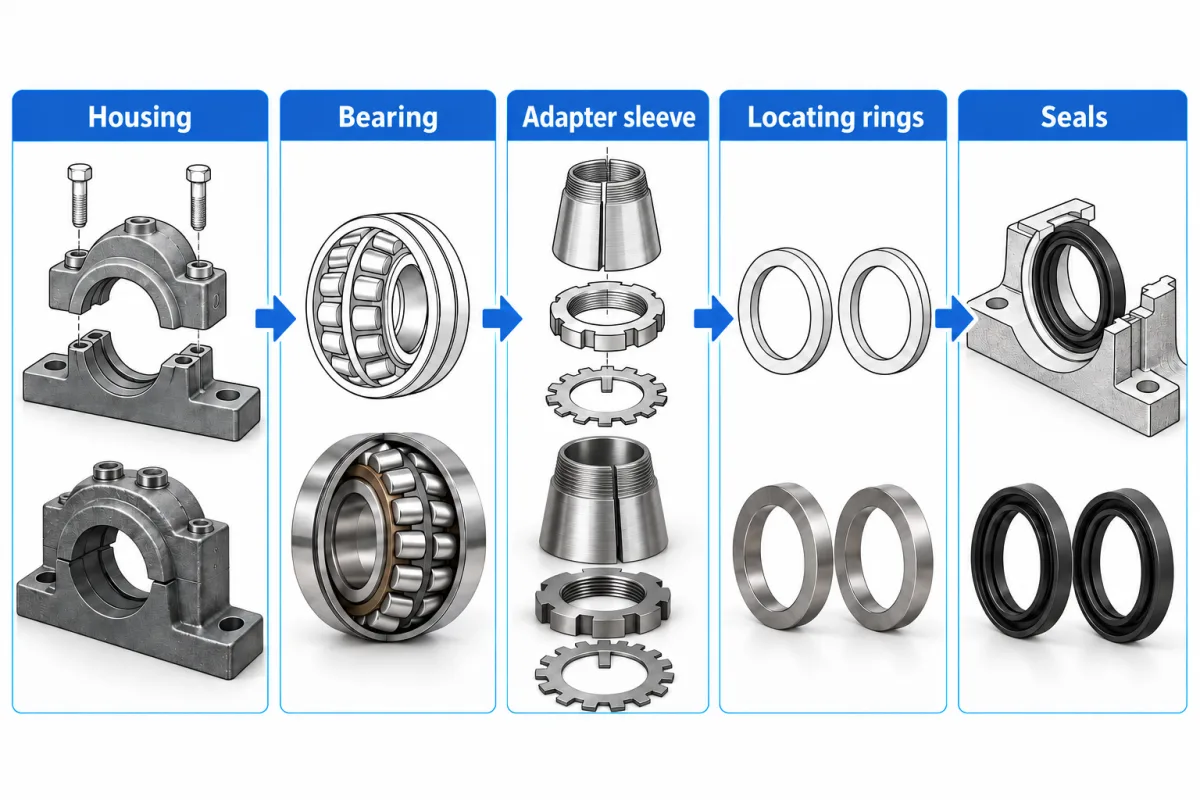
For a plummer block, list every part:
- Housing: for example SNL 508-607, or SN 508 on an older list.
- Bearing: for example 22208 K, a spherical roller bearing with a tapered bore. K marks the taper.
- Adapter sleeve: for example H 308. SKF supplies its sleeves with the lock nut and locking washer [3].
- Locating rings: for example 2 x FRB 8/80. With a spherical roller or self-aligning ball bearing, fit them at the fixed end only [2] [3]. The free end can go without them, so the shaft can move axially [1].
- Seals and end cover: the seal type, and an end cover if the housing sits at the shaft end. For the seals, you can also order the housing complete with two seals, such as SNL 508 TG [3]. The end cover is still ordered as a separate part [3].
Do not order a cap or a base alone. SKF matches each cap to its base during manufacture and marks both with the same number. A cap from another housing will not fit [3].
We supply UCP pillow block units. We also supply split plummer block housings (SN / SNL style). For the bearing, see our spherical roller bearing page; for the K tapered bore version, add K to the number. Send the housing designation and list the sleeve, rings and seals you need, and we will confirm which lines we can quote.
Replacing an old mounted bearing: three checks
Before you order a replacement, measure the old part. Three numbers decide whether a new one bolts straight in.
- Shaft diameter at the bearing. If there is a sleeve, measure the shaft, not the bearing bore.
- Center height. Measure from the bottom of the base to the shaft center. Both ends of the shaft must stay level.
- Bolt hole spacing and bolt size. Measure center to center across the base.
Measure the center height at both ends of the shaft and put both values on the inquiry, with a photo of the old housing. The pillow block bearing identification checklist walks through the same steps. For bolt torque on cast iron feet, see the installation checklist.
Which bearing housing type suits your machine
| Option | Use it when | Avoid it when | Cost to plan for |
|---|---|---|---|
| UCP pillow block unit | Light to moderate loads on the 200 series, heavier loads on the 300 series, a shaft end you can reach, and quick replacement | Loads beyond a UCP300 unit, high power, or a heavy constant axial load | Set screws lock the insert to the shaft; a worn insert can be changed without replacing the housing |
| Split plummer block (SN / SNL) | Heavy loads and high power [1]; pre-assembled shafts that need easy mounting and dismounting [1] | A small machine where one-line ordering matters | More parts to order and fit; the sleeve and clearance must be set at mounting |
| One-piece pillow block on an adapter sleeve (UKP) | A plain shaft and a one-piece housing, without set screws | You need a split cap for inspection | A sleeve to fit; check the sleeve size on the order |
For a typical belt conveyor or a farm machine, a UCP unit is the simple choice. For heavy loads and high power, NSK points to the split plummer block with a spherical roller or self-aligning ball bearing [1]. If a standard UCP unit is too light, look at the UCP300 series first: the same bore with a larger insert. If you are not sure which one is on your machine, our bearing housing page lists one-piece units and explains split plummer block housings.
Dusty and damp, but light loads: a case from Egypt
A dusty, damp machine with light loads does not have to go straight to split housings. Some years ago, a customer in Egypt was building a new machine. They asked our factory which housing to use: split plummer block housings (SN series), or insert bearing housings (P, F or FL type). The machine would run in heavy dust, and the air is very damp in summer. Loads and speeds were low.
The price gap was large: for the same shaft size, an SN housing cost about 3 to 5 times as much as an insert bearing housing. The SN housing also needs a different bearing. It is usually a spherical roller or self-aligning ball bearing with a tapered bore, fitted on an adapter sleeve. That bearing with its sleeve also cost about 3 to 5 times as much as an insert bearing for the same shaft. The machine used close to 100 mounted bearings.
| One machine, close to 100 mounted bearings | SN split housings | Insert bearing housings (P, F, FL) |
|---|---|---|
| Housing price, same shaft size | About 3 to 5 times the insert housing | Lower |
| Bearing | Spherical roller or self-aligning ball bearing, tapered bore, adapter sleeve; about 3 to 5 times the price | Insert bearing with its own seals |
| Cost of the mounted bearings per machine, as first compared | More than $3,000 | Under $1,000 (before dust covers) |
| Dust and damp | Better protected | Seal side open to the air; a matching dust cover was added |
On dust and damp, the SN option would have protected the bearing better. An insert bearing in its housing is open to the air on the seal side. It has a double dust seal, but in that much dust and damp its service life would be short. So our factory suggested something the customer had not thought of: keep the insert bearing housings, machine screw holes into each housing, and fit a dust cover made to match it. For us, that machining added very little cost.
The customer agreed at once and asked for samples. After a trial fit they were satisfied and placed an order. The saving came to close to $2,000 per machine, and the same customer still reorders.
This worked because loads and speeds were low. For heavy loads and high power, the split plummer block is still the type to look at [1]. The same goes for a pre-assembled shaft that needs easy mounting and dismounting [1]. Based on our experience, we recommend writing the dust, the damp, the load and the speed on the inquiry, next to the housing type and shaft size. Then ask whether a matching dust cover can go on an insert bearing housing before you price a change to SN housings.
Sources
- https://www.nsk.com/eu-en/products/bearings/bearing-units/plummer-blocks/
- https://docs.rs-online.com/7896/A700000007292622.pdf
- https://help.bdsbearing.com/hubfs/Knowledge%20Base/SKF/SKF%20SNL%20Plummer%20Block%20Housings.pdf
- https://www.skf.com/group/products/mounted-bearings/bearing-housings/split-pillow-block-housings-snl-2-3-5-6-series
FAQ
Is an SNL housing a pillow block or a plummer block?
Both names are used. SKF's web address for the SNL range says split pillow block housings, and its catalog calls the same housings plummer block housings. Order by the build, not the name. An SNL is a split housing that takes a self-aligning bearing on an adapter sleeve. A UCP208 is a one-piece pillow block with a ball bearing insert.
Can a UCP208 replace an SN 508?
Not directly. The UCP208 takes a 40 mm shaft and has a 49.2 mm center height. The SNL 508-607 with H 308 takes a 35 mm shaft and has a 60 mm center height. The bolt holes do not line up either.
Which bearings go in a plummer block?
Self-aligning ball bearings or spherical roller bearings, usually with a tapered bore on an adapter sleeve. A 22208 K on an H 308 sleeve is one example for the 508 size.
Do both ends of the shaft need locating rings?
Not with a spherical roller or self-aligning ball bearing. Fit locating rings at the fixed end only, and leave them out at the free end so the shaft can move axially. A CARB toroidal bearing is the exception: SKF says it must always be mounted with locating rings.
Can a UCP unit work in a dusty, humid plant?
It can when loads and speeds are low, but protect the seal side. The insert has its own seals; heavy dust and damp can still shorten its service life. For a customer in Egypt, our factory machined screw holes into the insert bearing housings and fitted a matching dust cover, instead of a change to SN split housings. For heavy loads or high power, look at a split plummer block.
Does FULI supply plummer block housings?
Yes. Besides UCP pillow block units, we also supply split plummer block housings (SN / SNL style). Send the housing designation and list the bearing, sleeve, rings and seals you need. We will confirm which lines we can quote.