How to Choose a Wheel Hub Bearing: Tube vs Forged Rings
How to choose a wheel bearing or hub assembly: the three hub generations, tube vs forged rings, replacement signs and what to put in an inquiry.
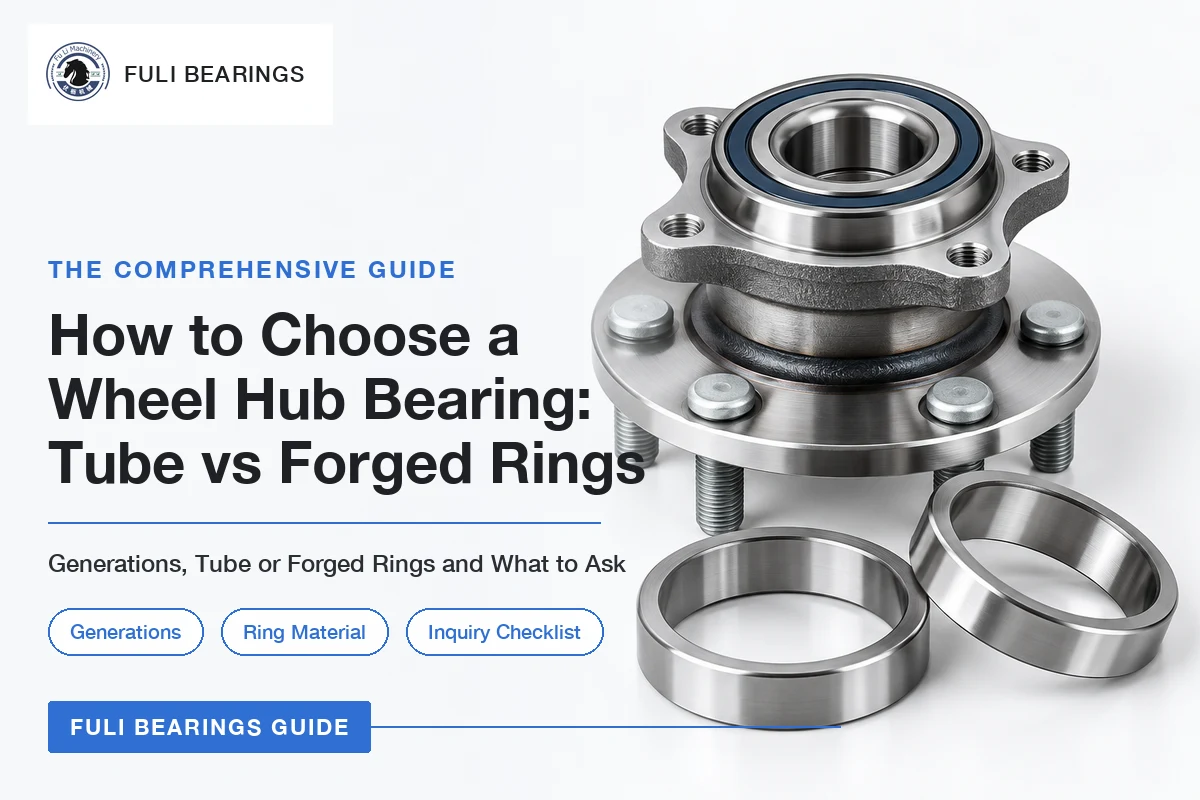
A bearing for a car wheel is ordered by part number, but two bearings with the same number can be made in quite different ways. Below we cover the three generations, the signs that a replacement is due, why quotes for the same part can be far apart, how tube and forged rings are made, and what to put in an inquiry.
Wheel bearing and hub assembly generations: what each one includes
These bearings come in ball and roller types, and the ball type is made in three generations [1]. The ball type is built on a double row angular contact ball bearing that is sealed for life [4]. The roller type is most often a tapered roller bearing, once common at both ends of the car before sealed ball-type units became the automotive standard. Trucks and trailers still run tapered roller bearings in pairs; the L44649 is a common outer bearing on light trailers. Our guide to ball and roller bearings by load direction covers how angular contact and tapered roller designs take combined load.
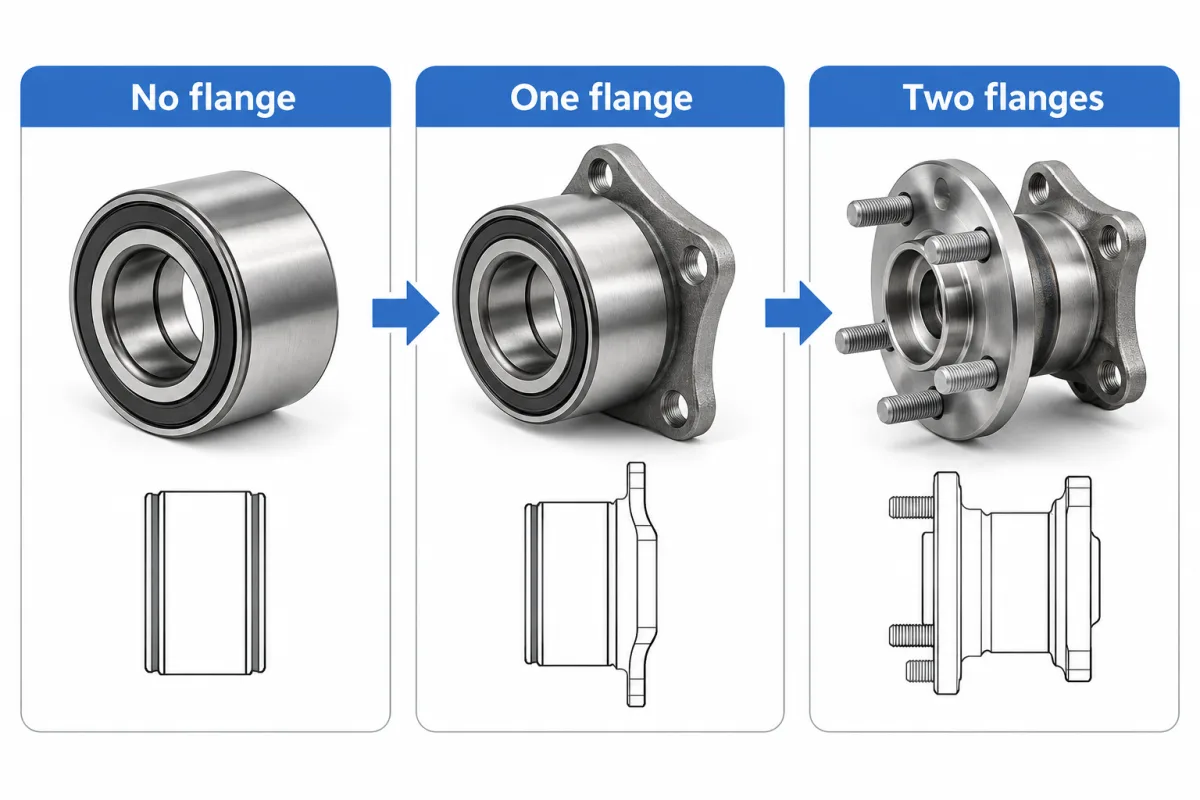
- Gen 1. A Gen 1 bearing has no flange. It consists of an inner ring, an outer ring, balls, a cage and seals [1], and it is fitted into a housing on the vehicle [1], on a front wheel usually the steering knuckle.
- Gen 2. A Gen 2 unit has one flange. In one layout the flanged outer ring is bolted to the vehicle body; in the other the outer ring turns, and the brake disc and wheel are mounted on it [1].
- Gen 3. A Gen 3 unit has two flanges: one for the wheel and disc, and a second for fixing the unit to the suspension [4]. The hub itself is part of the unit [1], with the wheel studs pressed into its flange. That makes the complete wheel hub and bearing assembly a bolt-on replacement, with no press step. On a driven front wheel of an FWD car, the inner ring is splined for the CV joint shaft.
SKF dates the first pre-adjusted wheel bearing assemblies to the late 1960s and the second generation to the early 1970s [4]. NTN describes the Gen 3 unit as the predominant design today [5], and in its comparison table the later generations score higher for ease of assembly on the line and for serviceability [1].
For an order, the generation tells you what you are buying: a loose bearing that a workshop presses in, or a unit that bolts on. It also decides which parts can be made from tube, which matters for price.
Is a hub bearing the same as a wheel bearing?
Wheel bearing is the general name for the bearing that lets the wheel turn on the axle. A hub assembly is that bearing packaged with the flange, the studs and often the ABS encoder. A Gen 1 bearing is replaced on its own. On Gen 2 and Gen 3 designs the bearing race inside the hub cannot be reached, so the whole sealed hub is replaced.
Workshops and auto parts catalogues use the two names loosely, so say whether you mean the bearing or hub assembly.
Matching a front wheel hub or rear bearing to a specific vehicle
In our factory the hard part of these orders is matching each car maker’s OEM number to the right standard part.
Aftermarket numbers add another layer. Brands such as Timken, MOOG and Mevotech cross OE numbers to six-digit interchange numbers, and one number often covers many vehicles. A retail listing on Amazon.com, for example, sells a 513288 front or rear wheel bearing hub assembly compatible with Chevy Malibu 2013-2015, Impala 14-17, Cadillac CTS and XTS 13-17, Buick LaCrosse and Regal 11-17 and GMC Terrain 10-17, with 5 lugs. A 4WD front unit for the Chevrolet Silverado 1500 is a different part again, so tie every quote to the OE number, not the model name.
Retail listings also call nearly every part an OE-grade replacement with long-lasting durability and hassle-free installation. None of those phrases tells you how the rings were made.
Bad wheel bearing symptoms and how to replace a wheel bearing
A failing wheel bearing usually gives warning:
- A hum or growl that rises with road speed and often changes when the car leans into a turn.
- Play when the wheel is rocked at the top and bottom, felt on the road as loose steering.
- Uneven tire wear on that corner.
- An ABS warning light, when a damaged encoder upsets the ABS sensor signal.
The usual causes of bearing failure are water past a damaged seal, pothole impacts that dent the raceways, and a retaining nut left loose or overtightened. The wheel end sees water, salt and grit every day, so the seal matters as much as the steel. Bad wheel bearings only get louder and looser, and replacing wheel bearings early costs less than driving on them.
For a pressed-in Gen 1 bearing, the workshop has to remove the hub, push the old bearing out with a press or puller, press in the new bearing with force on the outer ring only, then finish by reinstalling the hub and tightening the axle nut to the torque in the service manual. A Gen 3 unit simply unbolts, so on most current cars a wheel bearing replacement means fitting new hub assemblies.
Why two quotes for the same hub bearing can differ
In our experience at FULI, the quality of these bearings depends on two things. One is the machining process. The other, and the more important one, is the raw material of the rings.
Many lower-priced units on the market have rings made from steel tube. Tube is not one product either. It is made from round bar, and round bar from different steel makers varies a great deal. For tube of the same size, the brand of round bar alone makes a difference of USD 200 to 300 per ton of finished tube.
So when two quotes for the same front wheel bearing are far apart, ask first how the rings are made and from which steel. The price gap usually starts with the ring blank, which is hard to see on a finished, sealed bearing. A price far below the rest is a warning too: a 2003 hub bearing batch at about one third of the normal price could not be used.
A lower-cost spec has its place. In our 51108 order for a robot arm we matched the steel to a very light, slow duty. A wheel bearing carries the weight of the car at road speed, which is a different kind of duty.
One wheel hub customer from Africa shows how this plays out. We met at the Canton Fair in 2026. The customer had brought samples to China but not to the fair, so we quoted from the model numbers. The price looked high to the customer, and we parted without a deal. After the fair the customer came back every few weeks to ask the price again. We kept the same quote, and the order stayed open.
Then we learned that the customer lives in Guangzhou. We suggested bringing the samples to our factory instead of comparing prices over a screen, and the customer came. We took the sample apart on the table and went through it part by part: the steel, the heat treatment and the machining accuracy. After a few rounds on price the customer knew what the money was paying for, and placed the order at the factory. The same visit added several other bearing types from our range to the order.
A buyer who keeps asking the price is often not saying the price is too high. The buyer has not seen the product. If you are in China, bring your sample to the factory. A sample taken apart answers more questions than a quotation can.
Tube rings and forged rings: two routes from round bar
Both routes start from the same round bar:
- Tube route: round bar, piercing, cold drawing, cutting, turning.
- Forged route: round bar, forging, heat treatment, turning.
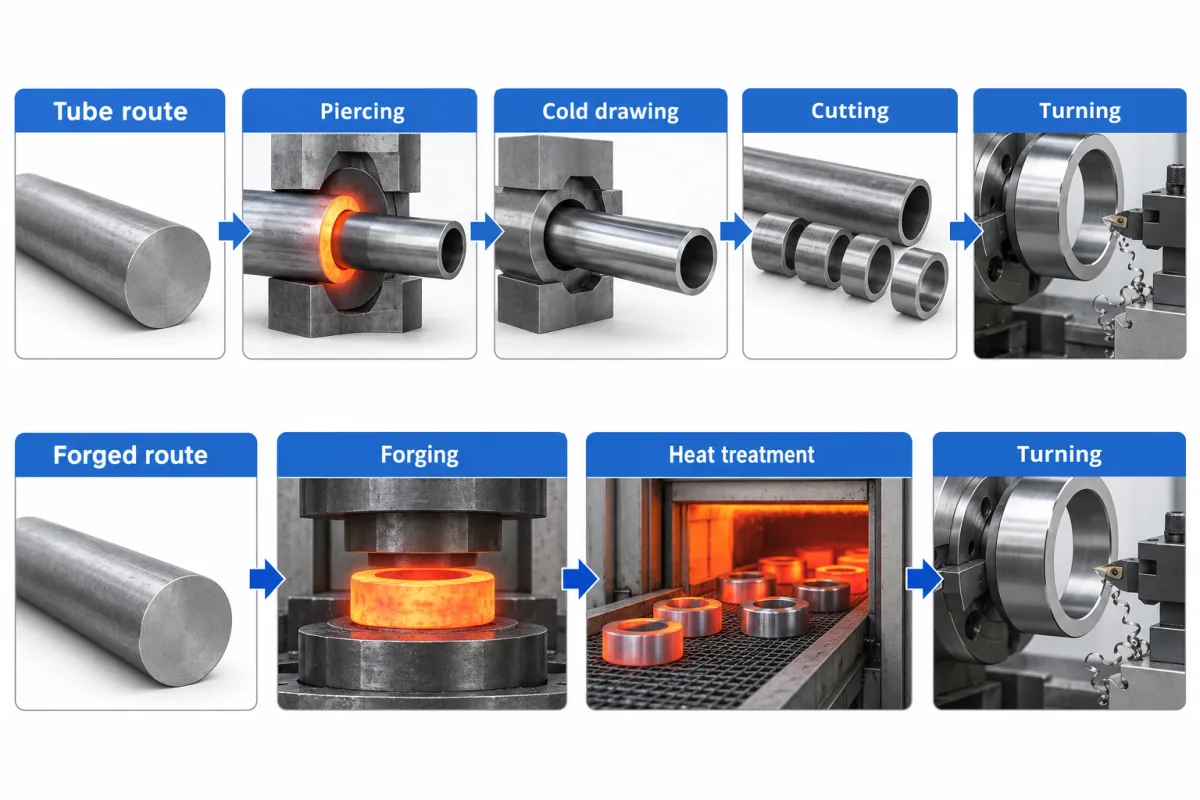
On the tube route, the bar is pierced into a hollow, cold drawn to size and cut into ring blanks, and the blanks are turned. On the forged route, each blank is forged from the bar, heat treated after forging to stabilize the microstructure, and then turned.
The bearing industry uses both routes. Schaeffler’s introduction to how rolling bearings are made says that large rings start as forgings, while smaller rings are usually cut from tube or bar stock before machining [2]. For a car bearing, the route is something the buyer has to ask about.
A forged ring takes more raw material than a ring cut from tube, so it costs more to make.
What forging and heat treatment change in the ring
From what we see in our factory, the forged route has three effects that the tube route does not:
- Forging does less damage to the structure of the steel.
- Heat treatment after forging stabilizes the microstructure.
- Once machined, the finished ring is tougher and more wear-resistant.
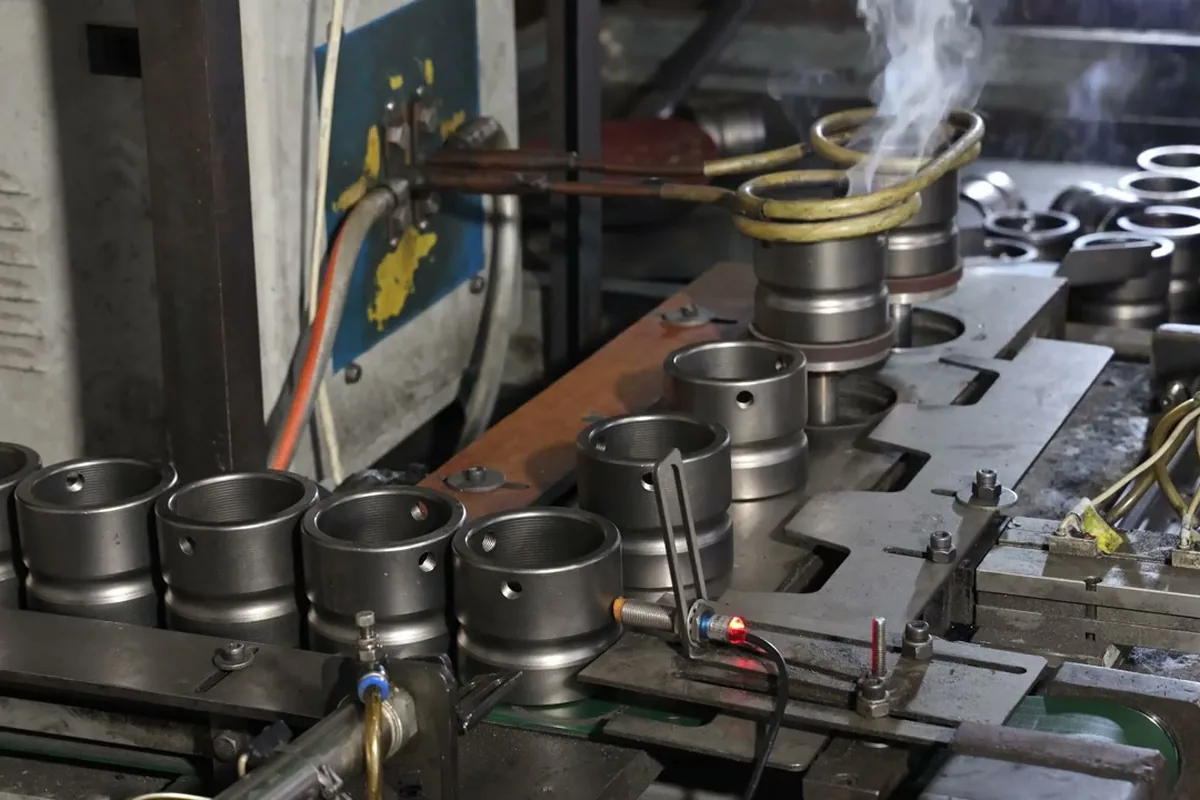
Rings made from tube do not have these properties. That is why a forged-ring bearing costs more, but lasts longer and is more consistent in quality.
The Forging Industry Association gives the general reason. Forging refines the grain structure and develops a grain flow that improves ductility, impact toughness and fatigue strength [3]. A forged part also has uniform material, which gives an even and predictable response to heat treatment [3].
Where the tube or forging choice applies
The tube or forging question applies mainly to Gen 1 bearings. A Gen 1 bearing is built from plain rings. NTN makes the inner and outer rings of its Gen 1 ball type from bearing steels such as SUJ2, the equivalent of SAE 52100, a through-hardening alloy steel [1]. Plain rings like these can be cut from tube or forged, and that is where the choice shows up in the price.
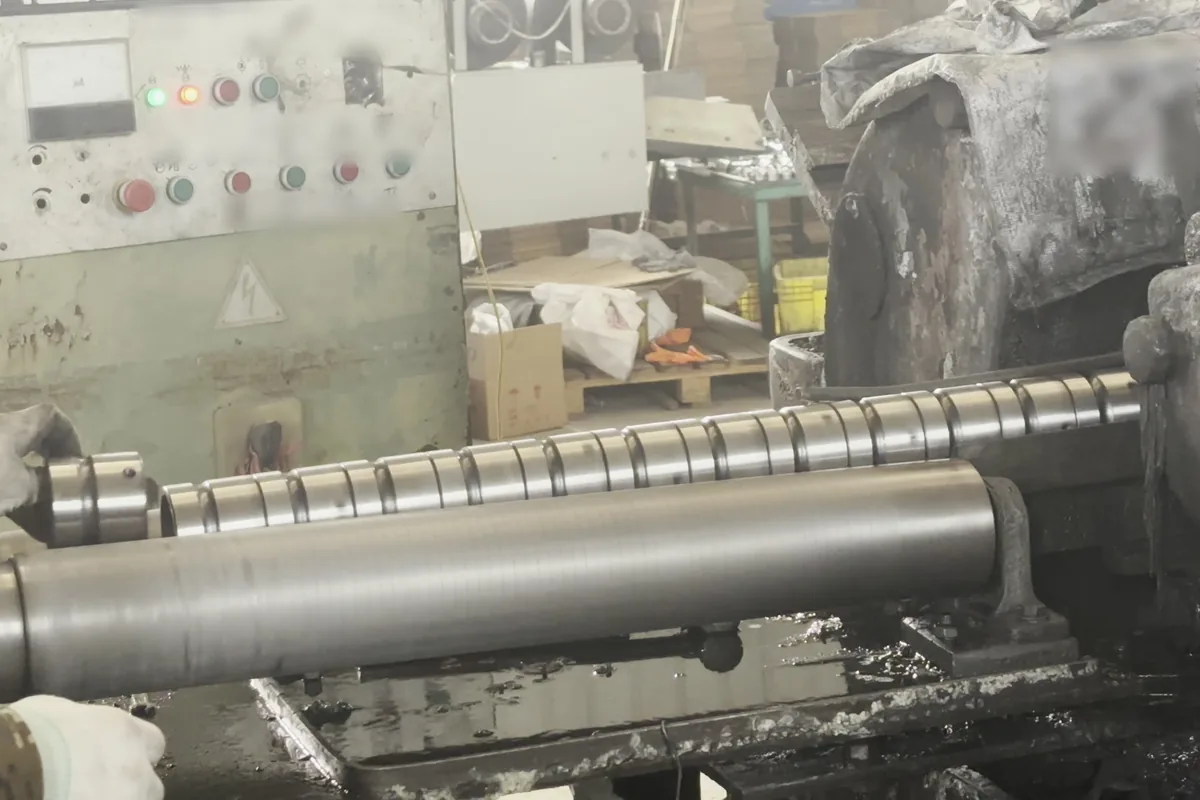
The flanged parts of Gen 2 and Gen 3 units are a different case. NTN makes the hub and the flanged outer ring of these units from S53C, a carbon steel it describes as highly forgeable, with induction hardened raceways [1]. For a Gen 2 or Gen 3 unit, ask about the steel and process of the flanged parts and of the inner rings.
Many units also carry a magnetic encoder that gives the anti-lock braking system (ABS) its wheel speed signal. Active systems that read very low wheel speeds can need a multipole magnetized encoder in place of the older tone wheel [1]. Gen 2 and Gen 3 units can have the encoder built into the bearing [1]. Whether ABS is fitted is one of the selection items in NTN’s catalogue [1], so state it in the inquiry.
What to put in an inquiry for hub assemblies
We supply wheel hub bearings to order. With these items an inquiry can usually be answered with a spec and a price in one round:
- The OE number, or the vehicle make, model and year, plus the wheel position: front or rear, driven or non-driven.
- The generation: a Gen 1 bearing, a Gen 2 unit or a Gen 3 unit. A photo of the old part helps.
- The ring material and process. Ask directly whether the rings are made from tube or from forgings, and which round bar steel is used. Ask every supplier the same question, so the quotes can be compared on the same basis.
- Whether an ABS encoder is needed. If the old part has one, say so.
- The quantity.
- Any packing or marking requirements.
Before shipment each batch is checked for rotation smoothness, dimensions, grease fill, rust and appearance, and units can be run one by one on a vibration and noise tester before packing. Export documents are the commercial invoice, packing list and CCPIT certificate of origin, plus an FTA Form COO where the destination country qualifies.
Backed by 20+ years of bearing export experience in Linqing, Shandong. FULI ships to 50+ countries & regions. You can send the list through the contact page or to sales@fuli-bearings.com.
Sources
- https://www.ntnglobal.com/en/products/catalog/pdf/4601E.pdf
- https://www.schaeffler.com/remotemedien/media/_shared_media/08_media_library/01_publications/schaeffler_2/brochure/downloads_1/bwk_de_en.pdf
- https://www.forging.org/Common/Uploaded%20files/Design%20Engineering%20Center/Product%20Design%20Guide%20for%20Forging.pdf
- https://automotive.skf.com/nam/en/product-assortment/passenger-vehicles/hub-bearings-kits
- https://www.ntnglobal.com/en/products/review/pdf/NTN_TR89_en_14.pdf
FAQ
What are the three generations of hub assemblies?
A Gen 1 bearing is a double row angular contact ball bearing with no flange. A Gen 2 unit adds one flange. A Gen 3 unit has two flanges, one for the wheel and brake rotor and one for the suspension.
Is a bearing with forged rings better than one with tube rings?
In our experience, a forged ring lasts longer and is more consistent. Forging does less damage to the structure of the steel, and heat treatment after forging stabilizes the microstructure, so the finished ring is tougher and more wear-resistant. It costs more because a forging uses more steel.
Why is one quote for the same part much cheaper than another?
Usually because of the rings. Many lower-priced parts use tube rings, and for tube of the same size the round bar brand alone changes the price by USD 200 to 300 per ton of finished tube. Ask each supplier how the rings are made.
Do Gen 2 and Gen 3 units use tube rings?
NTN makes the flanged parts from S53C, a carbon steel it describes as highly forgeable. The tube or forging question applies mainly to the plain rings of a Gen 1 bearing; for Gen 2 and Gen 3 units, ask about the steel and process of the flanged parts and the inner rings.
Can I drive with a bad wheel bearing?
Only as far as a workshop. A worn bearing gets louder and looser, and in the late stage it can overheat, seize or let the wheel wobble, which affects steering and braking.
Is changing wheel bearings a big job?
It depends on the generation. A bolt-on Gen 3 unit comes off with a few bolts once the caliper and disc are out of the way. A pressed-in Gen 1 bearing needs a hydraulic press and more time, because the old bearing has to be pushed out of its housing.
How much does a wheel bearing cost?
It depends mostly on what is in the box. A loose Gen 1 bearing costs less than a Gen 3 unit that also carries the flange, the studs and an ABS encoder, and workshop labour is higher for a pressed-in bearing. Between suppliers of the same part, the ring material and process move the price most.
What should I send with an inquiry for hub assemblies?
The OE number or vehicle model, the wheel position, the generation, the ring material and process you want, whether an ABS encoder is needed, and the quantity.