Bearing Lubrication Guide: How Much Grease Is Right
Why too much grease causes as many problems as too little, the general fill rules for sealed and open bearings, and one order we got wrong.
This bearing lubrication guide covers one number buyers often leave to the factory: how much grease goes into the bearing. The right amount depends on speed, environment and whether the bearing will ever be regreased. Below are the published fill rules, then an order where we set the fill ourselves and got it wrong.
Bearing lubrication guide: why the amount of grease matters
Grease is the lubricant in most rolling bearings. NSK puts it at 80% of rolling bearings, because it needs no pumps or coolers and stays in place with simple seals [2]. A grease is a base oil held in a thickener, with additives. The base oil makes up 70-95% of it and does the lubricating; the thickener, about 5-30%, keeps the oil where it is needed [2]. Base oil viscosity matters too: an oil that is too thin breaks down under load and lets metal-to-metal friction rise, while one that is too thick adds drag of its own, which is why the same grease fill principles carry over to roller bearings such as cylindrical and tapered designs, not just the ball bearings this guide focuses on.
Getting the amount wrong hurts either way. With too little grease, the film between the balls and the raceways is not kept up. The right amount keeps that film in place without packing the space solid. With too much grease, the balls have to push the surplus out of the way on every turn. Machinery Lubrication describes what follows: the rolling elements churn the grease, which wastes energy and raises the temperature, and the heat speeds up oxidation of the grease and oil bleed, the separation of oil from thickener. Over time the churning heat can cook the thickener into a hard crust that stops fresh grease from reaching the bearing. SKF describes the same effect in new bearings: excess grease gives a high frictional moment and a considerable temperature rise until it works its way out of the contact zone [4].
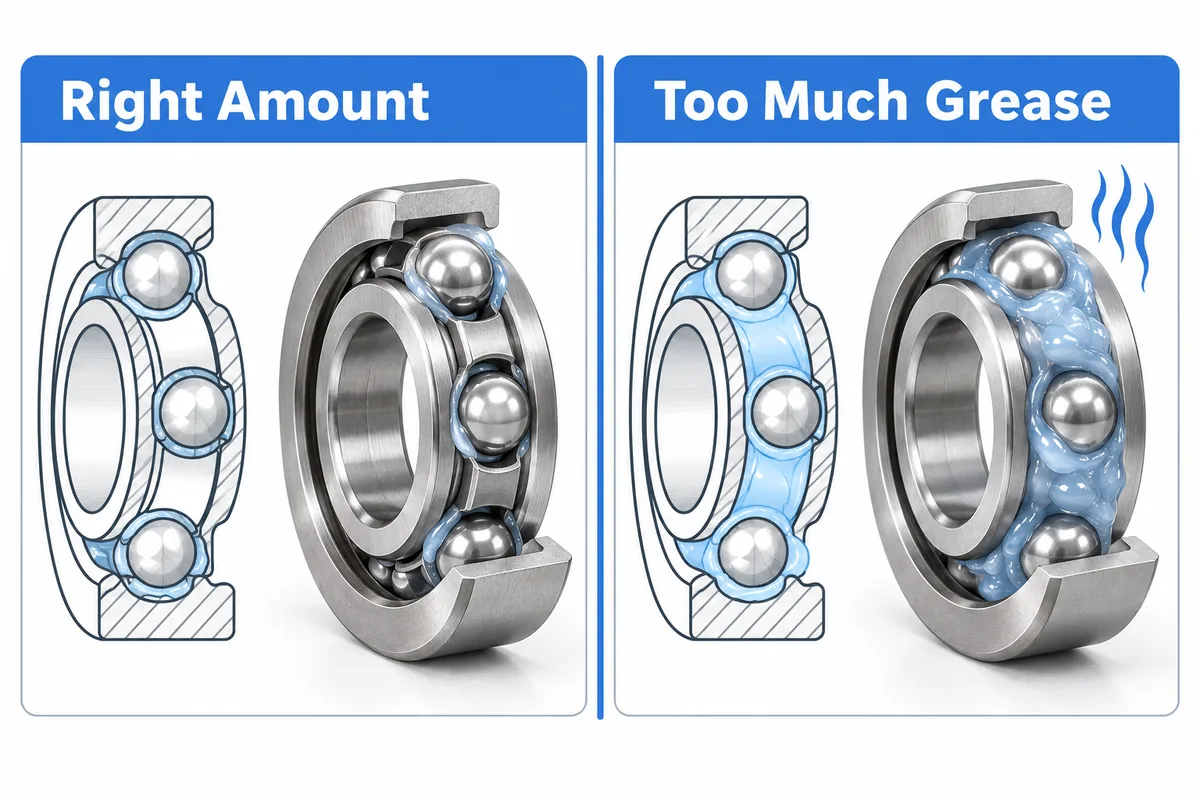
Pressure is the other risk when bearings are regreased by hand. A grease gun can produce up to 15,000 psi, while lip seals usually fail at around 500 psi, so overgreasing a housing can rupture the seals and let water and dirt in. Shields facing the grease supply can be pushed into the raceway.
How much grease in a bearing: the general fill rules
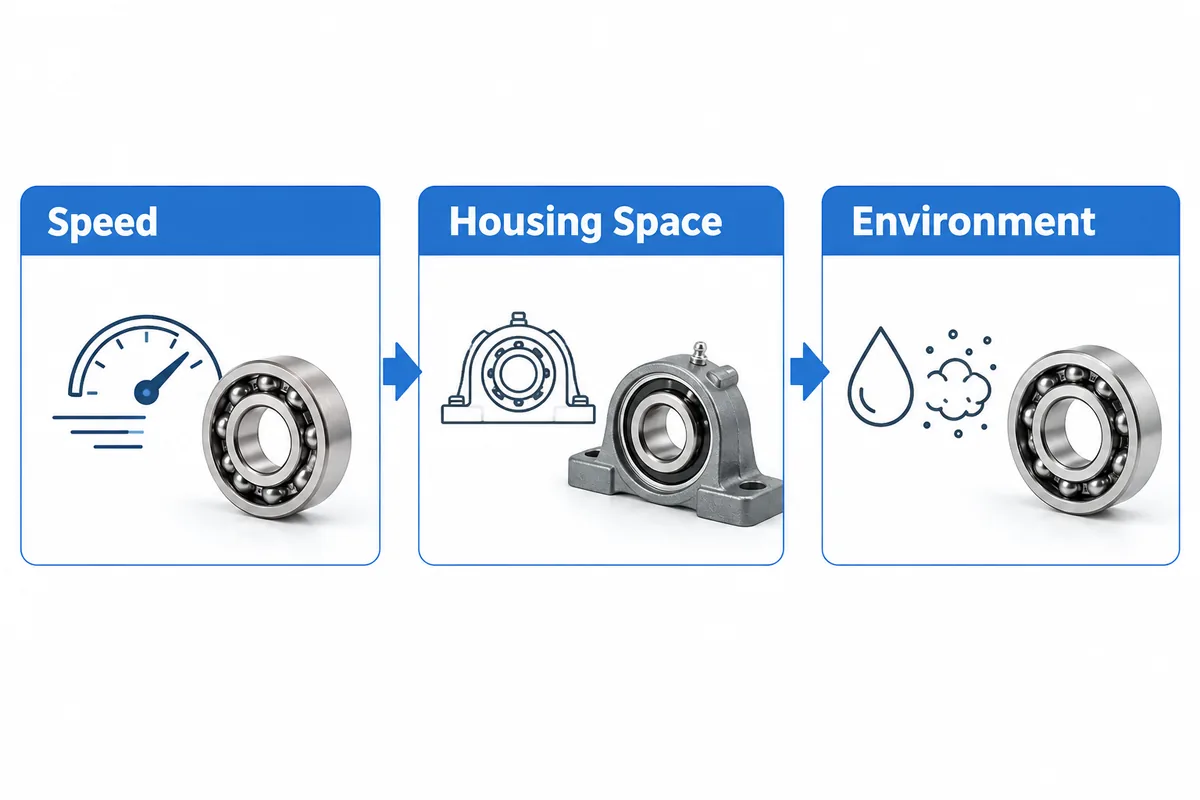
There is no single right percentage. NSK lists what the fill depends on: rotational speed, housing structure, available internal space, the grease used and the operating environment [2]. Bearing makers publish rules of thumb that work inside those limits:
- The bearing itself. When open bearings are installed, SKF says the space inside the bearing is usually packed full, while the housing gets only part of its space filled [1].
- Housing space and speed. NSK fills 1/2 to 2/3 of the housing’s free space when the bearing runs at 50% of its limiting speed or less, and 1/3 to 1/2 when it runs faster [2]. The faster the bearing turns, the less grease the housing takes.
- Slow, wet or dirty duty. For slow bearings that must be shielded from dirt and rust, SKF’s advice is to pack the housing 70% to 100% full [1].
- High speed. For super-precision bearings running at high speed, SKF keeps the grease below 30% of the free space in the bearing [4].
In an open arrangement, running-in deals with some of the surplus. SKF notes that during running-in the surplus spreads out or leaks away, and once it has, the bearing runs cooler [1]. A sealed bearing has much less room to push grease out, which is why its fill has to be right when it is made.
Relubrication quantities are worked out from the bearing size. SKF gives Gp = 0.005 x D x B grams when grease is added from the side of the bearing, and Gp = 0.002 x D x B grams when it goes in through holes in the ring, with D the outside diameter and B the width in millimetres [1]. Our bearing grease fill calculator runs the side-fill formula for a given size. For a 6018 bearing, 140 mm outside diameter and 24 mm wide, the side-fill quantity comes to about 17 g [1].
Sealed or open bearings: who sets the grease fill
With a 2RS or ZZ bearing, the fill is settled before the bearing leaves the factory. SKF treats bearings with a seal or shield on each side as greased for life and close to maintenance-free [3]. The grease that goes in at assembly is the grease the bearing runs on for its whole life. The user cannot add to it or take any out, so the amount and the type are set by the maker.
Choosing the grease type belongs to the same decision. Standard grease carries no suffix in the bearing designation; special greases such as low-noise, high-temperature or food-grade types are marked with a suffix, and SKF advises checking their availability before ordering [3]. Temperature narrows the choice further: SKF puts the practical upper limit of standard greases at 100 °C on the hottest ring [5]. SKF also notes that a capped bearing run very fast or very hot can show grease at the seal edge [3].
Put the bearing outdoors and water becomes part of the duty. Water causes surface corrosion, has been linked to accelerated surface fatigue in bearings, and thins the lubricant film. When comparing greases for wet service, Machinery Lubrication points to three tests: water washout, water spray-off, and penetration for consistency. For a sealed bearing that will sit in rain or washdown, the grease type, the fill and the seal are chosen together, and the factory fixes each of them at assembly.
Open bearings in housings are the user’s job. Add the calculated quantity slowly, because fast strokes on a grease gun build pressure and can damage seals, and let the bearing run in before judging its temperature [1].
Our 6018-2RS grease fill mistake
This one was our fault.
In 2016 a German importer in equipment manufacturing ordered 6018-2RS bearings from us. The customer required a grease fill of 90/100, meaning grease filling 90% of the free space inside the bearing. We chose Great Wall BLU-A low-noise bearing grease.
Our technical department set the fill the way it would for a usual speed of 1500 rpm. That fill was lower than the one on the order. We did not tell the customer. Our assumption was that the amount of grease would not make much difference in use, so nobody raised it.
The customer could see directly that the grease was not at 90/100. The reason for the number was the duty. The customer uses the bearings outdoors and requires them to be waterproof and maintenance-free for life. Nobody regreases a bearing like that, so the grease inside has to protect it against water for its whole life. SKF points the same way for housings: when a slow bearing has to be kept free of dirt and rust, it puts the housing fill at 70% to 100% [1]. We had replaced the customer’s operating conditions with our general speed setting, and we had done it without asking.
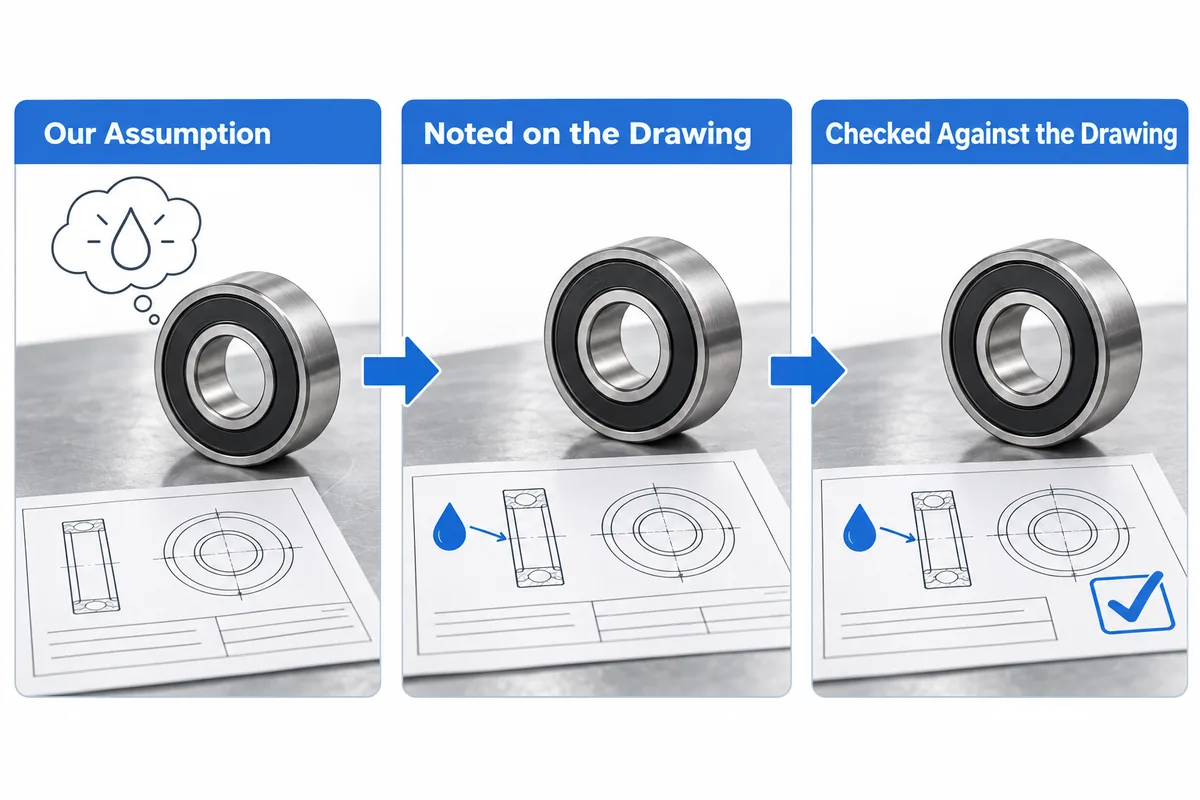
We bore the cost of the grease-filling machine, the grease and the labour.
After this, our factory began drawing product drawings to the customer’s requirements, with the requirements noted on the drawing. We now produce and inspect strictly to the drawing and those requirements, so the grease fill is checked against the drawing.
The customer is still with us. Every bearing in the customer’s engineering projects is now made by our company.
Two things came out of it. The fill has to follow the real operating conditions: speed, outdoor exposure, water, and whether the bearing will ever be regreased. And any change to a customer’s specification, including one we think is harmless, has to be confirmed by the customer in writing before production.
What to put on the drawing or order
In that case the customer had done the right thing: the fill was on the order. What failed was the step between the order and the filling machine. The practical part of this bearing grease guide is to give the factory the operating conditions along with the number, and to ask for any change to come back in writing.
For sealed bearings going into a known machine, put these on the drawing or the purchase order:
- Operating speed, or the speed range.
- Environment: indoor or outdoor, rain or washdown water, dust.
- Maintenance plan: sealed for life, or regreased, and from where.
- Operating temperature range.
- The grease by name, or the requirement for it (low-noise, water-resistant, high-temperature).
- The grease fill as a percentage of the bearing’s free space, where the application needs a specific fill.
- A line saying that any change to the above needs the buyer’s written approval before production.
| Option | Use it when | Do not use it when | What it costs you |
|---|---|---|---|
| Factory standard fill (not stated on the order) | Distributor stock with no known application; indoor duty at ordinary speed | Outdoor, wet or maintenance-free duty; a known speed or temperature outside the ordinary | Nothing extra; the fill is the factory’s usual one |
| Fill and grease stated on the drawing or order | OEM and project orders where speed, environment and maintenance plan are known | General stock with no known application | A drawing to agree, and grease availability to confirm first [3] |
Before shipment each batch is checked for rotation smoothness, dimensions, grease fill, rust and appearance. The same habit of writing the requirement down applies to clearance codes, covered in bearing internal clearance. Dimensions and seal options for the size in the case are on the 6018 bearing page, and the full range is under deep groove ball bearings.
Backed by 20+ years of bearing export experience in Linqing, Shandong. Send the drawing, or the speed, environment and maintenance plan, to sales@fuli-bearings.com, and ask us to confirm the fill and the grease in writing before production.
Sources
- https://www.skf.com/us/products/rolling-bearings/principles-of-rolling-bearing-selection/bearing-selection-process/lubrication/determining-grease-quantities
- https://www.nsk.com/tools-resources/abc-bearings/grease-lubrication/
- https://www.skf.com/group/products/rolling-bearings/ball-bearings/deep-groove-ball-bearings/single-row-deep-groove-ball-bearings
- https://www.skf.com/group/products/super-precision-bearings/principles/bearing-selection-process/lubrication/suitable-grease
- https://www.skf.com/group/products/rolling-bearings/principles-of-rolling-bearing-selection/bearing-selection-process/lubrication/selecting-a-suitable-grease
FAQ
How to calculate bearing grease?
For relubrication from the side of the bearing, SKF uses Gp = 0.005 x D x B, where Gp is in grams, D is the outside diameter and B the width in millimetres; through holes in the ring it is 0.002 x D x B. The initial fill of an open bearing is commonly its whole free volume. The grease fill calculator does the side-fill sum.
Can a sealed bearing have too much grease?
Yes, and it is set at the factory. Higher speed calls for less grease: NSK reduces the housing fill above 50% of the limiting speed, and SKF keeps high-speed precision bearings below 30% of the free space. Excess grease churns and raises the temperature.
Do 2RS bearings need regreasing?
No. A bearing sealed on both sides is greased for life and needs almost no maintenance. Their grease life still depends on operating temperature and speed, so give the factory both when you order.
What are the types of lubrication for bearings?
Grease and oil. NSK counts grease in 80% of rolling bearings. Unlike oil, it needs no pumps or coolers and can be used in small quantities, which suits a wide range of machines.
How do I properly lubricate a bearing?
Pack the free space of the bearing, work the grease in evenly between the balls and the rings, and turn the bearing by hand until every inside surface is coated. Fill the housing to the level for its speed, add grease slowly, and expect the temperature to settle after running-in.