Carrier Bearing Guide: Parts, Wear Signs and Inquiry Specs
What a driveshaft carrier bearing (center support bearing) is made of, the ball bearing inside, wear signs, replacement cost and the specs for a fitment.
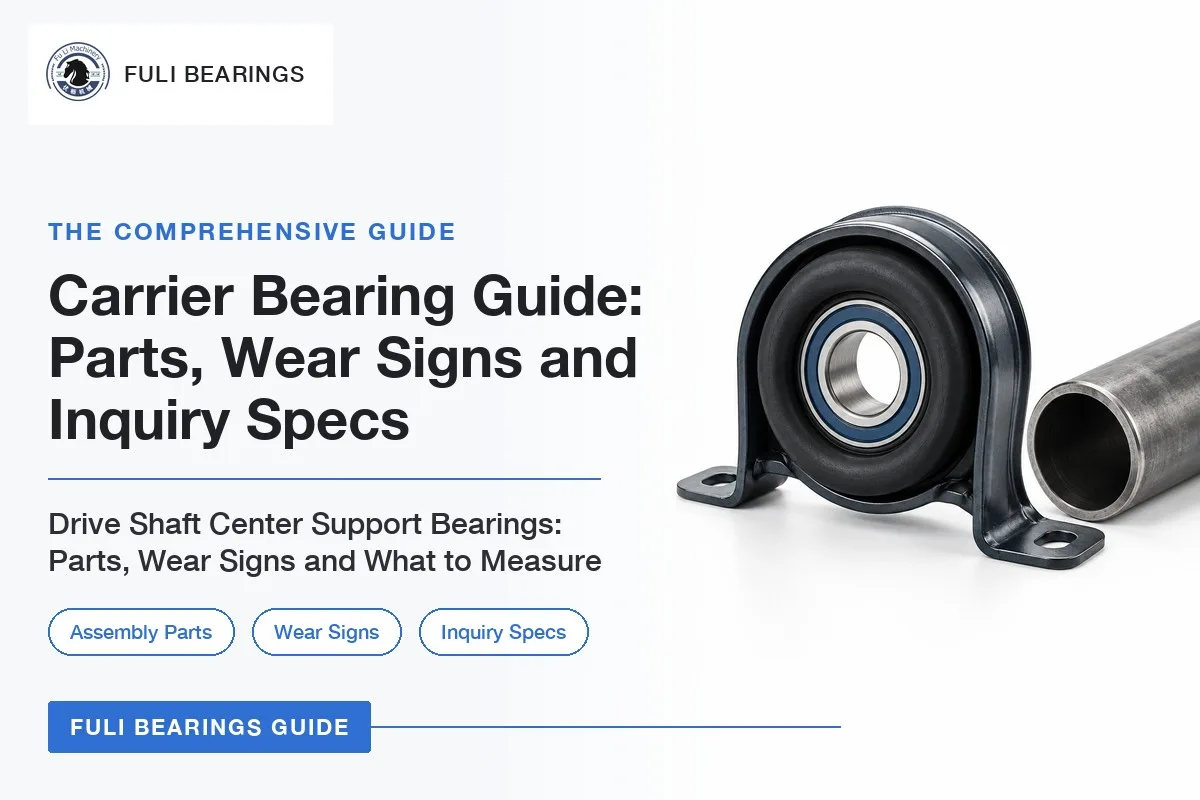
A carrier bearing holds up the middle of a driveshaft that is built in two or more sections. Most are found on rear-wheel drive and four-wheel drive vehicles with a long wheelbase: pickup trucks, vans, many SUVs, commercial trucks and some cars. This guide covers what the unit is made of, the bearing inside it, the signs of wear, the checks at replacement and the measurements to send with an inquiry.
Where a driveshaft carrier bearing sits
On a long drivetrain, the driveshaft is split into sections that meet partway between the transmission and the rear axle, and that joint needs support from the vehicle frame. Spicer’s service manual describes the part that does this as a rolling bearing set in a cushion and bolted to the frame [1]. In the same manual it is called a center bearing [1]. Timken sells it as a driveline center support bearing and notes that many people call it a hanger bearing [3].
Mevotech, an aftermarket parts maker that calls the part a driveshaft center bearing, describes its job: to carry the shaft as it turns, let it flex a little, and absorb part of the shock from rough roads [6].
The reason for the split is length. A long one-piece tube can bend and whip at high speed, so longer vehicles use multi-piece driveshafts, usually a two-piece driveshaft or a three-piece one, with u-joints between the sections. The carrier bearing supports the joint in the middle, keeps the sections in line and passes the load into the frame. Length changes as the suspension moves are taken by the splined slip joint, not by the bearing.
Carrier bearing types: driveshaft or differential
The name can cause confusion. The same name is used for another part, and RockAuto, an automotive parts catalog, lists the two as separate part types [8]. In a rear differential, the carrier bearings are the pair of tapered roller bearings that hold the differential case in its housing, next to the pinion bearings. They are set with preload and carry combined loads, so they are ordered by tapered bearing number, not by the measurements in the list below.
In our experience, an inquiry that says only “carrier bearing” needs one question answered first: which of the two is meant. The rest of this guide is about the driveshaft part.
Parts of a drive shaft carrier bearing assembly
A complete carrier bearing has four kinds of parts:
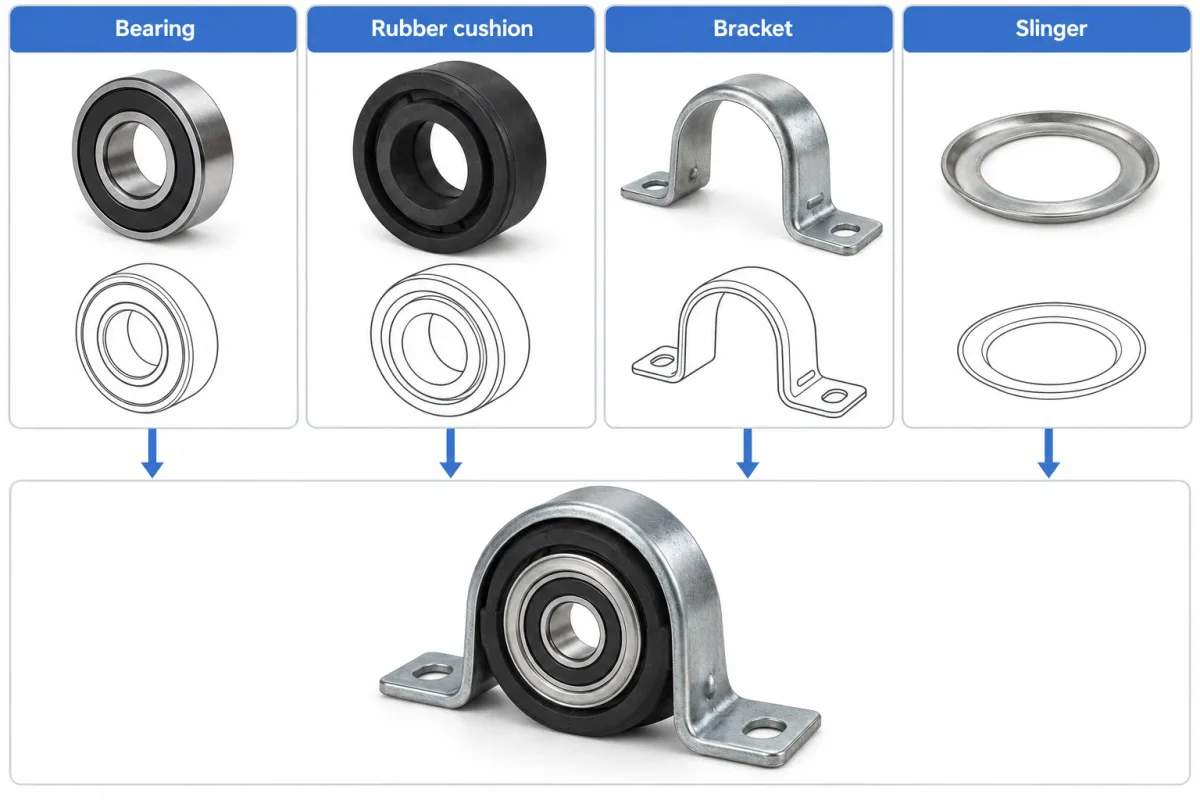
- Bearing. The rolling bearing at the center of the unit. SKF’s center support units use ball or needle bearings [4].
- Cushion. The flexible ring that holds the bearing and absorbs vibration [3]. Spicer’s installation bulletin calls it the isolator [7].
- Support bracket. The metal frame that bolts the unit to the vehicle [1]. Timken makes this part from heavy-gauge cold-rolled steel [3], while SKF uses steel or aluminum frames [4].
- Slinger. A thin stamped ring that keeps dirt and other foreign matter out of the bearing [1]. SKF includes the frame and slingers where the application needs them [4].
The bearing sits under the vehicle, open to the road. NSK points out that this position calls for resistance to mud and dirty water on top of high rotating speed [5]. Timken fills its bearing inserts with grease, seals them, and adds a further grease barrier between the retainer caps and the sealed bearing [3]. Spicer states that its center bearings are lubricated for life and that no grease should be added to them [1].
In our experience, it is worth stating the seal type and the grease in the order, because the bearing is not regreased once it is fitted [1].
The bearing inside: often a sealed deep groove bearing
NSK lists bearings for propshafts among its driveline products, with a product image titled “Deep Groove Ball Bearing, Propshaft Support” [5].
Replacement catalogs show the same thing through part numbers. RockAuto’s list of SKF parts for this position has plain deep groove ball bearings sold on their own, next to complete HB-series units [8]:
- the 6005 bearing, 6006 bearing, 6007 bearing and 6009 bearing, each with two seals (2RS) [8]
- the 6206 bearing with two seals (2RS) [8]
- the 6210 bearing with two metal shields (2Z) [8]
Sizes from both the 60 series and the 62 series appear in that list [8]. Read the size from the marking on the old bearing or from its part number, and do not assume one series. The bearing size chart gives the bore, outside diameter and width for each number.
A deep groove bearing suits this job because the load at the center joint is mostly radial, with little axial load. Because the part sits under the vehicle, the seal matters as much as the size: 2RS contact seals keep out water better than 2Z metal shields, and our seal type guide compares the two.
We recommend settling first whether the buyer wants the complete unit or the bearing only. Where only the bearing is replaced, the size and the seal type are enough. Where the whole unit is replaced, the mounting dimensions matter as well, as the inquiry list at the end of this guide shows.
Signs of a worn carrier bearing: noise, vibration and wobble
Mevotech lists three common signs that the bearing is wearing out [6]:
- A shudder or jolt when the vehicle pulls away from a stop, because the joint can no longer flex through its normal range.
- Unusual noise from under the vehicle during acceleration, slowing down or cruising, heard as howling, grinding, knocking or squealing.
- A feeling of lost power or drag while driving.
Spicer adds that a damaged center bearing, or a damaged part of one, can cause driveshaft imbalance, which in turn wears other parts [1].
Mevotech’s advice is to follow the vehicle’s factory service manual for diagnosis, and to replace a bearing that is out of specification before it damages other parts. Worn related parts and the chassis should be checked at the same time [6].
Vibration and noise from under the vehicle can also come from worn universal joints or an unbalanced tube, so a quick inspection helps before parts are ordered. With the vehicle safely supported, look at the rubber cushions for cracks, tears or a bearing that has dropped out of center. Then grip the tube next to the bearing and try to move it. Play you can feel, visible movement when it turns, or a whine or grind that rises with road speed point to the bearing. A clunk when the vehicle shifts into drive or reverse often comes from a torn cushion that no longer holds the bearing in place. Any abnormal vibration that starts after a repair is a reason to recheck alignment and the marks made at removal.
In these driveshaft systems, the usual causes of worn bearings are water and road dirt getting past the seals, a cushion that has aged and cracked, misalignment after a ride height change, and heavy loads such as towing. The service life of a carrier bearing depends on these conditions more than on mileage alone.
How to replace a carrier bearing: checks, bearing puller and press
Spicer’s manual gives three checks for a center bearing in service [1]:
- Look for gaps between the midship nut and the parts it clamps.
- Check the bolts that hold it to the frame. If they are loose, set the unit straight and tighten them to the torque in the vehicle maker’s specification.
- Check the cushion for damage, check that it is properly seated, and check that the slingers do not rub on it.
Misalignment causes trouble as well. A vehicle maker’s service article for an adjustable Spicer center bearing says that if the bearing is not aligned, the isolator can work out of place and the shaft or yoke then rubs on it. The cushion should sit at a right angle to the tube, and on that design the steel cage can be turned up to 10 degrees either way to get there [7].
For replacement, Spicer’s steps include the following [1]:
- Mark the yoke and the shaft before removal, so they go back together in the same phase.
- Pull the yoke off with a puller, not a hammer.
- Inspect the bearing seat on the shaft. If a seized bearing has damaged it, the whole coupling shaft is replaced.
- Fit a new slinger instead of the old one.
- Fit a new midship nut, not the old one, and tighten it to the specified torque.
The bearing itself is a press-fit on the shaft. Once the yoke is off, the old bearing is pulled or pressed off. The new one is pressed on by its inner ring only, so that no force passes through the balls. Without a press, the job is harder, which is why DIY repairs often use a complete unit instead of a loose bearing, or leave the work to a professional mechanic.
The same manual notes that most replacement center bearings come without slingers [1]. That is a point to settle with the supplier before the parts ship.
Ordering replacement carrier bearings: what to send
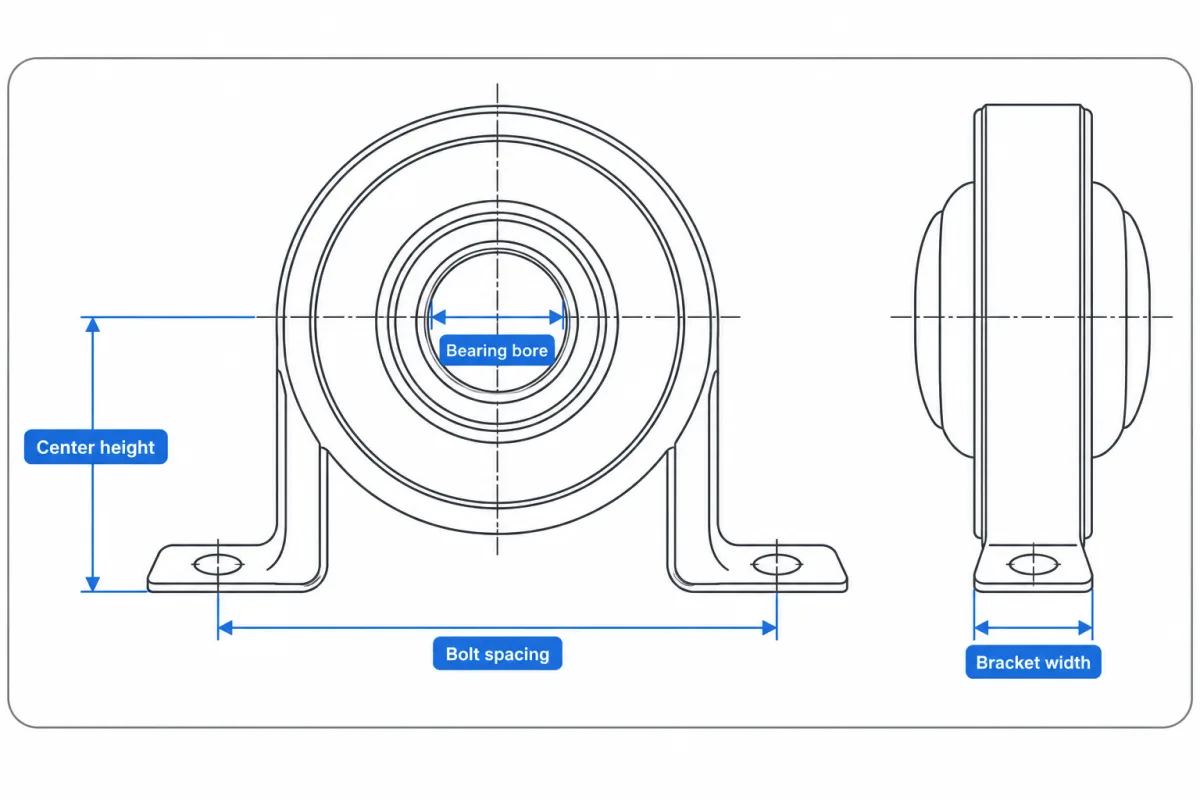
We supply carrier bearings (drive shaft center support bearings) to order. Dana’s Spicer product pages describe each center bearing by its driveshaft series and a short set of measurements [2]. The same measurements make a good inquiry and settle fitment before the order ships:
- The part number of the old part, or clear photos of it, including any marking on the bearing.
- Whether you need the complete unit or the bearing only.
- Bearing bore: the inside diameter of the bearing, which fits on the driveshaft [2].
- Center height: the distance from the bearing centerline to the mounting face [2].
- Bracket width [2].
- Bolt spacing: the distance between the centers of the two bolt holes, plus the bolt hole size [2].
- The driveshaft series, if you know it [2].
- Whether slingers should be included.
- The quantity, and any packing or marking requirements.
As an example of how these figures look, Spicer lists part 210084-2X for a 1610 series driveshaft with a 1.771 in bearing ID, 2.690 in from centerline to mounting face, a 2.250 in width, 7.620 in between bolt hole centers and a 0.560 in bolt hole [2].
Before shipment each batch is checked for rotation smoothness, dimensions, grease fill, rust and appearance. Export documents are the commercial invoice, packing list and CCPIT certificate of origin, plus an FTA Form COO where the destination country qualifies. If you also buy wheel bearings, our guide to choosing wheel hub bearings lists what to ask for those.
Backed by 20+ years of bearing export experience in Linqing, Shandong. FULI ships to 50+ countries & regions. You can send the list through the contact page or to sales@fuli-bearings.com.
Sources
- https://www.dana.com.au/wp/wp-content/uploads/2025/02/DSSM-0100-SPL-Service-Manual.pdf
- https://www.danaaftermarket.com/210084-2X
- https://www.timken.com/resources/timken-passenger-vehicle-driveline-center-support-bearings-overview-and-interchange/
- https://cdn.skfmediahub.skf.com/api/public/0945d0a969e01689/pdf_preview_medium/0945d0a969e01689_pdf_preview_medium.pdf
- https://www.nsk.com/am-en/products/automotive/bearings-for-prop-shafts-and-differentials/
- https://www.mevotech.com/tips-practices/common-indicators-of-a-failing-driveshaft-center-support-bearing/
- https://static.nhtsa.gov/odi/tsbs/2014/SB-10096282-2280.pdf
- https://www.rockauto.com/en/parts/skf,drive+shaft+center+support+bearing,12743
FAQ
Is a carrier bearing the same as a center support bearing?
On a driveshaft, yes. They are two names for the same part, and center bearing is a third. The name is also used for a bearing in the axle, which is a different part.
What bearing is inside a carrier bearing?
Often a sealed deep groove bearing. SKF's units use ball or needle bearings, and NSK shows one for propshaft support. Sizes sold as replacement inserts include 6005, 6006, 6007, 6009, 6206 and 6210.
What are the symptoms of a bad carrier bearing?
A shudder when pulling away from a stop, howling, grinding, knocking or squealing from under the vehicle, and a feeling of drag. A damaged center bearing can also cause driveshaft vibration.
Can you drive with a bad carrier bearing?
We recommend having it checked as soon as the symptoms show. Mevotech advises replacing a bearing that is out of specification to avoid damage to the driveshaft and other driveline parts.
Can you drive without a carrier bearing?
No. The carrier bearing is what holds up the center joint. Without it that joint drops and swings, which quickly damages the joints and the transmission.
How long does a carrier bearing last?
There is no fixed figure. It depends on how much water and dirt reach the seals, the condition of the cushion, misalignment and load. Check it at every service under the vehicle.
How much does it cost to replace a carrier bearing?
The replacement cost depends on the vehicle, on whether only the bearing or the complete unit is replaced, and on labor. A loose bearing costs less but needs a press to fit.
Can you grease a carrier bearing?
Spicer's center bearings are lubricated for life, and Spicer says no grease should be added. Timken's inserts also come greased and sealed.
What measurements are needed to order a carrier bearing?
The bearing bore, the center height from the bearing centerline to the mounting face, the bracket width, the bolt spacing and bolt hole size, and the driveshaft series. Add the old part number or photos, and say whether slingers are needed.