Adapter Sleeve Bearing: How to Read, Match and Order
Adapter sleeve bearing guide: read an H sleeve number, match it to the shaft and bearing bore, and list the lock nut and washer on your inquiry.
An adapter sleeve bearing is a bearing with a tapered bore, held on a plain shaft by a slotted sleeve, a lock nut and a locking washer. To order a replacement, you need the sleeve number as well as the bearing number. The shaft size comes from the sleeve. It is not the bearing bore, which is larger [5].
Buyers and maintenance teams who replace spherical roller bearings on plain shafts in industrial machinery can use this guide as a checklist. It covers how to read a number such as H 308, how to match it to your shaft, how an adapter sleeve differs from a withdrawal sleeve, and what to write on the inquiry.
How an adapter sleeve bearing works
The bearing has a tapered bore. Its number ends in K, as in 22208 K. The taper is 1:12 [3].
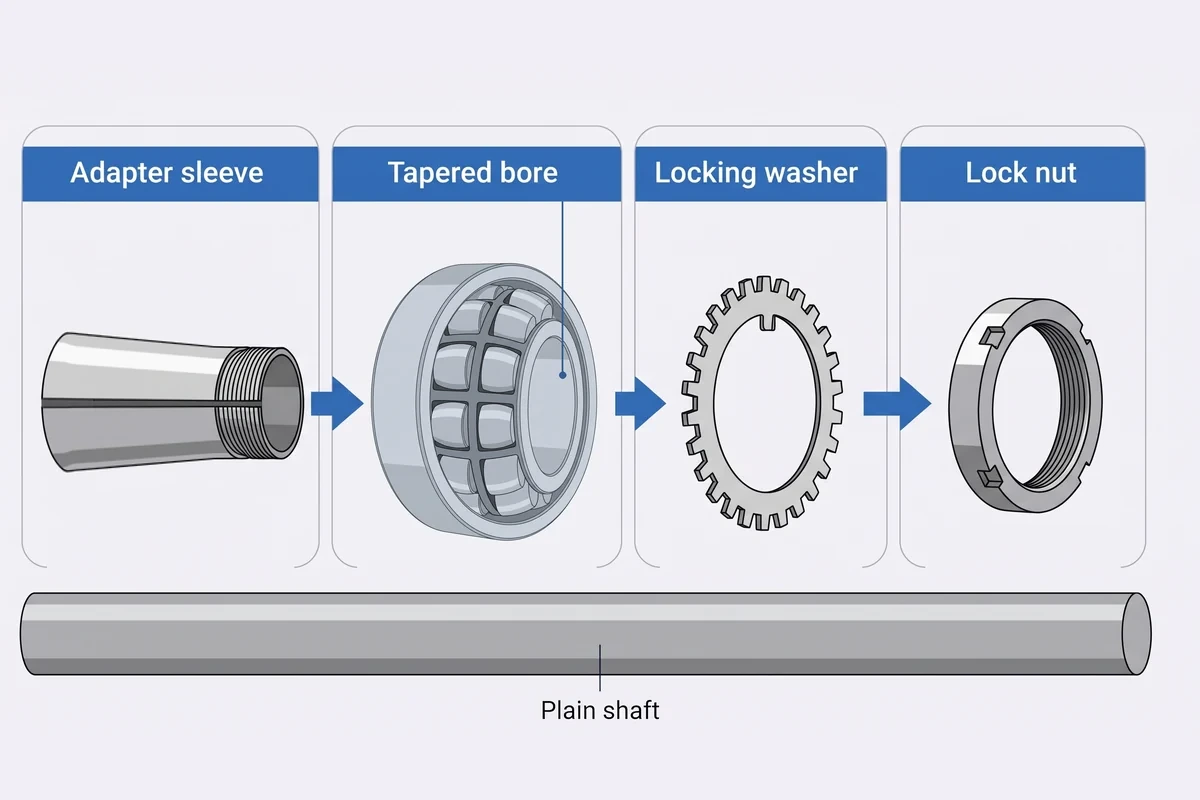
The adapter sleeve has a slot along its length. Its outside is tapered to match the bearing bore [3]. Its bore is straight, so it fits a plain shaft [5]. One end has a thread for the lock nut.
When you tighten the nut, it drives the bearing up the taper. The sleeve closes on the shaft and holds the bearing secure. The inner ring of the bearing expands a little [6]. The locking washer then stops the nut from turning back. A tab in its bore sits in the slot of the sleeve. A tab on its outside is bent into a slot on the nut [5].
With a sleeve, the bearing can sit at any position on a plain shaft, and the shaft needs no shoulder. Drawn round bar with tolerance h9 can be used without machining [3].
Adapter sleeves are used with spherical roller bearings and self-aligning ball bearings [3]. They are also used with UK insert bearings. In FULI’s catalog, UKP pillow block units are listed with H 23 adapter sleeves, for example UKP208 with H2308. For the bearing sizes we list, see our spherical roller bearing range.
An old part on a sleeve is therefore an assembly of four components: bearing, sleeve, lock nut and washer. Order the four together, or check which of them come as a set.
How to read an adapter sleeve number
H 308 has three parts:
- H: an adapter sleeve for a metric shaft [5].
- 3: the series. H 3 sleeves go with 213 and 222 series bearings, such as 21308 K and 22208 K. H 23 sleeves are longer and go with 223 series bearings, such as 22308 K [5].
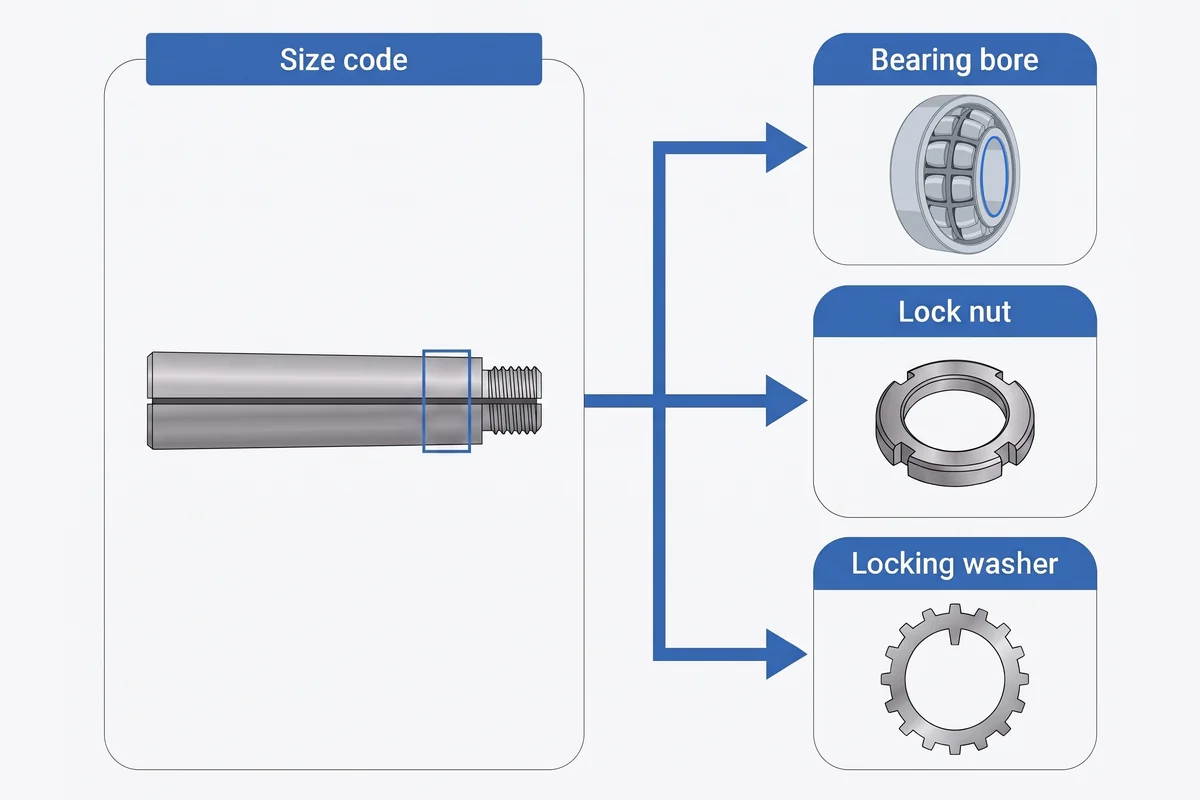
- 08: the size code. It is the bearing bore code, not the shaft size. For H 308, the bearing bore is 40 mm and the shaft is 35 mm [5].
The size code also names the nut and the washer. H 308 takes lock nut KM 8 and locking washer MB 8 [5]. NTN lists the same sizes as AN08 and AW08X [4].
Other letters you may see on the old sleeve or in a catalog:
| Code | Meaning |
|---|---|
| H | Adapter sleeve, metric shaft [5] |
| HE | Metric sleeve for an inch shaft, English standard [5] |
| HA | Metric sleeve for an inch shaft, American standard [5] |
| OH | Adapter sleeve with an oil hole, for hydraulic mounting [5] |
| AH | Withdrawal sleeve, not an adapter sleeve [5] |
| X (NTN suffix) | Narrow slit; uses a washer with straight inner tabs [4] |
| KM / KML | Lock nut / light lock nut with a smaller outside diameter [5] |
| MB | Locking washer [5] |
Copy the full code from the old sleeve, with every letter. H 308 and HE 308 have the same bearing seat, but they fit different shafts [5].
Match the shaft, the sleeve and the bearing
Start from the shaft and measure it where the bearing sits. Then find the sleeve in a maker’s table. The shaft size and sleeve width in each row agree in NTN and Timken. The nut and washer codes are Timken’s [4] [5].
| Bearing | Sleeve | Shaft | Bearing bore | Sleeve width | Lock nut / washer |
|---|---|---|---|---|---|
| 22208 K | H 308 | 35 mm | 40 mm | 36 mm | KM 8 / MB 8 [2] [4] [5] |
| 22308 K | H 2308 | 35 mm | 40 mm | 46 mm | KM 8 / MB 8 [1] [4] [5] |
| 22213 K | H 313 | 60 mm | 65 mm | 50 mm | KM 13 / MB 13 [4] [5] |
| 22214 K | H 314 | 60 mm | 70 mm | 52 mm | KM 14 / MB 14 [4] [5] |
| 22216 K | H 316 | 70 mm | 80 mm | 59 mm | KM 16 / MB 16 [4] [5] |
Three points stand out in the table.
- One shaft can take two sleeves. A 60 mm shaft fits H 313 with a 22213 K, or H 314 with a 22214 K [5]. The shaft size alone does not tell you the bearing.
- The gap between bore and shaft is not fixed. It is 5 mm on a 22208 K and 10 mm on a 22216 K [5]. Do not add a fixed number to the shaft size.
- The same shaft can need a longer sleeve. H 308 and H 2308 both fit a 35 mm shaft [5]. H 2308 is 46 mm wide, for the wider 22308 K [5].
Send the shaft size and the old bearing number together. With both, anyone can check the sleeve in a maker’s table.
Our model pages list both bore versions from FULI’s catalog, such as 22208W33 (cylindrical) and 22208K/W33 (tapered). See the 22208 bearing, 22213 bearing, 22214 bearing, 22216 bearing and 22308 bearing. For sleeve mounting, write the bearing as K/W33 (for example 22208K/W33) and put the sleeve number on its own line. We will confirm availability with the quote.
For an inch shaft, the bearing stays metric and the sleeve changes. HE308 fits a 1-1/4 inch shaft, which is 31.75 mm [4] [5].
Adapter sleeve vs withdrawal sleeve
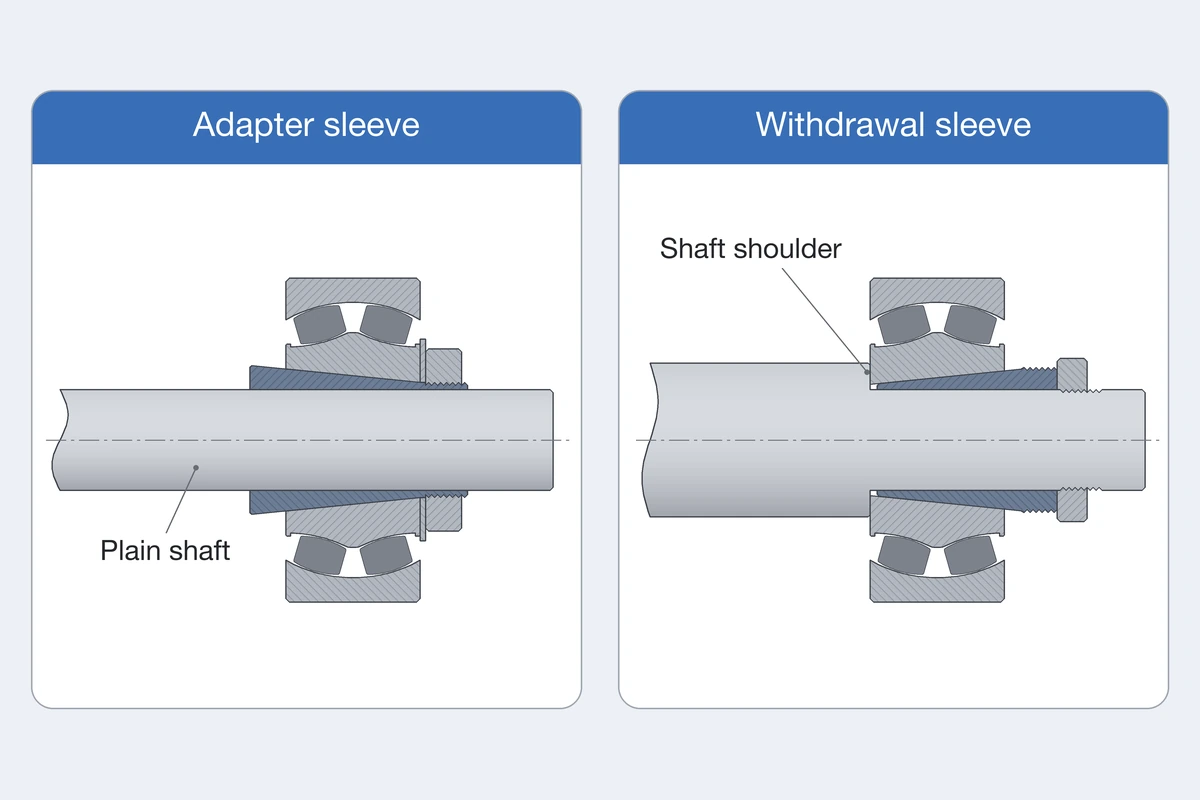
Both are slotted sleeves with a tapered outside, but they are fitted in opposite ways. For 222 and 223 series bearings, both have a 1:12 taper on the outside [3] [5]. Withdrawal sleeves for 240 and 241 series bearings use a 1:30 taper [4] [5].
| Adapter sleeve (H) | Withdrawal sleeve (AH) | |
|---|---|---|
| Shaft | Plain or stepped [3] | Stepped only; the bearing sits against a shoulder [3] |
| Mounting | The nut drives the bearing up the sleeve | The sleeve is pressed into the bearing bore, then held by a nut or end plate on the shaft [3] |
| Nut | Supplied with the sleeve, with the washer [3] [5] | Not supplied with the sleeve; order it separately [3] [5] |
| Example for 22208 K | H 308, 35 mm shaft, nut KM 8 [5] | AH 308, 35 mm shaft, thread M 45x1.5, removal nut KM 9 [4] [5] |
KM 9 is the removal nut. It screws onto the sleeve thread and pulls the sleeve out of the bearing [4] [5]. In service, the sleeve is held by a lock nut or end plate on the shaft [3].
The shaft decides which one suits your application. On a plain shaft, use an adapter sleeve, because a withdrawal sleeve needs a shoulder [3]. SKF says adapter sleeves are more popular, because they are more versatile and easier to mount [3]. If your old part is an AH sleeve, order an AH sleeve again and add the removal nut, KM 9 for AH 308, as its own line.
What to write on an adapter sleeve bearing inquiry
Put each component on its own line. A sample for a 35 mm shaft [5]:
- Bearing: 22208 K. The K means tapered bore. If the old bearing shows a clearance, such as C3, add it.
- Adapter sleeve: H 308. Copy every letter, including HE, HA or an X suffix.
- Lock nut and washer: KM 8 and MB 8. Write them even if you expect them with the sleeve.
- Shaft: 35 mm [5]. Measure it on the shaft, not on the old bearing.
- Housing and seals: only if the bearing sits in a split housing.
Based on our experience, we recommend copying every letter of the old bearing and sleeve numbers onto the inquiry: in 2025, a customer wrote F205 instead of UCF205, and since F205 is the flange housing alone, the insert bearing had to be shipped later. Measure the shaft diameter before you send the inquiry. If the sleeve number is worn off, send the shaft size and the bearing number. A maker’s table then gives the sleeve [5].
For a split housing, our guide to pillow block vs plummer block lists the housing, ring and seal lines. We also supply split plummer block housings (SN / SNL style).
Backed by 20+ years of bearing export experience in Linqing, Shandong. For the tapered bore version of a model, add K to the number in your inquiry and we will confirm availability with the quote. For the sleeve, lock nut and washer, send the sleeve number with your inquiry. We will confirm with the quote which of these parts we can supply.
Mounting: check the clearance reduction
When the bearing moves up the taper, its inner ring expands and the internal clearance gets smaller. This drop is the clearance reduction, and it tells you when to stop tightening [6].
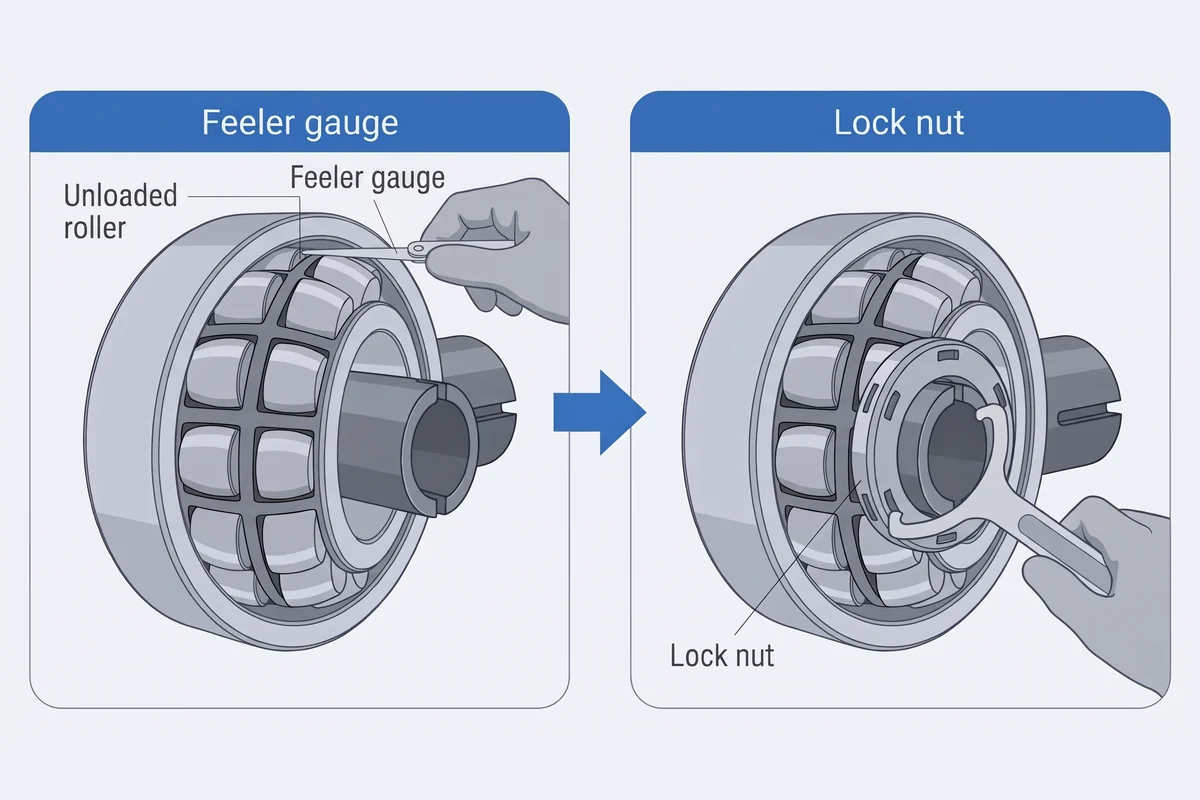
SKF’s installation guide for a spherical roller bearing on an adapter sleeve gives the steps below [6]. Install the parts in this order:
- Remove burrs and rust from the shaft. Wipe it clean.
- Wipe the preservative off the sleeve. Remove oil from the shaft, so it does not get into the sleeve bore.
- Slide the sleeve onto the shaft, thread end outboard, up to the bearing position [6].
- Measure the clearance of the bearing before you mount it. Slide feeler blades between the most unloaded roller (the one carrying the least load) and the outer ring. Do this on both rows.
- Put the bearing on the sleeve, large bore end first. Fit the lock nut with its chamfer facing the bearing. Do not fit the locking washer yet; the drive-up can damage it.
- Hand-tighten the nut until the sleeve grips the shaft. Set the bearing to its axial position.
- Tighten the nut with a spanner until the clearance has dropped by the value in the maker’s table. Large bearings need a heavy-duty impact spanner or a hydraulic nut. Do not use a hammer and drift on the nut [6].
- Remove the nut. Fit the locking washer, with its inner tab in the sleeve slot. Tighten the nut again, without driving the bearing further.
- Bend the washer tab nearest to a nut slot. Check that the shaft and outer ring turn easily by hand.
Use the clearance reduction table from the maker of your bearing, because makers give different values for the same bore size. After mounting, check that the clearance is not below the minimum in that table [5] [6]. For shafts above 200 mm, Timken notes that hydraulic nuts may be used for mounting [5].
Sources
- https://docs.rs-online.com/b3d5/A700000007167207.pdf
- https://docs.rs-online.com/7896/A700000007292622.pdf
- https://help.bdsbearing.com/hubfs/Knowledge%20Base/SKF/SKF%20SNL%20Plummer%20Block%20Housings.pdf
- https://www.ntnglobal.com/en/products/catalog/pdf/4201E.pdf
- https://www.timken.com/wp-content/uploads/2024/07/Timken-Spherical-Roller-Bearing-Catalog.pdf
- https://cdn.skfmediahub.skf.com/api/public/0901d1968024f02a/pdf_preview_medium/0901d1968024f02a_pdf_preview_medium.pdf
FAQ
Is an adapter sleeve bearing the same as a sleeve bearing?
No. A sleeve bearing is a plain bearing, a bushing with no rollers or balls. An adapter sleeve bearing is a rolling bearing with a tapered bore, fitted on an adapter sleeve. The adapter sleeve only holds the bearing on the shaft.
Does an adapter sleeve come with the lock nut and washer?
In the SKF and Timken catalogs, metric H sleeves are supplied with the matching lock nut and locking washer. Withdrawal sleeves come without a nut. Other suppliers may differ, so list the nut and washer on your inquiry.
Can a cylindrical bore bearing go on an adapter sleeve?
No. The sleeve needs a bearing with a tapered bore, marked K. A 22208 has a cylindrical bore. A 22208 K has the taper and fits H 308.
Which adapter sleeve fits an inch shaft?
Look in the HE or HA series. HE is the English standard and HA the American standard. Not every size has an HE or HA sleeve: NTN and Timken list none for H 312, H 314, H 2312 or H 2314. Other inch series cover some of these sizes, such as NTN HS and Timken SNW. HE308 fits a 1-1/4 inch shaft. It has the same width and nut as H 308, so it takes the same bearing.
Can FULI quote the sleeve with the bearing?
Send the bearing number with K, the sleeve number and the measured shaft size. We will confirm with the quote which parts we can supply.